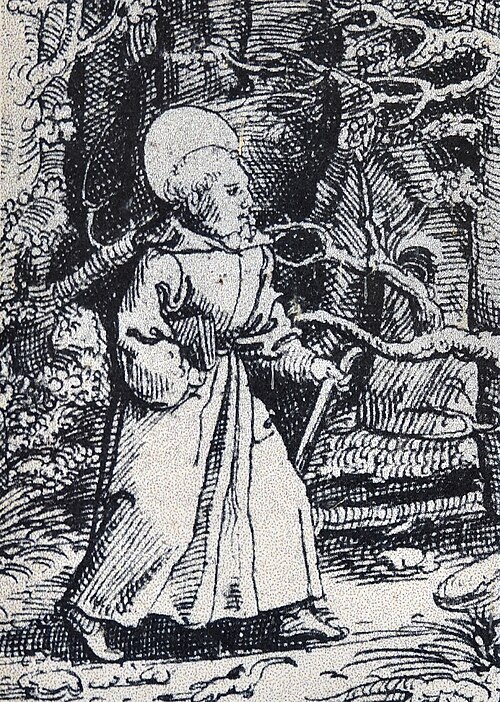
Venerable Martyr
Meinrad of Einsiedeln
Hermit of Einsiedeln
German hermit of the ninth century, killed at Einsiedeln and known as the martyr of hospitality.
- Feast
- January 21old style February 3
- Reposed
- 8619th century
- Place
- Einsiedeln
- Order
- Martyrs
Life
The Holy Martyr Meinrad of Einsiedeln was a German hermit of the ninth century, killed at Einsiedeln and known as the "martyr of hospitality." He lived between 797 and 861. His feast is on 21 January.
Life
He is thought to have been born into the family of the Counts of Hohenzollern and was educated at the abbey school of Reichenau, an island in Lake Constance, under his kinsmen, the Benedictine abbots Hatto and Erlebald. There he became a monk and was ordained priest. After some years at Reichenau and the dependent priory at Benken, near Lake Zurich, around 828 or 829 he embraced the hermit's life and established his cell on the slopes of the Etzel Pass, taking with him a wonder-working statue of the Mother of God, which he had been given by Hildegard, abbess of the Fraumunster of Zurich. Because so many sought him out, in 835 he withdrew to a cell in the forest on the site of today's monastery in Einsiedeln. Inspired by the Desert Fathers, he practiced strict asceticism; gifts presented to him he passed on to the poor.
Martyrdom
He was killed in 861 by two robbers who wanted the treasures they believed pilgrims had left at the shrine. For this he is called the martyr of hospitality, for, according to tradition, he had received the two kindly before they killed him. According to the legend, the two ravens he had earlier tamed followed the murderers, tracking them to Zurich; so they were caught and burned at the stake.
Relics and veneration
For eighty years the cell was occupied by a succession of hermits. One of them, Eberhard, previously provost of Strasbourg, erected a monastery, Einsiedeln Abbey, and became its first abbot. Meinrad was first buried at Reichenau, but his relics were returned to Einsiedeln in 1029; according to another source, he was canonized in 1039 by Pope Benedict IX, and on 6 October of the same year his relics were moved from the island of Reichenau to Einsiedeln.
In the Middle Ages Einsiedeln became a place of pilgrimage for people from southern Germany, Switzerland and Alsace, and then from northern Italy, Poland, Hungary and Slovakia. Meinrad's cell became the shrine of the Black Madonna of Einsiedeln; over the years dust and the smoke of candles, oil lamps and incense darkened the image, and in 1803 the hands and face were painted black. The Chapel of Saint Meinrad at the summit of the Etzel Pass is first mentioned in the thirteenth century; the chapel and a nearby inn lie on the pilgrimage route to Santiago de Compostela. Saint Meinrad Archabbey in Saint Meinrad, Indiana, is named for him.
Commemorated the same day January 21
 Agnes of RomeMartyr · of RomeJan 21
 Maximus the GreekVenerable · Monk and scholar in RussiaJan 21
 Publius of MaltaHieromartyr · Bishop of Malta and AthensJan 21
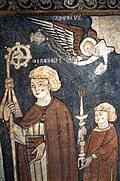 Fructuosus of TarragonaHieromartyr · Bishop of TarragonaJan 21
 Neophytos of NicaeaMartyr · Martyr of NicaeaJan 21
 Patroclus of TroyesMartyr · Martyr of TroyesJan 21
 Eugenius of TrebizondMartyrJan 21
 Callistratus of GeorgiaSaint · Catholicos-Patriarch of GeorgiaJan 21
 Publius of AthensHieromartyr · Bishop of AthensJan 21
 Zosimus of SyracuseSaint · Bishop of SyracuseJan 21
- Anastasius the ApocrisiariusVenerable · Disciple of Saint MaximusJan 21
- Apollonios the AnchoriteVenerable MartyrJan 21