Martyr
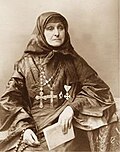
Agrippina Kiseleva
A Russian woman put to death for her faith in Christ in 1942, during the communist persecution.
- Feast
- December 29old style January 11
- Reposed
- 194220th century
- Order
- Martyrs
Life
Saint Agrippina Kiseleva was one of eleven women shot in the Karlag camp in Kazakhstan on 11 January 1942 for refusing to work for the Soviet authorities. They are commemorated on 11 January, on 7 February with the synaxis of the new martyrs and confessors of the Russian Church, and on 12 June with the saints of the Penza metropolis.
The eleven martyrs are: Natalia Sundukova, Natalia Siluyanova, Evdokia Nazina, Anna Borovskaya, Matrona Navolokina, Varvara Derevyagina, Anna Popova, Evdokia Guseva, Euphrosyne Denisova, Agrippina Kiseleva and Natalia Vasilyeva.
Natalia Ivanovna Sundukova was born in 1887 into a priest's family. In the 1930s she was exiled to the city of Stalinabad in Tajikistan. There she was arrested again and sentenced to five years of imprisonment. The charge said that she had been organizer and leader of a counter-revolutionary cell of the "True Orthodox Church" organization in Stalinabad and had carried on propaganda against the measures of the Soviet authorities: elections to the soviets, Soviet holidays, leaders of the party and government. In the camp report on her it was said: "has not worked a single day, declaring categorically that she will not work for antichrists." In Karlag ten other women were arrested with her, and a group case was drawn up, saying that the accused, from the time of their arrival in the camp, had systematically refused to work without any reason and had conducted anti-Soviet propaganda among the prisoners, making use of religious prejudices. At the interrogation, all of them with one voice declared themselves believing Christians and confirmed that they did not go out to work because they considered the Soviet power to be that of the Antichrist and did not wish to work for it.
Natalia Tikhonovna Siluyanova, also a priest's daughter (the other nine were from peasant families), was sentenced to the camp because she had allegedly taken part in a counter-revolutionary group aiming to disrupt the measures of the Soviet authorities in the countryside, had agitated against the elections to the Supreme Soviet and had sung the tsarist anthem. She came to Karlag in March 1941 and, according to the report, "did not work a single day in the camp, from religious conviction."
The eleven martyrs were shot in Karlag on 11 January 1942. The place of their burial is not known.
Commemorated the same day December 29
 DavidProphet · King and ProphetDec 29
 Martinian of MilanSaint · Archbishop of MilanDec 29
 EbrulfVenerable · Frankish hermit and abbotDec 29
 Lawrence of ChernigovVenerable · Schema-archimandriteDec 29
 Mark the Grave-digger of the CavesVenerable · Monk of the Kiev CavesDec 29
 Marcellus of AcemataVenerable · Monk of the Unsleeping OnesDec 29
 George of NicomediaSaint · Metropolitan of NicomediaDec 29
 Theophilus the WeeperVenerable · Monk of the Kiev CavesDec 29
 Basiliscus of SiberiaVenerable · Siberian hermitDec 29
- Euthymius of KareliaVenerable · Founder of Nikolo-Korelsky MonasteryDec 29
 Nino the HegumenVenerableDec 29
- Chrysostomos PapasarantopoulosVenerable · Missionary in AfricaDec 29