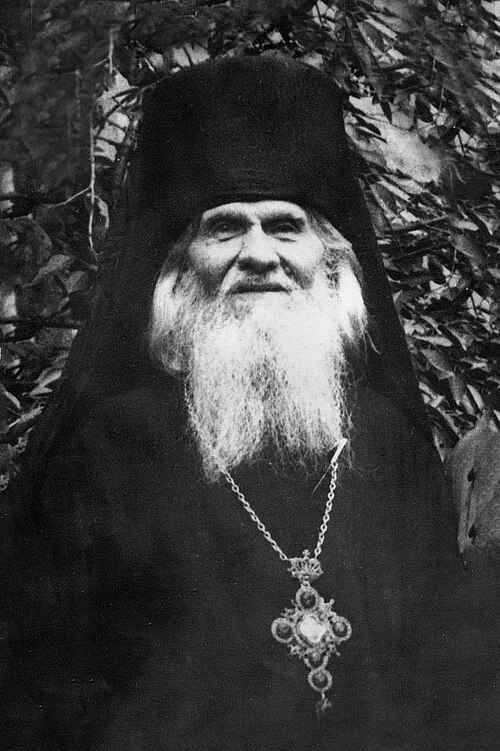
Venerable
Lawrence of Chernigov
Schema-archimandrite
Schema-archimandrite born in 1868 in Chernigov province, who died at Chernigov in 1950; canonized in 1993.
- Feast
- December 29old style January 11
- Reposed
- 195020th century
- Place
- Chernihiv
- Order
- Venerables
Life
Saint Lawrence of Chernigov, known in the world as Luka Evseevich Proskura, was a schema-archimandrite and spiritual father in Ukraine who lived from 1868 to 1950. A church singer and choir director, a tailor, a monk tonsured late in life, a confessor of the faith in the years of Soviet persecution who served in secret in a church set up in a cellar, and the founder of monastic communities in Chernigov, he was revered by the people as a holy elder even in his lifetime.
He was numbered among the saints by the Ukrainian Orthodox Church in 1993, and in 2016 the Russian Orthodox Church extended his veneration to the whole Church. He is commemorated on 29 December in the Julian calendar, that is, 11 January in the new calendar.
Childhood and youth
He was born in 1868 in the village of Karylske in the Krolevets district of the Chernigov province, into a poor family. His father died early, and his mother was frail and often ill. He had a beautiful voice and sang in the church choir. He attended the zemstvo primary school, finishing at thirteen, and was kept on there as an assistant teacher.
In Korop he met a former director of the imperial choir, who recognised his gifts and began teaching him the art of choral conducting; at the same time he learned to play the violin. On returning home he became director of his village choir. He also learned tailoring and began to earn by his own work to help his family; by seventeen he was a skilled tailor.
Seeking his path
After his mother's death he wished to enter a monastery, but his elder brother Bartholomew insisted that he not leave the family. With a friend from his youth, Simeon, he walked to Kiev to Saint Jonah to ask a blessing to pursue theological study. The elder, however, did not bless them and told them that their seminary was within them.
With Simeon he also went to Mount Athos and stayed at the monastery of Saint Panteleimon, where five men from his village of Karylske were living as monks. After persistent requests Simeon was received into the brotherhood, but one of the Athonite elders told Luka to go back home, for he would be needed there. The historian Sergei Shumilo could not determine who that elder was, but considers it possible that it was Saint Silouan the Athonite, who was then living at the Panteleimon monastery and whom Luka probably met.
The monk Lawrence
In 1912, in the forty-fifth year of his life, Luka was tonsured a monk with the name Lawrence. Two years later he was ordained hierodeacon, and in 1916 hieromonk.
When the Renovationist schism broke out, Father Lawrence stood firmly on the side of Saint Tikhon, Patriarch of Moscow.
Years of persecution
In 1930, after his church was closed, he went underground. He joined the movement of the non-commemorators, who refused to commemorate Metropolitan Sergius (Stragorodsky) at the services after his declaration of loyalty to the Soviet state, and during the years of persecution and war he belonged to that part of Orthodoxy not recognised by the Moscow Patriarchate. In 1936-1937 his name appeared in a case opened by the NKVD of the Chernigov region concerning alleged membership in the anti-Soviet underground of the True Orthodox Church. He was interrogated, and by some accounts tortured; a whole group of Chernigov clergy was arrested in the same case. They meant to send him too to a labour camp, but he was released because he was nearly seventy, as the record of the investigation notes.
From 1930 to 1942 he served in secret at home, where he had set up a hidden church in the cellar, and received his spiritual children at night.
Founder of communities
After the German occupation of Chernigov during the war, he gathered two monastic communities: one of men, thirty-five in number, and one of women, seventy. The women's community settled in the Holy Trinity monastery in Chernigov, where at Pascha 1942 Father Lawrence reopened the church, which became one of the centres of church life in the region.
After the war he was persecuted again and even barred from serving. According to tradition, he blessed for the service of the Church the future Metropolitan Volodymyr (Sabodan) of Kiev and All Ukraine, who had come to him as a child with his mother.
Repose
Schema-archimandrite Lawrence reposed on 19 January 1950 and was buried in the small church of the former Holy Trinity monastery in Chernigov.
Memoirs and prophecies
His name was surrounded by veneration even in his lifetime. In the 1980s a collection of simple, sometimes naive recollections by his spiritual children, who had known him well and kept his memory, circulated in samizdat. In 1988 these recollections were printed in issue 14 of the collection Nadezhda. Christian Reading, published in Germany by the Posev press and smuggled into the Soviet Union; all later publications about his life rest on them. They were reprinted in Kiev in 1991, in abridged form in Chernigov in 1992, and again there in 1993 by Archpriest Ioann Fesik, in small local editions. In 1995 a collection of recollections compiled by Pavel Alekseevich Flerov, who had known him personally, also appeared.
A brochure printed in Moscow in 1994 in thirty thousand copies, and many times reprinted, was widely circulated and became the basis of the official life of the saint. Its first part reproduces, with minor stylistic changes, the recollections from Nadezhda, while the second contains accounts gathered by Cherubim (Degtyar), a hierodeacon suspended from ministry by Patriarch Pimen who later styled himself a schema-archbishop.
Many prophecies and sayings, some apocalyptic and political in character, are attributed to Lawrence of Chernigov and circulate in certain conservative circles. Several scholars, beginning with Metropolitan Valentin (Rusantsov) in 1997 and continuing with the historian Vitaly Shumilo, have argued that their authorship is doubtful and that they may be modern additions by later compilers of his life. Shumilo wrote that things were already being attributed to the elder that, by his very nature, he could never have done or said.
Glorification and veneration
In 1993 his relics were transferred to the Holy Trinity Cathedral of the former Holy Trinity monastery in Chernigov. On 9 (22) August 1993 the Council of Bishops of the Ukrainian Orthodox Church glorified him among the venerable. On 3 February 2016 the Council of Bishops of the Russian Orthodox Church extended his veneration to the whole Church.
On 27 December 2002 the Holy Synod of the Ukrainian Orthodox Church founded a convent bearing the name of Saint Lawrence in the village of Veresoch in the Kulykivka district of the Chernigov region. Among its treasures are a portion of the saint's right hand, portions of the relics of the venerable sisters of Diveyevo, the revered icon of the Mother of God Look Upon Humility, and old icons of Saint Theodosius of Chernigov and Saint Nicholas. The relics of Saint Lawrence rest in the Holy Trinity Cathedral in Chernigov.
Commemorated the same day December 29
 DavidProphet · King and ProphetDec 29
 Martinian of MilanSaint · Archbishop of MilanDec 29
 EbrulfVenerable · Frankish hermit and abbotDec 29
 Mark the Grave-digger of the CavesVenerable · Monk of the Kiev CavesDec 29
 Marcellus of AcemataVenerable · Monk of the Unsleeping OnesDec 29
 George of NicomediaSaint · Metropolitan of NicomediaDec 29
 Theophilus the WeeperVenerable · Monk of the Kiev CavesDec 29
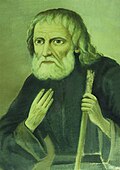 Basiliscus of SiberiaVenerable · Siberian hermitDec 29
- Euthymius of KareliaVenerable · Founder of Nikolo-Korelsky MonasteryDec 29
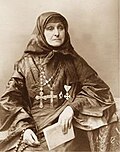 Nino the HegumenVenerableDec 29
- Chrysostomos PapasarantopoulosVenerable · Missionary in AfricaDec 29
- Nicholas I of ThessalonikiSaint · Bishop of ThessalonikiDec 29