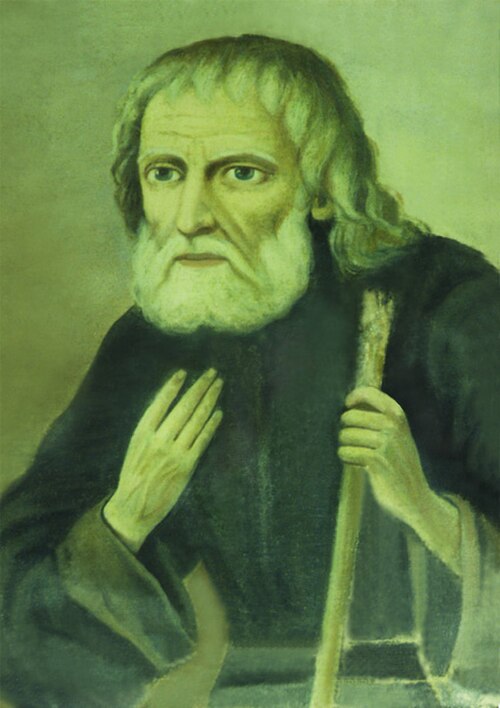
Venerable
Basiliscus of Siberia
Siberian hermit
Hermit born about 1740 near Kalyazin, who died at Turinsk in 1824; canonized in 2004.
- Feast
- December 29old style January 11
- Reposed
- 182419th century
- Place
- Turinsk
- Order
- Venerables
Life
Saint Basiliscus of Siberia (Basiliscus of Turinsk, in the world Vasily Gavrilovich Gavrilov, about 1740-1824) the venerable was a Siberian hermit, a disciple of the elder Adrian of Bryansk, and a fellow ascetic of Saint Zosimas (Verkhovsky). He died at the monastery of Saint Nicholas in Turinsk on 29 December 1824 (old style). He was canonized in 2004. He is commemorated on 29 December, on 10 June (in the synaxis of the saints of Siberia) and on the last Sunday of August (in the synaxis of the saints of Kemerovo).
Youth and the search for the wilderness
He was born into a family of state peasants of the Tver governorate, in the village of Ivanishchi near Kalyazin. He lost his mother early, and his father brought a stepmother into the house for Vasily and his three older brothers. The family lived in poverty, and the child was sent to beg alms. He was impressed by the sermons of Bishop Gabriel (Petrov) of Tver, which he had heard at the Macarius monastery of Kalyazin. Inclined to asceticism, Basiliscus married, but under the pretext of going off to earn money worked in various monasteries, and about 1777 he left his family and came to the Ostrov Hermitage, to the hieromonk Cleopas, a disciple of Saint Paisius Velichkovsky, who blessed him for the life of a hermit.
At first he lived with his older brother Kosma, who was also inclined to asceticism (he wore a horsehair shirt and chains), and then, with two hermits, Paul and John, went into the forests of Chuvashia. After their death he came to the elder of the Ploshchansk monastery, the hieromonk Adrian (Blinsky), who lived as a hermit in the forests of Bryansk. Adrian tonsured him a monk and gave him the name Basiliscus. Around Adrian there was a small community of hermits, where Basiliscus met his disciple and the venerable Zosimas (Verkhovsky). In 1788 Adrian moved to the Konevets monastery, and after him came Basiliscus and Zosimas, who settled three versts from the monastery.
To Siberia
In 1799 Adrian decided to receive the great schema and left the Konevets monastery for the Simonov monastery in Moscow. Parting from his disciples, he blessed Basiliscus and Zosimas for the life of hermits in Siberia, but they were drawn more to Athos. Three times they tried to go to the Holy Mountain and each time they failed. They went to Kyiv, where, with the metropolitan's permission, they stayed two months in the Caves Lavra, then went to the Crimea and later to Mozdok. Because of raids by mountain tribes, they were taken from there under escort to Taganrog, from where they moved to Astrakhan, where they decided to fulfil the blessing of Elder Adrian and, buying a horse, set out for Siberia.
In autumn 1800 they reached Tobolsk, where Archbishop Varlaam (Petrov) gave them leave to settle in his diocese. For a year they wandered through the Siberian districts, choosing a place for their future hermitage, and in 1802 they settled in the forests of the Kuznetsk district. In the taiga, forty versts from the nearest village, they dug a dugout, agreeing with a peasant to bring them food. In spring they decided to leave the taiga but lost their way and spent about two weeks in the forest. Coming out of the taiga, they decided to stay in the Kuznetsk district and chose a place on the river Srednyaya Tersya, fifty versts from Kuznetsk. The local peasants built them two cells, the monks made a vegetable garden and did handwork. Once a year a priest visited them with the Holy Gifts. Around the hermits a small community of ascetics formed, among them Saint Basiliscus's disciple, the righteous Peter of Tomsk.
The monastery at Turinsk
In 1818, at the request of the townswoman of Kuznetsk Anisia Kotokhova, Basiliscus became confessor of a monastic community she had formed in a village on the river Tom. Seeing the difficulty of a monastic community existing in the world, in 1821 he sent Zosimas to Archbishop Ambrose (Kelembet) of Tobolsk with a request to allow the opening of a convent at Turinsk, on the site of the men's monastery abolished in 1764. Permission was received, and in 1822 the Saint Nicholas monastery of Turinsk was opened, where Basiliscus bore the obedience of elder until his death.
He died on 29 December 1824, and on 4 January 1825 he was buried by the altar of the Ascension cathedral of the monastery he founded. In 1913 a chapel was built over the grave. After the revolution of 1917 the monastery was closed and its buildings destroyed. His relics were found in 2000 and are in the Saviour church of the New Tikhvin convent in Yekaterinburg. On 11 January 2004 he was canonized as one of the locally venerated saints of the diocese of Yekaterinburg, and on 4 October of the same year the Council of Bishops of the Russian Church decided on the glorification in the whole Church of the venerable elders Zosimas and Basiliscus. In the Turinsk local history museum his posthumous portrait is kept.
Commemorated the same day December 29
 DavidProphet · King and ProphetDec 29
 Martinian of MilanSaint · Archbishop of MilanDec 29
 EbrulfVenerable · Frankish hermit and abbotDec 29
 Lawrence of ChernigovVenerable · Schema-archimandriteDec 29
 Mark the Grave-digger of the CavesVenerable · Monk of the Kiev CavesDec 29
 Marcellus of AcemataVenerable · Monk of the Unsleeping OnesDec 29
 George of NicomediaSaint · Metropolitan of NicomediaDec 29
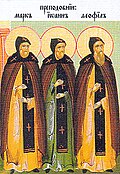 Theophilus the WeeperVenerable · Monk of the Kiev CavesDec 29
- Euthymius of KareliaVenerable · Founder of Nikolo-Korelsky MonasteryDec 29
 Nino the HegumenVenerableDec 29
- Chrysostomos PapasarantopoulosVenerable · Missionary in AfricaDec 29
- Nicholas I of ThessalonikiSaint · Bishop of ThessalonikiDec 29