Venerable
Euthymius of Karelia
Founder of Nikolo-Korelsky Monastery
A monk who went north around 1400 and founded the monastery on the shore of the White Sea.
- Feast
- December 29old style January 11
- Era
- unknown
- Order
- Venerables
Life
Venerable Euthymius of Karelia (Euthymius of Korela) was a monk, counted the founder of the Nikolo-Korelsky monastery, on the shore of the White Sea, who died in 1435. He is honoured in the Russian Church among the saints of Kola and in the Church of Finland among the saints of Karelia. His day of commemoration, according to our calendar, has several dates: 29 December, 2 February, 18 April, 3 June and 15 December. He was glorified in 1641, and his relics were found in 1647.
Life
According to the old manuscript Hemerologion, he was born in the second half of the fourteenth century. From youth he was inclined to monastic life and about the year 1400 he set out north, reaching the Cold Sea, as the White Sea was then called, to live as a hermit. There are records on the Kola Peninsula, in the villages of Varzuga and Ponoy, of a monk of the same name living there at the same time. Later, about 1410, several disciples joined him. On the shore of the sea they built or restored the men's monastery of Nikolo-Korelsky, in honour of the holy wonderworker Nicholas of Myra, where they made cells for monks.
In 1418 two sons from the first marriage of the boyaress Martha Boretskaya, Anthony and Felix, who were inspecting the boyaress's estates, were lost at sea. Martha Boretskaya asked Venerable Euthymius to pray for the souls of her dead sons. And so it happened that the bodies were brought by the sea to the shore, where the monks saw them. Anthony and Felix were buried and entered in the commemoration book. They were still young, but Felix was known in Pomorye for his charity to the monastery of the Archangel Michael, thirty-four versts from the Nikolo-Korelsky monastery, near Cape Pur-Navolok on the Northern Dvina.
In 1419 the "Murmans", as the Scandinavians of Norway were then called, about five hundred men, moored at the monastery's landing places, plundered the monastery, set fire to the church and killed several monks. Martha Boretskaya, learning of the unhappy state of the monastery, gave it three Pomor villages, left to her by her first husband, Philip Grigorievich, the father of her children: one on the island of Lyavlya and two at Konechnye (which had also suffered from the attack of the "Murmans" in 1419), and money for building a church of the holy wonderworker Nicholas of Myra, and charged her relatives not to leave the monastery without care. Over the graves of Anthony and Felix a wooden chapel was raised, and since 1749 there has been a brick and stone church of the Presentation of the Lord.
His enlightening work and veneration
Euthymius of Korela is known not only for his labour and care in building the monastery's buildings, but he enlightened with the truth of the Gospel all the peoples of the region. From the Solovki letters, drawn up some decades later, it is known that around the sea lived several kinds of peoples, called the "Korelian children": the Kurolts, the Rovkults, the Vymolts, the Tivrults and the Valedols. Saint Euthymius died in peace in 1435 and was buried in the monastery. His disciples are counted the righteous Stephen, an ascetic, and the venerable Isaiah and Nikanor, whose relics were moved to the Antoniev-Siysky monastery in 1676. In 1641 he was glorified for his apostolic labour on the sea coast and in the surrounding lands, and his relics were found in 1647. Today they rest in a secluded place in the monastery. On 7 April 2005, in the church of Saint Nicholas in Severodvinsk, a side chapel was consecrated in the name of the saints Euthymius, Anthony and Felix, with the first and only altar dedicated to them. On the icon the three saints are painted standing, frontal, with Euthymius in the middle, larger. The venerable one has a pointed beard, a crimson mantle, a blue schema with a cowl on his head, blesses with two fingers and holds a scroll in his left hand. Below, the monastery behind a wooden fence, a reconstruction of its appearance in the seventeenth century.
Commemorated the same day December 29
 DavidProphet · King and ProphetDec 29
 Martinian of MilanSaint · Archbishop of MilanDec 29
 EbrulfVenerable · Frankish hermit and abbotDec 29
 Lawrence of ChernigovVenerable · Schema-archimandriteDec 29
 Mark the Grave-digger of the CavesVenerable · Monk of the Kiev CavesDec 29
 Marcellus of AcemataVenerable · Monk of the Unsleeping OnesDec 29
 George of NicomediaSaint · Metropolitan of NicomediaDec 29
 Theophilus the WeeperVenerable · Monk of the Kiev CavesDec 29
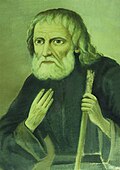 Basiliscus of SiberiaVenerable · Siberian hermitDec 29
 Nino the HegumenVenerableDec 29
- Chrysostomos PapasarantopoulosVenerable · Missionary in AfricaDec 29
- Nicholas I of ThessalonikiSaint · Bishop of ThessalonikiDec 29