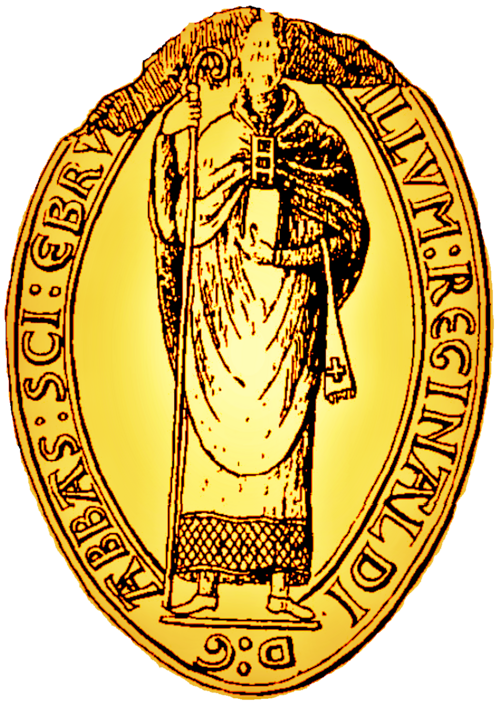
Venerable
Ebrulf
Frankish hermit and abbot
Frankish hermit and abbot, died in 596, associated with the abbey of Saint-Évroult.
- Feast
- December 29old style January 11
- Reposed
- 5966th century
- Place
- Saint-Evroult-Notre-Dame-du-Bois
- Order
- Venerables
Life
Saint Ebrulf (Evroul, Evroult) was a Frankish hermit and abbot, born in 517 at Bayeux and died in 596. He is commemorated on 29 December and is associated with the abbey of Saint-Évroult. Our sources show him venerated in the West and show no separate Orthodox glorification. The Russian source places him at the court of Childebert III and Chilperic II, which does not fit the years 517 to 596 of the English source, which links him with Childebert I.
He was of noble birth, born at Bayeux. He was a courtier at the Merovingian court of Childebert I, cup-bearer to the king and administrator of the royal palace. He lived a devout life and wished to become a monk. It was some time before he was given leave to go from court, and both he and his wife took monastic vows, parting by mutual consent, each into a monastery. He entered the abbey of Deux Jumeaux, near Bayeux, then decided to become a hermit at Exmes, but there crowds came to visit him and ask his advice, so he and three companions settled in the densely wooded Pays d'Ouche in Normandy. The secluded site spared it the raids of the Northmen.
A legend says that he converted a robber to Christianity, who came to the rough settlement that Ebrulf had built near a spring, consisting of a hedge enclosure and huts of wattle and daub. The robber warned Ebrulf of the dangers of the forest, but Ebrulf told him that he feared no one. Repenting of his sins, the robber brought a gift of three loaves baked in ashes and a honeycomb and asked to be admitted as a monk. This settlement became the abbey of Saint-Évroult. He founded other monastic houses, fifteen in total, all of which placed emphasis on manual labour as both a spiritual and an economic exercise. Nobles came to Ebrulf offering him money, land and houses to build monasteries. After 560 he founded several monasteries in the diocese of Séez, one of which became the important abbey of Saint-Martin de Séez.
He was venerated in England as a result of the Norman invasion, and the link between Ebrulf and England was maintained by the fact that four abbots of Saint-Évroult abbey ruled English monasteries in the eleventh and twelfth centuries, bringing to England some of his relics. A feast of the translation of his relics was kept at Deeping Abbey in England on 30 August. The earliest life of him is in the Historia Ecclesiastica of the Benedictine chronicler Orderic Vitalis. Ebrulf is mentioned in Béroul's Tristan, when Tristan invokes him at the fountain. A library in Cardiff holds a manuscript with a Life of Ebrulf, possibly compiled for the nuns of Barking Abbey. According to the Russian source, since the twelfth century his relics have been in different places; after the partition of Normandy they were moved to Orléans; an annual pilgrimage in his honour is known. Saint Ebrulf is invoked for skin diseases, blood diseases, fever and madness, for pimples called the flowers of Saint Ebrulf, and for the protection of cattle.
Commemorated the same day December 29
 DavidProphet · King and ProphetDec 29
 Martinian of MilanSaint · Archbishop of MilanDec 29
 Lawrence of ChernigovVenerable · Schema-archimandriteDec 29
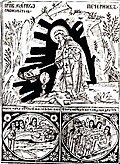 Mark the Grave-digger of the CavesVenerable · Monk of the Kiev CavesDec 29
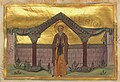 Marcellus of AcemataVenerable · Monk of the Unsleeping OnesDec 29
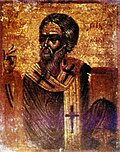 George of NicomediaSaint · Metropolitan of NicomediaDec 29
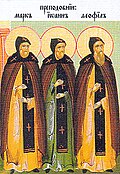 Theophilus the WeeperVenerable · Monk of the Kiev CavesDec 29
 Basiliscus of SiberiaVenerable · Siberian hermitDec 29
- Euthymius of KareliaVenerable · Founder of Nikolo-Korelsky MonasteryDec 29
 Nino the HegumenVenerableDec 29
- Chrysostomos PapasarantopoulosVenerable · Missionary in AfricaDec 29
- Nicholas I of ThessalonikiSaint · Bishop of ThessalonikiDec 29