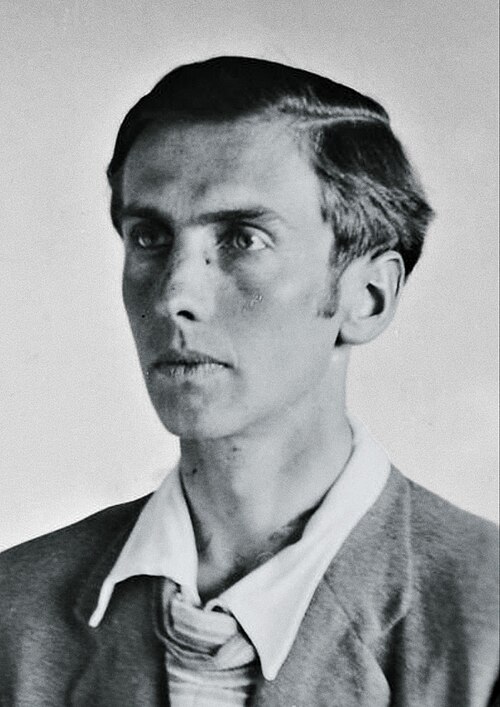
New Martyr
Alexander of Munich
Anti-Nazi resister of Munich
Russian-German student, co-founder of the White Rose resistance group, executed by the Nazis in 1943.
Life
Saint Alexander of Munich, new martyr, in the world Alexander Schmorell, was a Russian-German student, one of the two founders of the resistance group “White Rose” against the Nazi regime, and was executed in 1943. In 2012 he was glorified as a saint and passion-bearer by the Russian Orthodox Church Outside Russia and is venerated by Orthodox Christians throughout the world. He is commemorated on 13 July.
Childhood
He saw the light of day on 16 September 1917, at Orenburg, in Russia. His father, Hugo Schmorell, was a German physician, raised in the Russian Empire, and his mother, Natalia Vvedenskaya, was a Russian, the daughter of an Orthodox priest. He was baptized in the Orthodox Church. His mother died of typhus in the time of the civil war, when he was two. In 1920 his father married a German woman, Elisabeth Hoffman, also raised in Russia, and in 1921 the family fled Russia and moved to Munich, when Alexander was four. He grew up with his step-siblings, Erich and Natalie, and with his Russian nanny, Feodosiya Lapshina, who took the place of his mother. The nanny never learned German, so Alexander grew up bilingual, speaking both Russian and German from childhood. His friends called him Schurik. He was an Orthodox Christian and considered himself both German and Russian; he served in the Orthodox parish of Munich. When questioned by the Gestapo, he said he was a devoted believer of the Russian Church.
Military service and studies
After his school-leaving exam he was called into the Reich Labour Service, then into the Wehrmacht. In 1937, although he had volunteered, at the last moment he had second thoughts and refused to swear the Hitler oath, but was still accepted. In 1938 he took part in the Anschluss and in the entry into Czechoslovakia. After the army, in 1939 he began to study medicine, at Hamburg, and in the autumn of 1940 he returned to Munich, where he met Hans Scholl, through his lifelong friend Christoph Probst. He was gifted for art and loved Russian culture, poetry and sculpture.
The White Rose
In June 1942 Schmorell and Hans Scholl began the resistance movement “The White Rose”. Their struggle was simple but dangerous: writing leaflets. With many quotations from the Bible, from Aristotle, Novalis, Goethe and Schiller, the leaflets addressed those whom they considered the cultural elite of Germany. They were left in telephone books in public booths, mailed to professors and students and carried by couriers to other universities. In the summer of 1942 Schmorell, with Hans Scholl, Willi Graf and Jürgen Wittenstein, was sent as a medic to the Eastern Front, in the Gzhatsk region, until November, and the group’s activity ceased in that time. In Russia he felt at home. Although he had been born there, he had no memories of the homeland, for he had left at four. At night he slipped out of camp with his friends and went to the houses of Russian peasants, where he took part in their festivities. In August 1942 he fell ill with diphtheria and told his parents only after he had recovered. He left Russia on 31 October 1942 and thought of deserting, but gave it up. In December 1942 he sought contact with Professor Kurt Huber and together they wrote the fifth leaflet, “Appeal to All Germans”, which Schmorell distributed in the cities of Austria.
Arrest and martyrdom
After the arrest of Hans and Sophie Scholl, in February 1943, the Gestapo issued a notice with his description and the promise of a thousand marks to whoever gave news of him. He managed for a time to hide. On 24 February 1943, during an air raid, he was recognized in the shelter where he was hiding and was denounced by Alois Pitzinger, whom he had portrayed earlier. He was arrested at once. He was tried with Willi Graf and Professor Huber, on 19 April, and condemned to death. He was executed by beheading, on 13 July 1943, at Munich. The Russian Orthodox Church Outside Russia glorified him in February 2012, and he was the first new martyr of the Russian diaspora glorified jointly by the Church Outside Russia and the Moscow Patriarchate, after the renewal of their communion, in 2007.
Commemorated the same day July 13
 Henry IIRight-Believing · Holy Roman EmperorJul 13
 EzraProphet · Priest and ScribeJul 13
 SilasApostle · Companion of the Apostle PaulJul 13
 Mildrith of MinsterVenerable · Abbess of Minster-in-ThanetJul 13
 Eugenius of CarthageSaint · Bishop of CarthageJul 13
- Serapion of AlexandriaMartyrJul 13
- Alexander and the Thirty SoldiersHoly MartyrsJul 13
- AmmoniusVenerableJul 13
- AndrewHieromartyr · Kinsman of Saint PatapiusJul 13
- AuxoutheniusVenerableJul 13
- Cruimther Fionntain of Cill AirthirSaintJul 13
- DofganSaintJul 13