Right-Believing
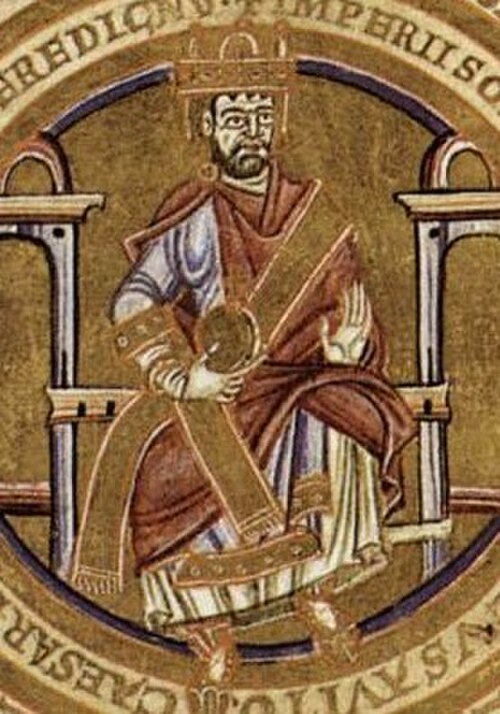
Henry II
Holy Roman Emperor
Holy Roman Emperor from 1014 to 1024, known for his support of the Church.
- Feast
- July 13old style July 26
- Reposed
- 102411th century
- Place
- Grone
Life
Henry II, called Henry the Saint, was king of Germany from 1002 and Holy Roman Emperor from 1014 until his death in 1024, the last ruler of the Ottonian dynasty. He was canonized in the Roman Catholic Church by Pope Eugene III, in 1146 or 1147 according to the sources consulted. He lived before the Great Schism of 1054, but the Orthodox sources consulted do not attest a commemoration of him in the calendars of the Orthodox Churches. He is therefore a saint venerated in the West, listed here under the title of right-believing.
Youth
He was born on 6 May 973, the son of Duke Henry II of Bavaria and Gisela of Burgundy, and a great-grandson of King Henry the Fowler. His father rebelled against Emperor Otto II and was sent into exile at Utrecht in 978. During those years the boy lived at Hildesheim, where he studied at the cathedral school, and was formed in the faith by Bishop Wolfgang of Regensburg. It is said that he also found refuge with Bishop Abraham of Freising.
After the death of Otto II his father was released and recovered Bavaria. In 995 Henry succeeded him as duke, under the name Henry IV. Around the year 1000 he married Cunigunde of Luxembourg.
King and emperor
Emperor Otto III died in January 1002, without heirs. Henry went out to meet the funeral procession and took possession of the royal insignia. After defeating the other claimants, he was anointed and crowned king at Mainz by Archbishop Willigis, in the summer of that year (the sources give 7 June or 9 July). In May 1004 he was crowned king of Italy at Pavia.
On 14 February 1014 Pope Benedict VIII crowned him emperor at Rome, in Saint Peter's Basilica. A synod held then under the presidency of the emperor and the pope ruled against simony and called for chastity among the clergy. Unlike Otto III, Henry concerned himself chiefly with the lands north of the Alps. He fought wars for over sixteen years against Duke Boleslaw I of Poland, ended by the peace of 1018. He went three times into Italy, to defend his rights and to repel Byzantine attempts in the south of the peninsula.
Benefactor of the Church
Henry supported monasteries and endowed them with gifts, appointed bishops with care and refounded the diocese of Merseburg in 1004. On 1 November 1007, at the synod of Frankfurt, he obtained consent to found the diocese of Bamberg, which he endowed richly. His chancellor Eberhard was its first bishop, ordained by Archbishop Willigis. Bamberg became a centre of learning and art.
When his wife Cunigunde fell gravely ill in 1017, Henry vowed to build a monastery if she recovered. After her recovery, in 1018, he ordered the building of Kaufungen Abbey. It is told that he himself wished to become a monk and asked the abbot of Verdun to receive him; the abbot ordered him, in virtue of obedience, to continue his service as emperor, and Henry obeyed. He also founded charitable institutions for the poor.
The way he bound Church and state, granting bishops lands and rights of rule, is judged by historians as a policy of power that also reduced the freedom of the Church. The sources say that he urged Pope Benedict to add the Filioque to the Creed, a word that would become one of the causes of the separation of 1054; for this reason the Orthodox Church cannot view this side of his deeds as the West does.
Death and veneration
He fell ill with a chronic and painful urinary infection. He died on 13 July 1024 at Göttingen, aged 51, and was buried in Bamberg Cathedral, as arranged by Empress Cunigunde. Their marriage had no children. Some hold that the couple lived in chastity, but this is disputed. With Henry the Ottonian dynasty ended, and the throne passed to Conrad II. His sister Gisela was the wife of the holy king Stephen I of Hungary.
Henry was an oblate of the Benedictine order. He was canonized in 1146 or 1147, and Cunigunde in 1200 under Pope Innocent III. The Roman Catholic Church commemorates him on 13 July (new calendar) and honours him as patron of the city of Basel and of Benedictine oblates.
Commemorated the same day July 13
 EzraProphet · Priest and ScribeJul 13
 SilasApostle · Companion of the Apostle PaulJul 13
 Alexander of MunichNew Martyr · Anti-Nazi resister of MunichJul 13
 Mildrith of MinsterVenerable · Abbess of Minster-in-ThanetJul 13
 Eugenius of CarthageSaint · Bishop of CarthageJul 13
- Serapion of AlexandriaMartyrJul 13
- Alexander and the Thirty SoldiersHoly MartyrsJul 13
- AmmoniusVenerableJul 13
- AndrewHieromartyr · Kinsman of Saint PatapiusJul 13
- AuxoutheniusVenerableJul 13
- Cruimther Fionntain of Cill AirthirSaintJul 13
- DofganSaintJul 13