Venerable
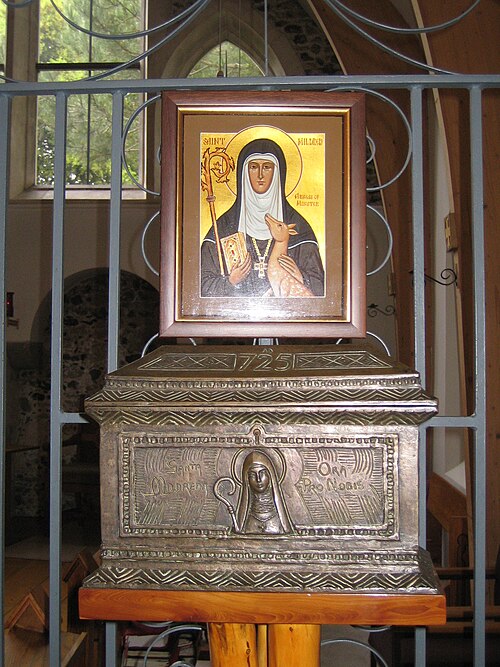
Mildrith of Minster
Abbess of Minster-in-Thanet
Anglo-Saxon abbess in Kent in the seventh and eighth centuries; her relics were moved to Canterbury in 1030.
- Feast
- July 13old style July 26
- Reposed
- 7348th century
- Place
- Minster
- Order
- Venerables
Life
Saint Mildred, also called Mildrith, was an Anglo-Saxon abbess of the abbey of Minster-in-Thanet in Kent at the end of the seventh and the start of the eighth century. After her repose she was numbered among the saints, and her relics were moved to Canterbury in 1030. She is commemorated on 13 July.
She was the daughter of Merewalh, king of the Magonsaete, a region like present-day Herefordshire, a sub-kingdom of Mercia. Her mother was Domne Eafe, sometimes called Saint Eormenburga, a great-granddaughter of Æthelberht of Kent, who appears in the Kentish Royal Legend, also called the Mildrith Legend. Her sisters, Milburga of Much Wenlock and Mildgyth, are also counted as saints. Her mother's family had close ties to the Merovingian rulers of Gaul, and Mildrith is said to have been educated at the royal abbey of Chelles. She entered the abbey of Minster-in-Thanet, founded by her mother, and became abbess there by 694. Several churches in Pas-de-Calais, among them Millam, bear her name, which shows that her ties with Gaul continued. She fell asleep at Minster-in-Thanet after 732 and was buried in the abbey church of Saint Mary. In the eleventh century Goscelin wrote her Life, and a work of 1516 gives an extensive account.
Her successor as abbess, Eadburg, who corresponded with Saint Boniface, built a new church dedicated to Saints Peter and Paul and moved her relics there by 748. The shrine became a place of pilgrimage, and Mildrith a much-loved local patron. The last abbess, Leofruna, was captured by the Danes in 1011, and the abbey was abandoned. In 1030, despite fierce local opposition, her relics were moved to Saint Augustine's Abbey in Canterbury, an event commemorated on 18 May. Saint Mildred's Church in Canterbury dates from that time. In the eleventh century some of her relics were given to a church in Deventer in the Netherlands. In 1881 Pope Leo XIII officially reinstated her feast. In 1937 the Minster house was bought by Benedictine nuns from Saint Walburga's Abbey in Eichstätt, and in 1953 a relic of her was brought there.
Commemorated the same day July 13
 Henry IIRight-Believing · Holy Roman EmperorJul 13
 EzraProphet · Priest and ScribeJul 13
 SilasApostle · Companion of the Apostle PaulJul 13
 Alexander of MunichNew Martyr · Anti-Nazi resister of MunichJul 13
 Eugenius of CarthageSaint · Bishop of CarthageJul 13
- Serapion of AlexandriaMartyrJul 13
- Alexander and the Thirty SoldiersHoly MartyrsJul 13
- AmmoniusVenerableJul 13
- AndrewHieromartyr · Kinsman of Saint PatapiusJul 13
- AuxoutheniusVenerableJul 13
- Cruimther Fionntain of Cill AirthirSaintJul 13
- DofganSaintJul 13