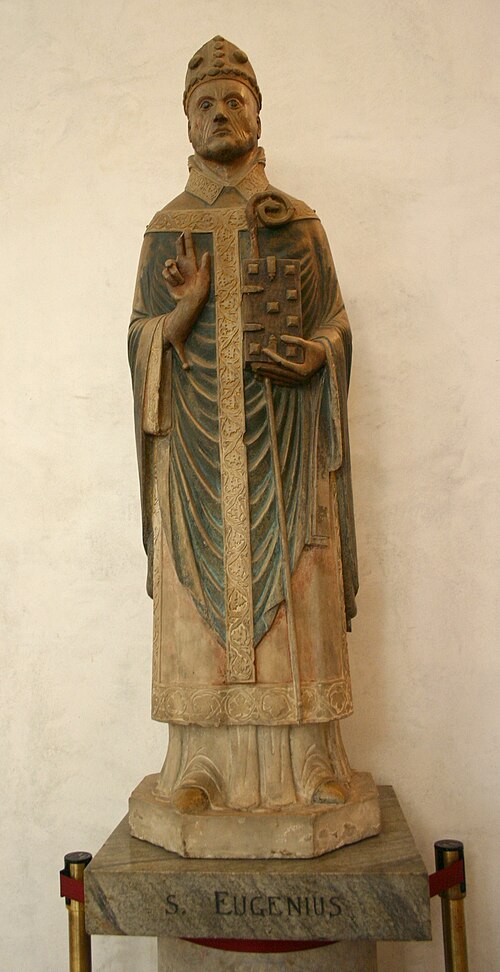
Saint
Eugenius of Carthage
Bishop of Carthage
Elected Bishop of Carthage in 480 during the disputes with Arianism; he died in exile at Albi.
Life
Saint Eugenius was unanimously elected bishop of Carthage in 480, successor to Deogratias, in the time of the disputes with Arianism. He died in exile at Albi on 13 July 505. The Church remembers him on 13 July.
His election was put off because of the opposition of the Arian Vandal kings and was permitted by King Huneric only at the urging of Zeno and Placidia, into whose family the Vandals had married. It is said that his governance, charity, austere life and courage won the admiration even of the Arians. He admitted Vandals into the Church, against the royal edict, and engaged in disputes with Arian theologians, whom the king set against the Catholics. Both sides called themselves "Catholic", and the Arians called their opponents "Homoousians". The conference took place between 481 and February 484 and ended with the withdrawal of the chief Arian bishop, on the plea that he could not speak Latin. The Arians enraged, Huneric exiled forty-six bishops to Corsica and three hundred and two to the African deserts. Among these was Eugenius, who lived in the desert of Tripolitania under the guard of Antonius, a merciless heretical bishop. On setting out he wrote a letter of consolation and exhortation to the faithful of Carthage, preserved in the works of Gregory of Tours. His flock followed him in the uncompromising defence of the divinity, many being exiled with him.
After Huneric's death, in December 484, Gunthamund, his successor, allowed him to return to Carthage and reopen the churches. After eight years of peace Thrasamund came to the throne, arrested Eugenius and condemned him to death, but commuted the sentence to exile at Vienne near Albi in Languedoc, where the Arian Alaric was king. There he built a monastery over the tomb of the holy martyr Amarantus and led a life of penance until his death on 13 July 505. According to another tradition he ended his days in exile on an island where he built a church, and his relics, later moved to Noli, appeared again in the place of veneration he had founded.
A legend says that a blind man of Carthage, Felix, dreamed that Bishop Eugenius would pray for him and he would be healed. Twice he ignored the dream, but the third time he sought out the bishop. He protested, saying: "I have already told you I am a sinful man, but may He who has deigned to visit you act according to your faith and open your eyes." When he prayed, the blind man saw. Learning of it, King Huneric tried in vain to kill Felix. Eugenius wrote an Exposition of the Catholic Faith, demanded of him by Huneric, probably the one submitted by the Catholic bishops at the conference, an Apology for the Faith and a Dispute with the Arians, fragments of which Victor of Vita quotes, as well as pleas addressed to Huneric or his successors. Two pastoral letters survive. In 992 the bishop of Savona founded on the island of Bergeggi a monastery dedicated to him.
Commemorated the same day July 13
 Henry IIRight-Believing · Holy Roman EmperorJul 13
 EzraProphet · Priest and ScribeJul 13
 SilasApostle · Companion of the Apostle PaulJul 13
 Alexander of MunichNew Martyr · Anti-Nazi resister of MunichJul 13
 Mildrith of MinsterVenerable · Abbess of Minster-in-ThanetJul 13
- Serapion of AlexandriaMartyrJul 13
- Alexander and the Thirty SoldiersHoly MartyrsJul 13
- AmmoniusVenerableJul 13
- AndrewHieromartyr · Kinsman of Saint PatapiusJul 13
- AuxoutheniusVenerableJul 13
- Cruimther Fionntain of Cill AirthirSaintJul 13
- DofganSaintJul 13