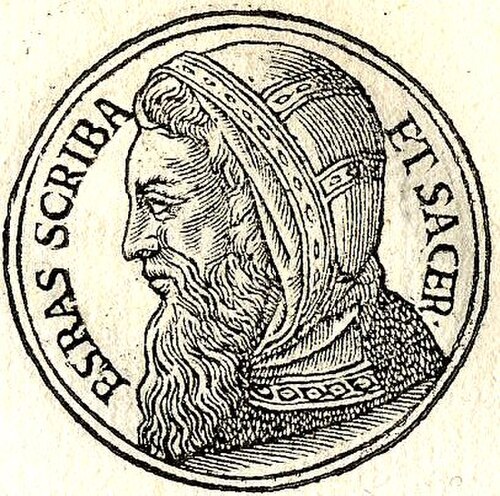
Prophet
Ezra
Priest and Scribe
Priest and scribe of Israel, who led a return from exile and the renewal of the Law in Jerusalem.
Life
The Holy Prophet Ezra (Esdras) was a priest and scribe of Israel, who led part of the remnant from the Babylonian captivity back to Jerusalem and renewed life there according to the Law of Moses. The Book of Ezra bears his name, and tradition also credits him with the Books of Chronicles and, according to some, the book of the prophet Malachi. The Orthodox Church honours him on the Sunday of the Holy Forefathers, before the Nativity; the Roman Catholic Church commemorates him on 13 July, together with Nehemiah.
Family and time
He lived in Babylon in the fifth century before Christ, or perhaps the fourth: the sources do not agree. The Book of Ezra says he came to Jerusalem in the seventh year of the Persian king Artaxerxes. If this is Artaxerxes I, the year is about 458 or 457 BC; if Artaxerxes II, about 398 BC, and most scholars prefer the first. Josephus places him in the time of Xerxes. His name means help, or in the longer Hebrew form, the Lord helps.
The genealogy in his book makes him a son of Seraiah, the last high priest of Solomon's Temple, killed by Nebuchadnezzar at the destruction of Jerusalem in 587 or 586 BC, and a descendant of Aaron. Since about a hundred and thirty years separate the two, commentators understand that some ancestors are omitted and that son here means descendant. He was a close relative of Jeshua, son of Jozadak, first high priest of the second temple. The Greek 1 Esdras, used in the East, also calls him high priest, though rabbinic tradition usually regards him as an ordinary priest.
The return to Jerusalem
King Artaxerxes sent him from Babylon to Jerusalem to teach the law of God to those in Israel who did not know it, and the king's letter gave him authority to appoint magistrates and judges and to take gifts for the temple. Ezra set out at the head of a group of Judean exiles and, as the book shows, arrived after four months. The book says that the hand of the Lord his God was upon him. A large part of the Book of Ezra is written in Hebrew and part (4:8 to 6:18 and 7:12-26) in Aramaic, both languages that Ezra mastered.
In Jerusalem he found the religious state low: the Law was not kept, and marriages with pagan women threatened the very identity of the people. When he learned that many Jews, priests and Levites among them, had taken foreign wives, he tore his garments and prayed with confession of the people's sins. With a covenant made before God, the Israelites were called to separate from their foreign wives, which took several months. The book presents this as a confession of sins.
The reading of the Law
Later, in the time of Nehemiah, sent as governor by Artaxerxes in his twentieth year (444 BC) to rebuild the city walls, Ezra read the Book of the Law before the assembled people. Nehemiah 8 describes the day: Ezra stood on a wooden platform before the Water Gate and read from morning until midday to the men, the women and all who could understand. The Levites explained what was read, and the people wept. Nehemiah and Ezra told them that the day was holy and that the joy of the Lord was their strength.
The people then kept the feast of Tabernacles with joy, and after eight days, on the twenty-fourth of the seventh month, they gathered in fasting and prayer with confession of sins. Under Ezra and Nehemiah a covenant was made in writing, sealed by the princes, Levites and priests, to keep the Law, keep the Sabbath, bring the tithes and gifts for the temple and not intermarry with foreign peoples.
The books and traditions about him
Tradition credits him with the Book of Ezra and Nehemiah with the book that bears his name; the two were long written on a single scroll. Tradition also says he wrote the Books of Chronicles, and some hold that he is the same as the prophet Malachi. Jewish tradition credits him with the beginning of the gathering and arranging of the books of the Hebrew Scriptures and with founding the Great Assembly of scholars and prophets, forerunner of the Sanhedrin, so the Talmud counts him among the greatest figures of Jewish history.
In the Eastern Church the First Book of Esdras is also used, a Greek version of the canonical book, telling events in a different order, which presents Ezra as high priest too. The fourth book of Ezra, a Jewish apocalypse from around AD 100, shows an Ezra who receives seven revelations and who, after the Scriptures were destroyed with the burning of the temple, dictates twenty-four books for the people and seventy more for the wise alone, and is at last taken up to heaven like Enoch and Elijah. This is a non-canonical work.
Death and tomb
Josephus says he died in old age and was buried with great honour in Jerusalem. Other traditions show his tomb near Basra in Iraq, a place of pilgrimage for Jews and Muslims, or at Tadef near Aleppo. There is no testimony outside the Bible about him, and scholars disagree on his historicity: some regard him as a real Persian official, others as a literary figure. Muslims honour him as Uzair.
Commemorated the same day July 13
 Henry IIRight-Believing · Holy Roman EmperorJul 13
 SilasApostle · Companion of the Apostle PaulJul 13
 Alexander of MunichNew Martyr · Anti-Nazi resister of MunichJul 13
 Mildrith of MinsterVenerable · Abbess of Minster-in-ThanetJul 13
 Eugenius of CarthageSaint · Bishop of CarthageJul 13
- Serapion of AlexandriaMartyrJul 13
- Alexander and the Thirty SoldiersHoly MartyrsJul 13
- AmmoniusVenerableJul 13
- AndrewHieromartyr · Kinsman of Saint PatapiusJul 13
- AuxoutheniusVenerableJul 13
- Cruimther Fionntain of Cill AirthirSaintJul 13
- DofganSaintJul 13