Venerable
Alexander Peresvet
Warrior monk of the Trinity Lavra
Monk of the Trinity Monastery who fought a duel with the Tatar Chelubey at Kulikovo in 1380 and died in it.
- Feast
- September 7old style September 20
- Reposed
- 138014th century
- Place
- Kulikovo Field
- Order
- Venerables
Life
Saint Alexander Peresvet, a venerable father, was a monk, a warrior of the Trinity Lavra of Saint Sergius, who fought a single combat with the Tatar champion Chelubey at the opening of the Battle of Kulikovo, on 8 September 1380, and died in it. His feast is on 7 September (and on other dates, among them 22 September, in the synaxes of the saints of Radonezh and of Tula).
Origin and monasticism
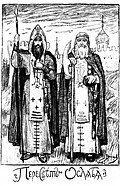
He is believed to have come from the Bryansk area and, before becoming a monk, to have been a boyar who took part in several campaigns and battles. According to one tradition he took the monastic habit at the Monastery of Saints Boris and Gleb in Rostov (the local historian A. A. Titov, however, notes that there is no news of an Alexander Peresvet in the Traditions of the Princes of Rostov). According to another view, he moved to the monastery in Pereslavl-Zalessky, in the service of Dmitry Donskoy, then to the Trinity Lavra, where he became a disciple of Saint Sergius of Radonezh. The Life of Peresvet and Oslyabya says that both were disciples and tonsured by Venerable Sergius.
The Battle of Kulikovo
According to the Life of Saint Sergius of Radonezh, before the Battle of Kulikovo, Prince Dmitry went to him at the monastery to ask a blessing; the Tatars were then thought invincible, and the name of Venerable Sergius, a righteous man and wonderworker, was glorified throughout Rus'. The blessing of such a man was to fill all the soldiers with hope. According to the author of the Tale of the Battle with Mamai, of the fifteenth century, Sergius blessed not only the prince but two monks who knew well the art of war, Alexander Peresvet and his brother Andrei Oslyabya (or Rodion Oslyabya). The historian A. L. Nikitin holds, however, that the episode of the blessing is rather invented, like the duel with Chelubey and Peresvet's monasticism; in the earliest known short chronicle account, the Rogozhsky Chronicle (1408), the name of Sergius does not appear at all.
According to tradition, before the battle Peresvet prayed in a hermit's cell near the chapel of the Holy Great Martyr Demetrius of Thessalonica, where later the Dimitrievsky monastery of Ryazhsk was founded, 7 km from the town of Skopin. After prayer he went away, leaving his apple-wood staff, now kept in the museum at Ryazan.
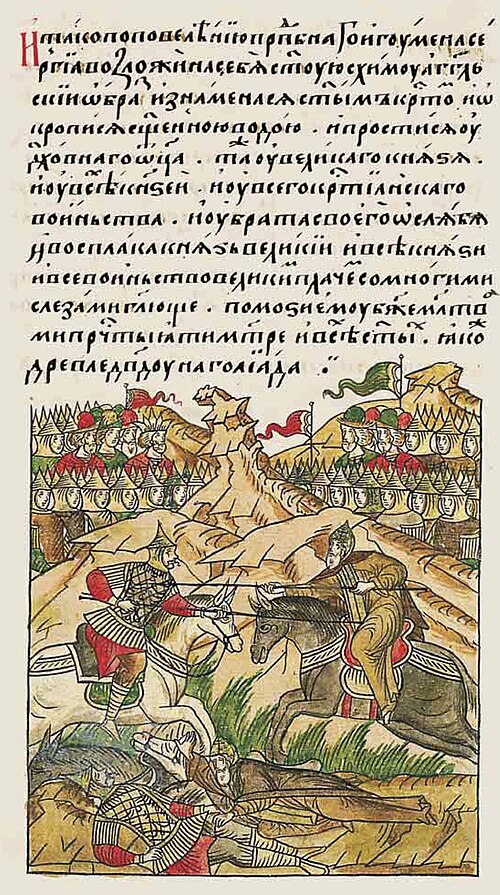
The Tale says that at the beginning of the battle Peresvet took part in the "duel of the champions." From Mamai's army the champion Chelubey (in other versions Chelibey, Temir-Murza or Tavrul) stood against him, said to be of great strength and special skill, an invincible duelling warrior, hired expressly for such duels. Both were on horseback and carried lances. "And they struck hard with their lances, so that the earth almost broke beneath them, and both fell from their horses to the ground and died." Another version says that Chelubey's lance was much longer than usual and that his opponent could not even strike before being defeated and unseated; then Alexander Peresvet, against the logic of the duel, took off his armour and stayed only in the Great Schema, so that the lance, passing through the soft body, would not knock him from the saddle and he could strike himself. Chelubey was killed and fell from the saddle. Peresvet, mortally wounded, stayed in the saddle, reached the ranks of the Russian army and only there died (or his faithful horse carried him to his own, dead on the way but still in the saddle). Immediately after the death of the two the battle began. The epic Zadonshchina, however, shows Peresvet alive during the battle, galloping on his good horse, which would mean he lived long enough to make one last speech; even if accurate, it is unlikely he survived, for no monastery or church record says where else he served after the war. If he did survive, he certainly died before his brother-in-arms Oslyabya died in 1398, for the two were buried together at the Simonov Monastery.
Burial
After the battle the body of Peresvet, with that of Oslyabya, was brought to Moscow and buried beside the church of the Nativity of the Mother of God in Old Simonov (then of wood), in a "stone chamber." According to other accounts (S. F. Platonov), Oslyabya did not die at Kulikovo, since the chronicles mention him in much later years. According to one version, the sarcophagi of Peresvet and Oslyabya were found in the eighteenth century, during the dismantling of the old bell tower: the workmen came upon a brick vault, whose floor was covered with gravestones without inscriptions, and under them they saw the sarcophagi.
Remembrance
Battleships (the Peresvet class), a landing ship of the Russian navy, an icebreaker, a town near Moscow, a fast train between Moscow and Saint Petersburg since 2003, and a Russian military laser, after 2018, bear his name. The boyar family Pereswetoff-Morath is said to descend from him.
Commemorated the same day September 7
 KassiaVenerable · Abbess and HymnographerSep 7
 ClodoaldVenerable · Merovingian prince and hermitSep 7
 Regina of AutunMartyrSep 7
 Gratus of AostaSaint · Bishop of AostaSep 7
 Gauzelin of ToulSaint · Bishop of ToulSep 7
 John of NovgorodSaint · Archbishop of NovgorodSep 7
 ChiaffredoMartyr · Patron of SaluzzoSep 7
 SozonMartyr · Shepherd of CiliciaSep 7
 Alpinus of ChâlonsSaint · Bishop of ChâlonsSep 7
 Andrew OslyabyaVenerable · Monk of the Trinity LavraSep 7
- Macarius of OptinaVenerable · Hieroschemamonk of OptinaSep 7
 Paragorius of NoliMartyrSep 7