
Venerable
Andrew Oslyabya
Monk of the Trinity Lavra
Russian nobleman, by tradition a monk of Sergius' Lavra, famed for his part in the Battle of Kulikovo.
- Feast
- September 7old style September 20
- Reposed
- 138014th century
- Order
- Venerables
Life
Venerable Andrew Oslyabya (Rodion Oslyabya) is a warrior monk, regarded by tradition as a monk of the Trinity Lavra of Saint Sergius of Radonezh, famed for his part in the battle of Kulikovo in 1380, beside Alexander Peresvet. The Russian Church venerates both among the venerable and commemorates them on 7 September. The sources do not agree on details of his life, and many scholars think that the stories of the two warrior monks are largely a literary invention.
The name
Traditionally he is held to have taken the name Andrew in monastic life. Another name given to him, Rodion, is regarded by the Russian Church as the result of misunderstandings; some sources take it as a secular name, others as a monastic one.
What the sources say
Before becoming a monk he was a boyar from Lyubutsk and a soldier. According to the Tale of the Battle with Mamai, written in the fifteenth century, he was, with the blessing of Saint Sergius of Radonezh, in the army of Grand Prince Dmitry Donskoy against the Tatars, with the monk Alexander Peresvet, and took part in the battle of Kulikovo. In 1380 Saint Sergius gave them the schema, the highest degree of monastic renunciation of the world. A chronograph of 1516-1522 says that Oslyabya was the first duellist in the battle, but later works mention only Peresvet.
According to the most widespread version he died at Kulikovo, but the Tale does not mention his death. Documents of 1389-1392 mention him as a boyar at the metropolitan's court, and some sources say he went to Constantinople on an embassy of Dmitry Donskoy. The name Oslyabya was also borne by real boyars at the metropolitan's court, but they were not monks. The scholar Kati Parppei considers that, although Peresvet and Oslyabya may have been historical persons, their inclusion in the Tale as two warrior monks is without doubt an invention. He is said to have had three sons: Yakov, killed at Kulikovo, Akinf, a boyar at the metropolitan's court, and Rodion, a boyar sent on an embassy to the Byzantine emperor in 1398.
Burial and veneration
He is said to have been buried beside Peresvet, near the church of the Nativity of the Mother of God in Old Simonovo near Moscow, in a small stone vault. At the end of the eighteenth century the vault was taken apart, and in 1849-1855 the refectory and bell tower were rebuilt, so the grave came to lie inside the refectory. On the supposed spot there is now a wooden tombstone. It is not known exactly when the veneration began, but in the mid-seventeenth century the names of Peresvet and Oslyabya were in the calendar of saints in Simon Azarin's menologium, and at the end of the century in the Description of Russian Saints. They are commemorated on 7 September, on the Sunday of All Saints of Russia and in the synaxes of the saints of Moscow, Tula, Bryansk and Radonezh. A Russian warship lost at Tsushima and a present-day landing ship were named after him.
Commemorated the same day September 7
 KassiaVenerable · Abbess and HymnographerSep 7
 ClodoaldVenerable · Merovingian prince and hermitSep 7
 Regina of AutunMartyrSep 7
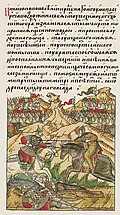 Alexander PeresvetVenerable · Warrior monk of the Trinity LavraSep 7
 Gratus of AostaSaint · Bishop of AostaSep 7
 Gauzelin of ToulSaint · Bishop of ToulSep 7
 John of NovgorodSaint · Archbishop of NovgorodSep 7
 ChiaffredoMartyr · Patron of SaluzzoSep 7
 SozonMartyr · Shepherd of CiliciaSep 7
 Alpinus of ChâlonsSaint · Bishop of ChâlonsSep 7
- Macarius of OptinaVenerable · Hieroschemamonk of OptinaSep 7
 Paragorius of NoliMartyrSep 7