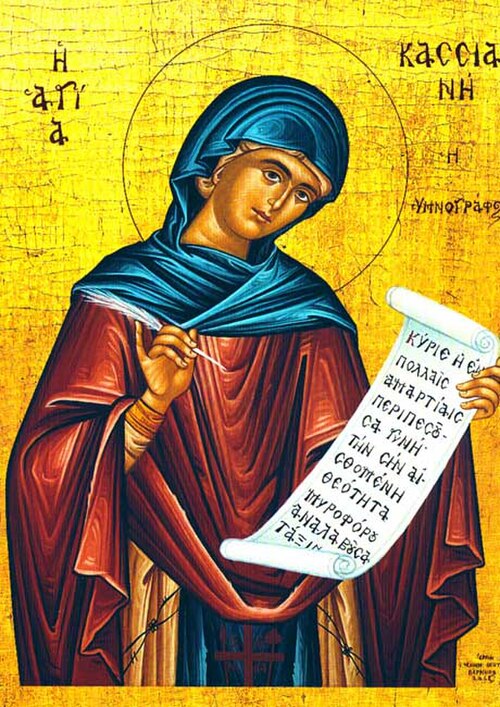
Venerable
Kassia
Abbess and Hymnographer
Byzantine abbess and hymnographer of the ninth century, author of the troparion sung on Holy Wednesday.
- Feast
- September 7old style September 20
- Reposed
- 8659th century
- Place
- Constantinople
- Order
- Venerables
Life
Saint Kassia the Venerable, called also Kassiani, was a Byzantine abbess, poet and hymnographer of the ninth century, author of the troparion sung on Holy Wednesday. The Church commemorates her on 7 September and on 16 October.
Youth
She was born between 805 and 810, at Constantinople, into a wealthy and noble family, and grew up exceptionally beautiful and intelligent. Her father was apparently a court official, perhaps dead before 815. She and her mother venerated the icons and, in the second period of the struggle against icons, helped the confessors of Orthodoxy. She corresponded with Saint Theodore the Studite, three of whose letters to her have survived. She received a good education, so she knew the Holy Scripture, the writings of the Holy Fathers and ancient authors such as Plato. The Byzantine chroniclers, Pseudo-Symeon the Logothete, George the Monk and Leo the Grammarian, relate that she took part in a bride show for the young emperor Theophilos, organized by his stepmother Euphrosyne, in which the emperor gave a golden apple to his choice. Theophilos, struck by her beauty, is said to have told her that through woman came the baser things, that is, sin and suffering because of Eve. Kassia is said to have answered that through woman too came the better things, that is, the hope of salvation through Christ's incarnation from the Virgin. Dissatisfied, the emperor chose Theodora.
The nun
By 843 she had founded a convent in the west of Constantinople, near the walls of Constantine, and was its first abbess. One view holds that she chose monastic life out of bitterness at not becoming empress, but a letter of Theodore the Studite shows that she had truly spiritual reasons. Her convent was closely connected with the neighbouring monastery of Stoudios, which had a central role in re-editing the liturgical books and thus helped to preserve her writings. The emperor Theophilos was a fierce iconoclast, and Kassia was punished for her defence of the veneration of icons, among other things by scourging. Still she remained courageous in defending the faith, saying that she hated silence when it was time to speak. After the death of Theophilos, in 842, his son Michael III came to the throne, with Theodora as regent, and they ended the second iconoclast period, in 843.
Her works
Kassia made a brief journey to Italy, but came to settle on the Greek island of Kasos, where she died around 865. About fifty hymns of hers survive, mostly stichera, of which at least twenty-three are regarded as certainly hers, as well as epigrams and gnomic verses, hundreds in all. She is the only woman whose compositions entered the service books of the Orthodox Church. Her best-known work is the troparion Lord, the woman who fell into many sins, sung on Holy Wednesday, at the end of the aposticha at matins. According to tradition, she wrote it when the emperor Theophilos, still in love with her, wished to see her. In 1892 she was numbered among the saints.
Commemorated the same day September 7
 ClodoaldVenerable · Merovingian prince and hermitSep 7
 Regina of AutunMartyrSep 7
 Alexander PeresvetVenerable · Warrior monk of the Trinity LavraSep 7
 Gratus of AostaSaint · Bishop of AostaSep 7
 Gauzelin of ToulSaint · Bishop of ToulSep 7
 John of NovgorodSaint · Archbishop of NovgorodSep 7
 ChiaffredoMartyr · Patron of SaluzzoSep 7
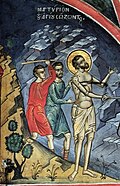 SozonMartyr · Shepherd of CiliciaSep 7
 Alpinus of ChâlonsSaint · Bishop of ChâlonsSep 7
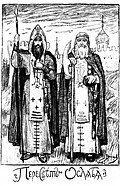 Andrew OslyabyaVenerable · Monk of the Trinity LavraSep 7
- Macarius of OptinaVenerable · Hieroschemamonk of OptinaSep 7
 Paragorius of NoliMartyrSep 7