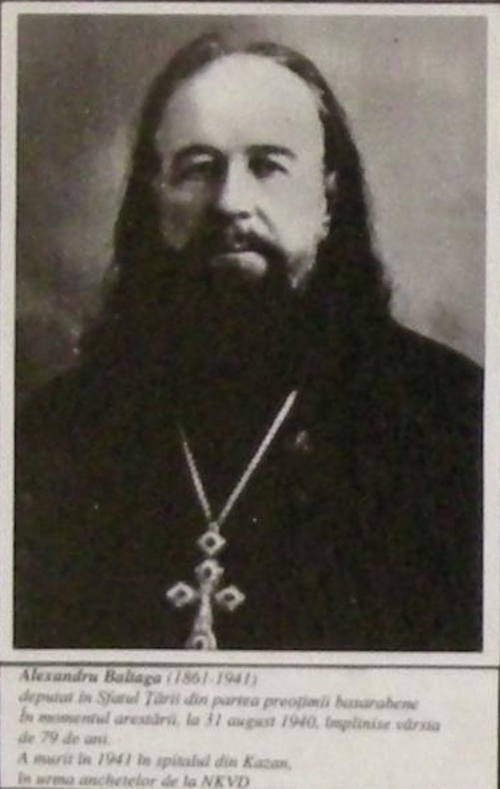
New Martyr
Alexandru Baltagă
Bessarabian priest and Soviet political prisoner, a founder of the Romanian religious press in Bessarabia, who died in 1941.
Life
Saint Alexandru Baltagă, the Priest-Martyr of Bessarabia (1861 to 1941), was a Bessarabian Orthodox priest, archpriest, one of the founders of the religious press in Romanian in Bessarabia, a member of Sfatul Țării and a deputy who voted for the Union of Bessarabia with Romania on 27 March 1918. Arrested by the NKVD in 1940, he was deported to Russia and died at Kazan on 7 August 1941. The Holy Synod of the Romanian Orthodox Church approved his canonization in July 2024, with the solemn proclamation foreseen for 2025.
Childhood and training
He was born on 14 April 1861 in the commune of Lozova, Lăpușna county, to the priest Ștefan Baltagă. After primary school in his native village he graduated with distinction, on 15 June 1883, from the Theological Seminary at Chișinău, then worked two years as a teacher at the Spiritual School for boys in the capital of the province. He was a classmate of Alexandru Ciugureanu, father of the future prime minister Daniel Ciugureanu. He was ordained deacon on 26 January 1886 and priest on 2 February 1886, for the parish of Călărași-Sat, Lăpușna county, with the patron saint Alexander Nevsky. The priest adopted and raised two children, Vsevolod and Margareta.
Church and cultural service
From 1890 to 1905 he was inspector of the church district of Orhei, in 1905 to 1926 archpriest of the fifth circle in Orhei county, and in 1928 to 1935 archpriest of the third circle in Lăpușna. In 1931 he became archpriest and president of the "priestly circle" of Lăpușna. From 1925 until his death he was a member of the Diocesan Assembly of the Archbishopric of Chișinău, and from 1932 representative of the diocese in the National Church Congress of the Romanian Orthodox Church. From 1904 to 1922 he was president of the revision committee, and from 1922 to 1935 president of the Administrative Council of the "Union of Orthodox Clerics of Bessarabia". On 1 July 1935 he retired, but the Metropolis of Bessarabia and the Ministry of Education and Cults gave him, by special decree, the exceptional right to serve until death in the parish of Călărași-Sat. He held the rank of mitred economos.
In 1893 to 1895, 1898, 1902 and 1919 to 1925 he was president of the School Congresses of Bessarabia, and from 1903 to 1918 each year he was elected president of the annual diocesan congresses. From 1908 he was one of the chief helpers of Gurie Grosu in editing and printing the Bessarabian religious journal in Romanian, "Luminătorul", which at first also served as the bulletin of the diocese. He made an important contribution to the founding and working of the diocesan printing press in 1906 to 1917. In 1906 to 1917 he was a member of the Council of the Nativity Brotherhood and in 1911 to 1918 director of the six-year school for church singers at Călărași-Târg.
Sfatul Țării
After the break-up of the Russian Empire, the diocesan Congress at Chișinău, held 21 to 27 November 1917 (4 to 10 December new style), elected him as representative of the Bessarabian priesthood in Sfatul Țării. He also represented the Social Democratic Party, the Mensheviks. As deputy, on 27 March 1918 (9 April new style), he voted for the Union of Bessarabia with Romania. He was esteemed, loved and regarded as spiritual father by his parishioners. It is said he often repeated that he would not allow his flock to be swallowed by the red wolves, an allusion to the Bolshevik danger. When the Kazan Icon of the Mother of God was carried through Bessarabia, his church was among those that displayed it. When the Soviet occupation of Bessarabia came, he stayed to serve in his church, though it was known that former members of Sfatul Țării were prime targets of the Soviets.
He had received numerous church and lay distinctions, among them the Golden Cross of the Holy Synod of Russia (18 April 1903), the Order of Saint Anne, third class (1907) and second (1912), the Order of Saint Vladimir, fourth class, in gold (1915), the Order of the Star of Romania as officer (1923), the Order of the Crown of Romania as commander (1928) and others. Gala Galaction regarded him as the "patriarch of the Bessarabian priests".
Arrest and death
On 31 August 1940, while celebrating the Liturgy in the church of Saint Alexander at Călărași, NKVD officers burst in and tried to arrest him. The priest refused, saying he would follow them only after the service. The political police had to withdraw empty-handed. The next night they took him from his bed, without letting him dress, and led him to Chișinău, where he was interrogated in the cellars of the NKVD building. His interrogator was NKVD lieutenant Cherepanov, who accused him that "in 1918, having a hostile attitude toward Soviet Russia, he took an active part in Sfatul Țării and voted for the estrangement of Bessarabia from Soviet Russia and for its union with Romania" and that "in the following years, as an active cleric, he fought against the revolutionary movement", according to a document in Russian in the Soviet political police file of 1940 and 1941. Relatives say that during the investigation he endured physical and psychological pressure. It is told that to the investigators' demand "Show us your God", the priest answered: "When you show me your mind, then I will show you my God". After the Romanian army crossed back into Bessarabia, in early July 1941, the Soviets took him into the interior of the USSR. He endured a martyr's death, as some Orthodox texts call it, at Kazan on 7 August 1941. One source shows that he died in a special psychiatric hospital at Kazan.
Canonization
In October 1995 the Diocesan Assembly of the Metropolis of Bessarabia proposed investigating his life with a view to canonization. In 2022 the Synod of the Metropolis of Bessarabia announced that the Priest-Confessor Alexandru Baltagă would be canonized in 2025. On 11 and 12 July 2024 the Holy Synod of the Romanian Orthodox Church approved the canonization of sixteen Romanian saints, great spiritual fathers and martyrs of the communist prisons, among them the archpriest Alexandru Baltagă. The proclamation of the canonization of the new saints was foreseen for the next year, when the Romanian Orthodox Church marks a century since the recognition of its Patriarchate.
Commemorated the same day August 8
 Severus of VienneSaint · Priest at VienneAug 8
- Gregory of SinaiVenerable · Hesychast monkAug 8
 Eusebius of MilanSaint · Archbishop of MilanAug 8
 Gregory the IconographerVenerable · Icon painter of the Kiev CavesAug 8
 Kallinikos of EdessaSaint · Metropolitan of EdessaAug 8
 Jacob of TumanVenerable · Monk and doctor of lawAug 8
 Theodosius of the CaucasusVenerable · HieroschemamonkAug 8
 Nikodim KrotkovHieromartyr · Archbishop of Kostroma and GalichAug 8
- Triantaphyllos the MartyrNew MartyrAug 8
 Zosimus of TumanVenerable · Sinaite hermitAug 8
 Myron of CreteSaint · Archbishop of CreteAug 8
- Ekvtime of GarejiSaintAug 8