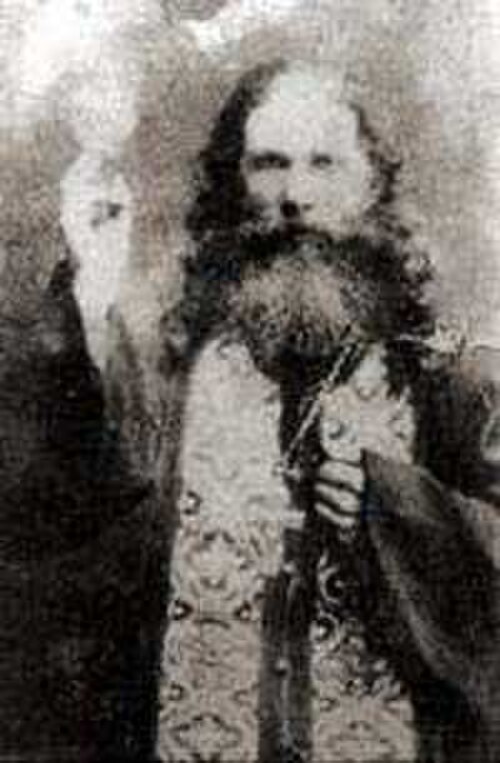
Venerable
Theodosius of the Caucasus
Hieroschemamonk
Russian hieroschemamonk born Fyodor Kashin, who served on Athos, in Constantinople, Jerusalem and the Caucasus; he died in 1948.
- Feast
- August 8old style August 21
- Reposed
- 194820th century
- Place
- Mineralnye Vody
- Order
- Venerables
Life
Saint Theodosius of the Caucasus (in the world Fyodor Fyodorovich Kashin) was a Russian hieroschemamonk who lived on Mount Athos, in Constantinople and in Jerusalem, and who later, back in Russia, became a confessor and elder in the Kuban and the North Caucasus. He passed through arrest and the camps and spent his last years in Mineralnye Vody, where he reposed in 1948. He is venerated as a clairvoyant elder and as the patron of the city of Mineralnye Vody.
The main sources for his life are the memories of the women he tonsured who lived near him, and of dozens of his spiritual children and their descendants. For this reason much in his biography remains unclear, and no scholarly study of him has yet been written. The life below gives both what the tradition of his disciples relates and what the documents of the time preserve.
Birth and childhood
The life published with the blessing of Metropolitan Gideon (Dokukin) of Stavropol states that he was born on 3 May 1841, the feast of Saint Theodosius of the Kiev Caves. This date rests on the death certificate issued in Mineralnye Vody, which gave his age at death as 107. Other data, from the archives of the period, indicate that he went to Athos in 1889 at the age of twenty or twenty-one, which would place his birth around 1868.
His birthplace is not known for certain. A Russian pilgrim's guide to Athos printed in 1905 says he came from the Perm province. The historian Pyotr Agafonov considers that he most likely came from the Upper Kama region, the Solikamsk district, where in the town of Dedyukhin the surname Kashin was more common than anywhere else in the Urals.
His parents, Fyodor and Ekaterina, were poor peasants with many children, but devout Christians who raised their children in the fear of God. The boy learned the psalms and the hymns of the Church from infancy. According to his life, while still a child he would go into the forest and pray for long hours on a great stone; once during his prayer he heard a voice telling him that the stone on which he stood was of paradise, and from then on he called it “the stone of paradise”.
On the Holy Mountain
It is certain that he went to Athos. According to the life written by his disciples, he arrived there very young with a group of pilgrims and grew up in the monastery. He learned to read and write and to speak Greek, fulfilled his obediences without complaint, spoke only when strictly necessary and prayed with great fervour. The abbot, seeing him obedient and diligent in prayer, kept him close. His virtues also roused the envy of some of the brethren, and he bore their humiliations with humility.
According to the same life, when he was fourteen a Russian general came to the monastery of Iviron. He had brought to Greece his wife, who was sick and tormented by an unclean spirit, and she had learned in a dream that a young novice of the brotherhood would be able to heal her. When young Fyodor was called, she cried out that this was the one who would drive the spirit out of her. The abbot blessed him to fast for three days and to wash the icon of the Mother of God of Kazan with water. With that water, after a service of supplication on board the ship, the sick woman was delivered from her torments. Asked to whom he prayed that his prayer had such power, the youth answered that he prayed to the “golden Mother of God”.
Records kept in the security service archive for the Krasnodar region state that he set out for Athos in 1889. The 1905 pilgrim's guide, however, says that he had arrived more than twenty years earlier. He settled in the kellion of the Holy Belt of the Mother of God, a dependency of Iviron; the kellia of Athos are large monastic settlements with cultivated land. Learning that he was not an orphan, the elder sent him home to receive his parents' blessing for the monastic life. The young man travelled to the Perm region, found his father and mother, and they blessed him with an icon of the Mother of God of Kazan. Back on the Holy Mountain he was tonsured a monk with the name Theodosius.
On 12 December 1897, at the request of the elected elders of Iviron and with the written testimony of his spiritual elder, Hieromonk Ioannikios, Metropolitan Nilus (Smyrniotopoulos), formerly of Karpathos and Kasos, ordained him in the church of the kellion of the Holy Belt as reader, subdeacon, deacon and priest. In a certificate dated 14 December 1897 the metropolitan allowed him to serve as a confessor, to hear the confession of thoughts, to guide each penitent according to his strength, and to tonsure tested candidates as monks. In 1901 Elder Ioannikios died, and Hieromonk Theodosius succeeded him as head of the kellion.
Constantinople and the years of trial
His disciples relate that he served in Constantinople for five years, loved by all, and that he distributed to the poor and the sick the money he received from wealthy people. According to some lives he received at the Russian hostel the poor, the sick and all who needed help and counsel.
The documents of the time also show a harder side. Hieromonk Theodosius had opened a metochion of his kellion in Constantinople, something the kellia of Athos were not permitted to have. In May 1902 the Ecumenical Patriarchate asked Archimandrite Jonah, rector of the Russian embassy church, to admonish him, because he celebrated the Liturgy at home without permission and did not heed the counsel of the Church; he was told that as elder of the kellion he belonged at the head of his brethren on Athos.
In 1905 a great scandal broke out, reported by both the Russian and the Greek church press. A young Russian woman, Tatiana Nikitina, was brought to the Holy Mountain dressed as a man and with a man's passport; when she was discovered she was removed, and the blame was laid on Hieromonk Theodosius. The Holy Community of Athos issued a decision against him, which the Synod of the Ecumenical Patriarchate confirmed on 18 October 1905. His disciples, however, tell the story of his meeting with the girl differently: a mother and her daughter Tatiana, pilgrims to Jerusalem from the stanitsa of Platnirovskaya, met the father there, and he blessed the girl to remain in a convent. The sources disagree both about her age and about the place of their meeting.
However it happened, the lives written by those who venerated him say that he was forced to leave Athos. Another tradition holds that in 1907 he stepped down as head of the kellion of his own accord.
In Jerusalem
From 1909 to 1913 he lived in the Holy City of Jerusalem, where he often served at the Tomb of the Lord. As a former elder of an Athonite kellion who spoke Greek, he was allowed to concelebrate with the priests of the Patriarchate of Jerusalem in the Church of the Holy Sepulchre, although he was not a member of the Brotherhood of the Holy Sepulchre. In Jerusalem he received the great schema, keeping his name.
There he met a retired general, a landowner from the stanitsa of Platnirovskaya, who had come to venerate the Tomb of the Lord. The general arranged the necessary papers and made his return to Russia possible.
Return to Russia
From 6 July 1912 he lived at the Kavkazskaya station. He spent about a year on the general's estate at Platnirovka. In these years he joined the Union of the Russian People: a document of 15 December 1915, issued by that organisation's central council, survives, granting him the right to open branches in the Kuban region.
He then served as a hieromonk at the Dormition skete known as the “Second Athos” on Mount Beshtau, in the Stavropol region, and later in the Kuban, at the stanitsa of Kavkazskaya and at the Romanovsky khutor (today the town of Kropotkin).
The forest hermitage
In the Krasnodar region he settled first near a monastery at a place called Tyomnye Buki, and later nearer to the hamlet of Gorny, 27 kilometres from the town of Krymsk. There he founded a small skete, a “little desert”, with a little wooden church. Disciples gathered around him and a community of nuns took shape. Several nuns from a nearby convent came to live near him, as did two girls, Anna and Lyubov, who remained at his side for thirty years and who after his death wrote a manuscript about his life.
The community kept goats and an apiary. All the wooden buildings were raised by “grandfather”, as they called him, with his own hands and an axe. Nun Alexandra, one of his spiritual daughters, remembered that he chopped the firewood himself and went out with the axe barefoot in all weather. The skete had small cell-houses named after the places the pilgrims came from: the Rostov cell, the Caucasus cell, the Novorossiysk cell. His disciples also said that he knew many languages and spoke with each visitor in his own tongue, with Moldovans, Georgians and Armenians.
In these years his ministry as an elder began and his gifts became manifest: clairvoyance, spiritual discernment and healing. Crowds of pilgrims came to him for counsel. Some he rebuked, some he healed of illness, some he comforted with a word, and often he answered questions not yet asked. According to the memories of the nuns, the Mother of God appeared to him here and commanded him to give those who came healing water from a spring.
Arrest and exile
In March 1927, two weeks before Pascha, Father Theodosius was arrested and taken to Novorossiysk. He was held under investigation until January 1929, then sentenced to three years in the camps and sent into exile. The novice Lyubov followed him and served him until the end of his term. He remained in exile until 1932.
From 1927 he sided with those who did not commemorate Metropolitan Sergius (Stragorodsky) in the services, but he did not submit to any centre of theirs and lived a very secluded life.
The years in Mineralnye Vody
After his exile he settled in Mineralnye Vody. During the war he was among the most fervent intercessors for the victory of his country, ceaselessly praying for its defenders and for the fallen.
His disciples preserve an episode from the days when the Germans were approaching the city. The old man, known to the town's children as “Grandpa Kuzka”, ran with a speed unusual for his age to a kindergarten and called the children who were in the street to run after him. The children followed him as if in play, and the teachers followed the children. Meanwhile a shell struck the kindergarten building and destroyed it, but no one was killed.
He often urged people to say the Jesus Prayer, and he used to say that if people knew what awaits them after death, they would pray to God day and night.
Repose and veneration
He reposed on 8 August 1948 (27 July in the Old Style) in Mineralnye Vody. According to his disciples, on the day of his death an unknown stranger came to the house and read the Psalter and the Holy Gospel from memory all night long. At the funeral four young men, unusually dressed in long shirts and boots and all fair-haired, offered to carry the coffin; they bore it in their arms to the cemetery and then disappeared.
On 25 April 1995, Tuesday of Bright Week, “Memory Eternal” was sung for the elder for the last time, in a church of the Archangel Michael. That same year Metropolitan Gideon (Dokukin) blessed his veneration as a locally honoured saint of the diocese of Stavropol, with his feast on the day of his repose, 27 July (8 August). He is also venerated by several Old Calendar Orthodox jurisdictions and is regarded as the patron of the city of Mineralnye Vody.
Commemorated the same day August 8
 Severus of VienneSaint · Priest at VienneAug 8
- Gregory of SinaiVenerable · Hesychast monkAug 8
 Eusebius of MilanSaint · Archbishop of MilanAug 8
 Gregory the IconographerVenerable · Icon painter of the Kiev CavesAug 8
 Kallinikos of EdessaSaint · Metropolitan of EdessaAug 8
 Jacob of TumanVenerable · Monk and doctor of lawAug 8
 Nikodim KrotkovHieromartyr · Archbishop of Kostroma and GalichAug 8
 Alexandru BaltagăNew MartyrAug 8
- Triantaphyllos the MartyrNew MartyrAug 8
 Zosimus of TumanVenerable · Sinaite hermitAug 8
 Myron of CreteSaint · Archbishop of CreteAug 8
- Ekvtime of GarejiSaintAug 8