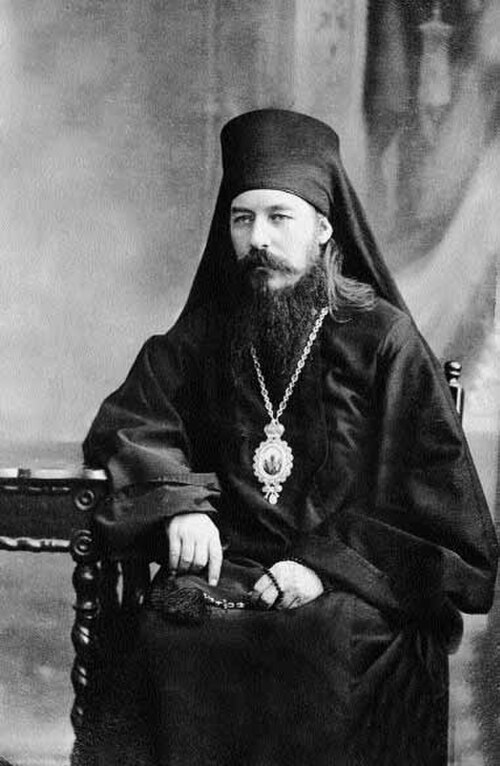
Saint
Ambrose Polyansky
Bishop of Kamianets-Podilskyi
Bishop of Kamianets-Podilskyi, born in 1878, who died in exile in Kazakhstan in 1932; glorified in 2000.
- Feast
- October 14old style October 27
- Reposed
- 193220th century
- Place
- Sozak
- Order
- Hierarchs
Life
Saint Ambrose Polyansky, Hierarch and Confessor (in the world Alexander Alekseevich Polyansky, 1878 to 1932), was bishop of Kamianets-Podilskyi and Bratslav, rector of the Kyiv seminary and a confessor in the time of Soviet persecution. He resisted the Renovationists, passed through prison and the Solovki camp and died in exile, in Kazakhstan, in 1932. The Russian Church canonized him in 2000, and the Ukrainian Orthodox Church also commemorates him in the Synaxis of the Saints of the Vinnytsia land.
Youth and learning
He was born on 12 November 1878 in the village of Pitelino, in the Elatma district, Tambov province (today the Ryazan region), to a priest's family from an ancient priestly line. He graduated from the parish school in his native village. In 1887 he entered the theological school at Shatsk. In 1899 he graduated from the Tambov seminary and the same year entered the Kazan Theological Academy. In 1901 he was tonsured a monk, ordained hierodeacon, and in 1902 hieromonk. In 1903 he graduated from the academy, with the degree of candidate in theology, with the work "The Doctrine of the Kingdom of God in the Work of Blessed Augustine, On the City of God".
After graduating he was named teacher at the Kyiv seminary and entered the brotherhood of the Caves Lavra, as cathedral hieromonk. In 1906 he was named rector of the Kyiv seminary, with the rank of archimandrite. He succeeded in quickly restoring the order disturbed by the revolutionary events. He was a permanent member of the society for aid to needy pupils of the Kyiv-Podil school and chairman of the council of the Saints Peter and Paul Trusteeship for poor pupils of the Kyiv seminary.
The bishop
On 22 October 1918, in the cathedral of Saint Sophia, he was consecrated bishop of Vinnytsia, vicar of the diocese of Kamianets-Podilskyi. From 1922 he was bishop of Kamianets-Podilskyi and Bratslav. After the Renovationist schism appeared, Archbishop Pimen (Pegov) of Podolia recognized the Renovationist Supreme Church Administration and asked Bishop Ambrose to do the same. Ambrose categorically refused and became temporary administrator of the diocese of Kamianets-Podilskyi. Together with his vicar, Bishop Valerian (Rudich), he resolutely opposed the Renovationist movement, and as a result both bishops were arrested in 1923. Ambrose was exiled to Vinnytsia. He was arrested a second time at Vinnytsia the same year for "harbouring six officers and ordaining them priests". He was exiled to Kharkov, and in 1924 outside the Ukrainian SSR, to Moscow. The diocese of Podolia was destroyed by the Renovationists, with the support of the Soviet authorities: at Vinnytsia, for example, not a single Orthodox church remained.
In September 1923, at the conference of bishops at the Donskoy monastery, he spoke sharply against reconciliation with the Renovationists, a position accepted by most of the episcopate. In Moscow he lived at Saint Daniel's monastery, served in various churches and preached much. He ordained former officers of the tsarist army priests. In 1924 he was arrested again and spent ten days in prison. On 12 April 1925 he took part in the burial of Patriarch Tikhon and signed the act transferring supreme church authority to Metropolitan Peter (Polyansky) of Krutitsy. In 1925 he was named administrator of the diocese of Kamianets-Podilskyi but had no time to leave, being arrested at the end of November 1925 together with other bishops close to the Locum Tenens. During the investigation he was held at Butyrka.
Solovki and exile
On 21 May 1926 the Special Council of the OGPU sentenced him to three years in camps, charged with having been an active participant in a church and monarchist group aiming to use the Church to damage the Soviet power by concentrating anti-Soviet elements. He was sent, with Archbishop Procopius (Titov) of Kherson, to the Solovki Special Purpose Camp. In July 1926 he took part in drawing up the "Memorandum of the Solovki Bishops" to the government of the USSR.
On 30 November 1928 he was exiled to the Urals region, where he lived together with Archbishop Procopius. In April 1929 both bishops were held for a month and a half in the Tobolsk prison, then served exile in the town of Obdorsk, not far from the place of exile of the Locum Tenens, Metropolitan Peter. There was minor correspondence between them and the metropolitan, with feast-day greetings, as Metropolitan Peter shows in a letter of February 1930 and Archbishop Procopius at interrogation in July 1931. In 1929 to 1931 Bishop Ambrose was in the village of Shuryshkary, where he worked at the enlightenment of the Zyrians and Ostyaks.
On 5 July 1931 he was brought back to Obdorsk, where on 30 July he was arrested again with Procopius. The bishops were accused of correspondence with Metropolitan Peter, then in exile, and the cause of the new arrest was also their refusal to make compromises with the Soviet power.
His death
On 14 December 1931 Archbishop Procopius and Bishop Ambrose were sentenced to three years' exile in the Kazakh SSR. In September 1932 Ambrose was sent into exile in the village of Suzak. The exile's road ran through desert and mountain paths, and the sun burned him badly. On arrival he was placed in the hospital, where he fell asleep a week later, on 20 December 1932.
Glorification
At the Jubilee Bishops' Council of the Russian Church in August 2000 he was numbered among the New Martyrs and Confessors of Russia. On 27 December 2010, at the Kyiv Theological Academy, Archpriest Sergiy Prychyshyn defended his candidate's thesis on the theological labour and the life of struggle of the confessor Bishop Ambrose, which remains to this day the fullest biography of the saint. On 1 April 2015 the Holy Synod of the Ukrainian Orthodox Church, headed by Metropolitan Onuphry, established the feast of the Synaxis of the Saints of the Vinnytsia land, in which, among the 15 ascetics linked to that region, Saint Ambrose Polyansky, confessor (died 1932), was also included.
Commemorated the same day October 14
 Callixtus IHieromartyr · Bishop of RomeOct 14
 Paraskeva of the BalkansVenerable · of EpivatesOct 14
 Burchard of WürzburgSaint · First Bishop of WürzburgOct 14
 Donatian of ReimsSaint · Bishop of ReimsOct 14
 Gaudentius of RiminiHieromartyr · Bishop of RiminiOct 14
 Domninus of ThessalonikiMartyr · Martyr of ThessalonikiOct 14
 NazariusMartyr · Martyr of MilanOct 14
 Fortunata of CaesareaMartyrOct 14
- 40 Martyrs of Egypt and PalestineHoly MartyrsOct 14
 AngadrismaVenerableOct 14
- Bernard of ArceConfessorOct 14
- CaelestiusSaint · Bishop of MetzOct 14