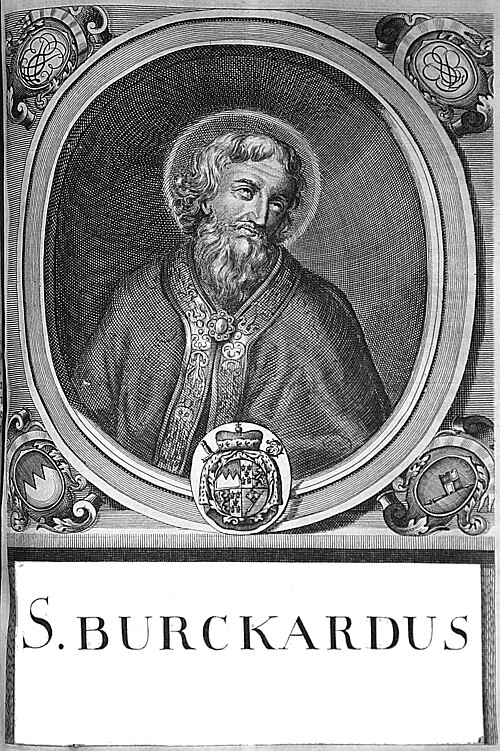
Saint
Burchard of Würzburg
First Bishop of Würzburg
Anglo-Saxon missionary to Germany and the first bishop of Würzburg, from 741 to 751.
- Feast
- October 14old style October 27
- Reposed
- 7558th century
- Place
- Homburg
- Order
- Hierarchs
Life
Saint Burchard was an Anglo-Saxon Benedictine monk, a missionary to Germany and the first Bishop of Würzburg, from 741 to 751. He laboured alongside Saint Boniface and is remembered as one of those who planted the Church in the heart of Germany.
He is said to have been of noble birth and educated at Malmesbury Abbey. After the death of his parents he left England and joined Boniface, possibly a kinsman, in his mission, some time after 732. He lived for a while at the abbey of Saint Peter in Fritzlar, founded by Boniface, and then went to work as a missionary in Thuringia.
When Boniface organised bishoprics in central Germany, he set Burchard over Würzburg. The appointment was approved by Carloman, who endowed the diocese. His consecration took place no later than the summer of 741, since in the autumn of that year he appears as a bishop at the consecration of Willibald of Eichstätt. Pope Zachary confirmed the new see in 743. Burchard took part in the first German council of 742 and the council of the Franks in 747. The following year he carried the council's decisions to Rome as Boniface's envoy. In 750 he went to Pope Zachary with Fulrad of Saint-Denis, bringing Pepin's well-known question, whose answer was used to justify the Carolingians' royal power.
In 751 he resigned the see in favour of Megingoz, a monk of Fritzlar, and withdrew to a life of solitude near Homburg on the Main. In 752 he dedicated the abbey of Saint Andrew in Würzburg, later renamed Saint Burchard's. On 8 July 752 he translated the relics of Saint Kilian and his companions Totnan and Colman into Würzburg Cathedral. He fell asleep around 753 or 755. His relics were taken to the abbey of Saint Andrew at the end of the tenth century. His feast is kept on 14 October.
Commemorated the same day October 14
 Callixtus IHieromartyr · Bishop of RomeOct 14
 Paraskeva of the BalkansVenerable · of EpivatesOct 14
 Donatian of ReimsSaint · Bishop of ReimsOct 14
 Gaudentius of RiminiHieromartyr · Bishop of RiminiOct 14
 Domninus of ThessalonikiMartyr · Martyr of ThessalonikiOct 14
 NazariusMartyr · Martyr of MilanOct 14
 Fortunata of CaesareaMartyrOct 14
 Ambrose PolyanskySaint · Bishop of Kamianets-PodilskyiOct 14
- 40 Martyrs of Egypt and PalestineHoly MartyrsOct 14
 AngadrismaVenerableOct 14
- Bernard of ArceConfessorOct 14
- CaelestiusSaint · Bishop of MetzOct 14