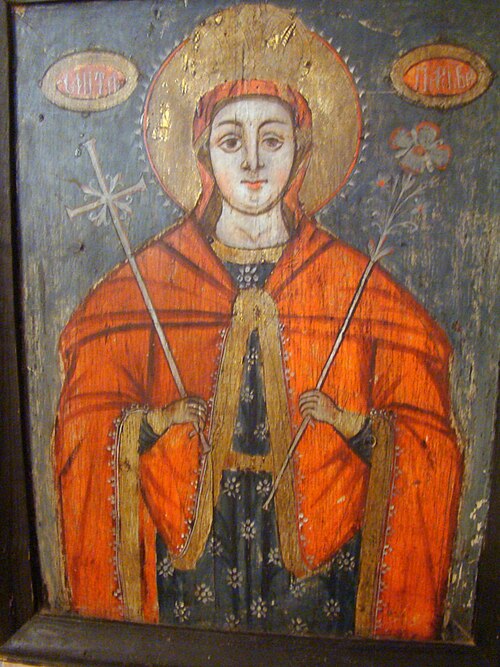
Venerable
Paraskeva of the Balkans
of Epivates
Ascetic of the eleventh century born at Epivates near Constantinople, whose relics rest in Iași.
- Feast
- October 14old style October 27
- Reposed
- 110011th century
- Place
- Selimpaşa
- Order
- Venerables
Life
The venerable Parascheva is one of the best-loved saints of the Orthodox East, patroness of Moldavia, whose holy relics lie at Iași. She was born at Epivates, near Constantinople, lived as a nun and hermit in the tenth or eleventh century and is commemorated on 14 October. The people also call her Saint Friday, because her Greek name, Paraskeví, means “Friday”, the day of preparation.
Childhood and calling
Paraskeva was born in the village of Epivates, today Selimpasa, on the shore of the Sea of Marmara, in Thrace, not far from Constantinople, in a wealthy and devout family. Her father, according to a Bulgarian source, was named Nicetas and was a landowner. She had a brother, Euthymius, who became a monk young and rose to be bishop of Madytos and a saint. According to the account of her life, as a child she heard in a church the words of the Lord: “If anyone desires to come after Me, let him deny himself, and take up his cross, and follow Me.” These words decided her to give her costly clothes to the poor and to exchange her garments for the rags of beggars; once, having nothing else to give a beggar woman, she gave her golden cross. Her beauty and kindness drew the eyes of many well-off young men, who asked for her hand, but she refused all offers.
Leaving home
Her parents did not support her decision to lead a life of struggle, and searched for her in various cities, and after their death she left the house, shared out her inheritance and went to Constantinople, where she spent five years, visiting the monasteries and churches. With her mind on the monastic life, she settled at the church of the Mother of God in Heraclea Pontica, in Bithynia, where she led an austere life, with visions of the Most Holy Virgin, and then became a nun. The wish to see the holy places took her to Jerusalem, where she venerated the Tomb of the Lord and the other places where the Saviour passed. After the pilgrimage she settled, following the example of Saint Mary of Egypt, in the desert of the Jordan valley, where she spent many years in fasting and prayer, asking God to forgive her sins.
Return and repose
When she had grown old, an angel of the Lord appeared to her and ordered her to leave the desert and return to the place of her birth. Reaching Epivates, her face was so altered by the hardships of the desert that no one knew her. She venerated the graves of her parents, went to Constantinople and settled in a village nearby, Kallikrateia, beside the church of the Holy Apostles, where, living in silence and prayer, two years later she fell asleep in peace. She was taken for a poor stranger and was buried without honour, in a place apart, where strangers lay. Some sources say she was twenty-seven; others, that she lived to a great age; so her years cannot be fixed with certainty.
The finding of the relics
According to tradition, after some time an old sinner was buried beside her forgotten grave, and the saint appeared in a dream to a local monk, complaining of the unclean neighbour. The monk learned where she was buried and, when the body was unearthed, it was seen whole and incorrupt. The relics were placed in the church of the Holy Apostles at Kallikrateia and proved to be wonderworking.
The journey of the relics
In the years that followed, her relics were moved to several cities. In 1238 the tsar John Asen II brought them from Kallikrateia to Tarnovo, the capital of the Bulgarian Tsardom, where she is honoured as Saint Petka of Tarnovo. After Bulgaria fell to the Turks, they were taken to Wallachia, and then, at the request of Princess Milica, brought to Belgrade, in 1393, to the church of Ružica. When Suleiman the Magnificent took Belgrade, in 1521, the relics were carried to Constantinople. In 1641 the prince of Moldavia, Vasile Lupu, who had paid the debts of the Ecumenical Patriarchate, received the relics in gratitude from Patriarch Parthenius I and the members of the Synod and brought them, on 13 June, to Iași, to his foundation, the church of the Three Hierarchs. In 1888-1889 they were moved to the Metropolitan Cathedral of Iași, where they lie today. The first mention in Romanian of Saint Parascheva of Iași is in the Romanian Book of Teaching of Metropolitan Varlaam, printed at Iași in 1643.
Veneration
Miracles and healings are attributed to Saint Parascheva. Each year, in the second week of October, hundreds of thousands of faithful gather at Iași from all over the country, on pilgrimage to her relics, and the city gives these days to the feast. The faithful tell that the saint protected the cathedral during the bombardments of the Second World War. In the Balkans her name is found in many forms: Petka, Sveta Petka, Paraskeva, and in memory she is sometimes mixed with other saints of the same name, among them the martyr Paraskevi of Iconium. She is patroness of Moldavia and, for the Bulgarians, of the people and of the towns of Tarnovo, Gabrovo and Troyan.
Commemorated the same day October 14
 Callixtus IHieromartyr · Bishop of RomeOct 14
 Burchard of WürzburgSaint · First Bishop of WürzburgOct 14
 Donatian of ReimsSaint · Bishop of ReimsOct 14
 Gaudentius of RiminiHieromartyr · Bishop of RiminiOct 14
 Domninus of ThessalonikiMartyr · Martyr of ThessalonikiOct 14
 NazariusMartyr · Martyr of MilanOct 14
 Fortunata of CaesareaMartyrOct 14
 Ambrose PolyanskySaint · Bishop of Kamianets-PodilskyiOct 14
- 40 Martyrs of Egypt and PalestineHoly MartyrsOct 14
 AngadrismaVenerableOct 14
- Bernard of ArceConfessorOct 14
- CaelestiusSaint · Bishop of MetzOct 14