Hieromartyr
Gaudentius of Rimini
Bishop of Rimini
Bishop of Rimini, died in 360, venerated as a martyr in the Orthodox and Catholic Churches.
- Feast
- October 14old style October 27
- Reposed
- 3604th century
- Place
- Rimini
- Order
- Martyrs
Life
Saint Gaudentius (Gaudenzio), Hieromartyr, is regarded as the first bishop of Rimini, the ancient Ariminum on the Adriatic coast, and its patron saint. He lived in the fourth century, in the time of the struggles against Arianism, and according to tradition he was stoned to death on 14 October 360 for the Nicene faith. He is venerated in both the Orthodox and the Roman Catholic Churches. The accounts of his life differ greatly, and historians regard many of them with caution; what follows is the tradition of the Church of Rimini.
Early life and calling
According to tradition he was born around 280 in Ephesus in Asia Minor, and so he is also called Gaudentius of Ephesus. His family was Christian and wealthy, which allowed him to receive a good education. His parents were killed by Manichaeans in 294, and he fled to Rome. There he was baptised, became a priest and, according to tradition, was consecrated bishop around 313.
Pope Sylvester sent him to preach the Gospel in Ariminum, where a small Christian community already existed. Gaudentius is regarded as its first bishop: he gathered the Christians in a house church (domus ecclesiae), preached to the pagans and fought the heresies that kept appearing in the city and its surroundings.
Saints Marinus and Leo
An old life of Saints Leo of Montefeltro and Marinus of Montetitano, kept in the Gambalunga library in Rimini, relates that they were Dalmatian stonecutters who came to Rimini in the time of the emperors Diocletian and Maximian to rebuild the city walls. When the work was done, Marinus laboured to bring the inhabitants to the faith, preparing the way for the bishop's preaching. Learning of these virtuous men, Gaudentius ordained Leo a priest and Marinus a deacon, sending them to preach to the pagans. Saint Marinus would go on to found the famous republic of San Marino, and the town of San Leo is named after Leo.
Tradition also attributes miracles to Gaudentius in his lifetime: he is said to have driven an unclean spirit out of a man and to have turned the water of the river Misa at Sena Gallica (Senigallia) into wine for his travelling companions.
The Council of Rimini
After the First Ecumenical Council of Nicaea (325) condemned Arius, Arianism did not disappear but came to dominate the Empire, above all because Emperor Constantius II, son of Constantine the Great, supported it. In 359 the emperor summoned a new council. It was to meet in Nicomedia, but because of an earthquake it was moved to Ariminum. Constantius had visited the city in 357 and charged the praetorian prefect Taurus with preparing it; some historians believe the place was also chosen because part of the local clergy was sympathetic to Arianism.
The council met from May into the autumn of 359, with more than four hundred bishops from the West. The emperor, who did not attend, wanted reconciliation with the Arians and gave Taurus full powers, including the power to exile those who resisted. The bishops were kept in Rimini for months, unable to leave, until they signed a creed that no longer confessed the Son to be of one essence with the Father, but only “like” Him. Many later repented, and the council, summoned to be ecumenical, came to be regarded as a robber council, and its decisions were condemned.
According to tradition, of the more than four hundred bishops only eighteen refused to accept the council's decisions in spite of all threats, and Gaudentius was among them.
Retreat to Cattolica
At the end of the council Gaudentius and the other seventeen bishops left Rimini and settled about twenty kilometres to the south. Tradition holds that the place has since been called Cattolica. The Church was then undivided, and the name does not refer to the Roman Catholic confession but to the conciliar faith: the Greek word katholikos means “universal”.
Martyrdom
After a short time Gaudentius returned to Rimini, where he was arrested. The sources give different reasons. According to one, he entered into a dispute with the consul Marcianus, who denied the resurrection of the dead, and was killed by his soldiers. According to another, he anathematised a heretical priest of Rimini, also named Marcianus, and was arrested by the magistrates of the city, which after the council had for a short time become Arian. Another tradition says that his miracles led to his being blamed for the deaths of two imperial soldiers. All the accounts agree that he confronted the heretics and was arrested by the authorities.
Before he could be tried, a mob seized him from the hands of the magistrates. The bishop, nearly eighty years old, was stoned, and his body was thrown into a marshy place outside the city, south of the Arch of Augustus. It was 14 October 360. The place, where the bodies of other Christians killed at that time were also thrown, was called Lacus Martyrum, the “Lake of the Martyrs”, from which the name of Rimini's Via Lagomaggio and its district is believed to derive.
Historians note that Gaudentius' participation in the council of 359 is hard to reconcile with the rest of the tradition, because another bishop of Rimini is already attested in 313.
The finding of the relics
The saint's remains lay forgotten for nearly seventy years. Around 430, according to tradition, an angel appeared to a woman from Ravenna named Abortina, blind from birth, and told her to go to Rimini, to the Church of Saint Gaudentius built on the presumed site of his grave, and to ask the abbot to give honourable burial to the relics of Saints Gaudentius, Valentinus and Victor, which lay forgotten at the bottom of a well covered with a marble slab inside the church itself. The angel carried her miraculously to Rimini, and when the relics were found she received her sight.
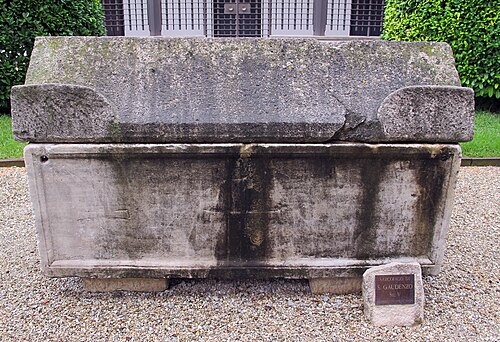
The relics were placed in a large stone sarcophagus behind the altar. The sarcophagus, without the relics, can still be seen in the courtyard of the bishop's curia in Rimini, next to the Tempio Malatestiano. Many pilgrims came to the saint's tomb, among them Saint Amato Ronconi in the thirteenth century.
The journey of the relics
Around 590, because of barbarian invasions, Theodelinda, Queen of the Lombards, had the relics, except the head, moved to Senigallia, where the local bishop received them. Later they were placed in a stone sarcophagus by the Malatesta family and then moved to an abbey dedicated to the saint outside Senigallia. When the abbey fell into ruin, in 1520, the relics were taken to Montalboddo, today Ostra, where they still rest.
In 1702 Cardinal Gaspare Carpegna gave a leg bone to the parish of Saint Nicholas in Garaguso, in Basilicata, and in 1794 the bishop of Tricarico gave the same parish an arm bone. According to a local tradition, a portion of the relics is hidden in the old church of Santa Maria Assunta in Guardalfiera. The head remained in Rimini; in 1857 Pope Pius IX gave a silver reliquary for it, kept in one of the chapels of the Tempio Malatestiano. Other fragments are in the church of Saint John the Baptist in Rimini.
Veneration
Gaudentius has been the patron of Rimini since time immemorial. In a codex of the acts of the Church of Ravenna from the eighth to the tenth centuries, the Arch of Augustus is called the Gate of Saint Gaudentius; beyond it lay the city's necropolis, whose most famous grave was his. The city's first cathedral, between the old Via Flaminia and the sea, was dedicated to him, and the medieval abbey of San Gaudenzo was one of the richest in the city until it was suppressed and sold under Napoleon.
In 1797, to save it from destruction, the bronze statue of Pope Paul V in Piazza Cavour was altered into a statue of Saint Gaudentius, with a bishop's mitre and crosier; only in 1939 was its original appearance restored.
Today 14 October is a holiday in Rimini and marks the beginning of the diocese's pastoral year, with services, processions and popular festivities. The saint is also patron of the towns of Ostra and Garaguso (where he is celebrated on 14 August, so as not to interrupt the October sowing) and of the village of Montefabbri in Vallefoglia. The Orthodox honour him as a hieromartyr and defender of the Nicene faith, and hymns in Church Slavonic have been composed for him. He is commemorated on 14 October.
Commemorated the same day October 14
 Callixtus IHieromartyr · Bishop of RomeOct 14
 Paraskeva of the BalkansVenerable · of EpivatesOct 14
 Burchard of WürzburgSaint · First Bishop of WürzburgOct 14
 Donatian of ReimsSaint · Bishop of ReimsOct 14
 Domninus of ThessalonikiMartyr · Martyr of ThessalonikiOct 14
 NazariusMartyr · Martyr of MilanOct 14
 Fortunata of CaesareaMartyrOct 14
 Ambrose PolyanskySaint · Bishop of Kamianets-PodilskyiOct 14
- 40 Martyrs of Egypt and PalestineHoly MartyrsOct 14
 AngadrismaVenerableOct 14
- Bernard of ArceConfessorOct 14
- CaelestiusSaint · Bishop of MetzOct 14