Holy The Righteous
Ananias, Azarias and Misael
The Three Holy Youths
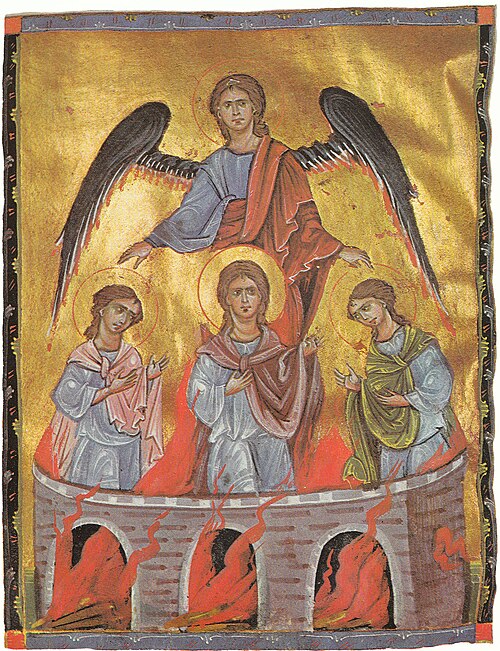
The Hebrew youths cast into the fiery furnace by Nebuchadnezzar and kept unharmed because of their faith.
- Feast
- December 17old style December 30
- Era
- unknown
- Order
- The Righteous
Life
The Holy Three Youths, Ananias, Azarias and Misael, were young Hebrews of the Babylonian captivity, friends of the Holy Prophet Daniel, who refused to bow down to the golden image of King Nebuchadnezzar and were cast into a burning furnace, from which they came out unharmed. In Babylon they were given the names Shadrach, Meshach and Abednego. Their song in the furnace entered the services of the Church, and the Orthodox Church celebrates them on 17 December together with the Holy Prophet Daniel.
At the court of Babylon
Their story is told in the first chapters of the Book of the Prophet Daniel (sixth century before Christ), and the Jewish historian Josephus retells it without significant changes in his Jewish Antiquities. After the conquest of Jerusalem, King Nebuchadnezzar II ordered Ashpenaz, the master of his eunuchs, to choose from the children of Israel, of royal and noble descent, young men without blemish, handsome, wise and learned, fit to serve in the palace, and to teach them for three years the writing and language of the Chaldeans. Among them, of the tribe of Judah, were Daniel, Ananias, Misael and Azarias. The master of the eunuchs changed their names: Daniel he called Belteshazzar, Ananias Shadrach, Misael Meshach and Azarias Abednego.
The king had assigned them food and wine from his own table, but the four youths would not defile themselves with it. The worried master of the eunuchs soon found that the youths, living on vegetables, were fairer and healthier than all the rest. After three years, when they were brought before the king, he found them ten times wiser than all the magicians and astrologers in his realm, and they entered the service of the court.
The king's dream
In the second year of his reign Nebuchadnezzar had a dream and demanded that the wise men of Babylon tell him both the dream and its meaning, threatening them all with death if they could not. The danger threatened the four Hebrew youths as well. They prayed to God, and He revealed the dream to Daniel: a huge image with feet of clay. After the interpretation the king set Daniel over the whole province of Babylon and over all its wise men, and placed his three friends over the affairs of the province.
The golden image
Later the king set up an image of gold and commanded all his subjects to fall down and worship it as soon as they heard the sound of the instruments; whoever did not worship would be cast into the burning fiery furnace. The three youths did not bow down, because this was against their faith, and their enemies at once denounced them to the king. Nebuchadnezzar ordered them once more to worship, but they answered that their God whom they served was able to deliver them from the furnace and from the king's hand, and that even if He did not, they would still not serve his gods or worship the golden image.
Enraged, the king ordered the furnace heated seven times hotter and had them thrown into it bound. The flame was so fierce that it killed the men who had thrown the youths in.
The miracle in the furnace
The Greek text of the Old Testament (the Septuagint), followed by the Orthodox Church, also preserves what happened inside. The youths walked in the midst of the flame, praising God. Azarias prayed in the midst of the fire, blessing the God of the fathers, confessing that all His judgements were just and that the people had been delivered into the hands of their enemies for their sins, and asking that, in the absence of sacrifices, they might be accepted with a contrite heart and a humble spirit. The king's servants did not cease to stoke the furnace with pitch, tow and brushwood, and the flame rose forty-nine cubits above it and burned the Chaldeans around it. But the angel of the Lord came down into the furnace, drove the flame out and made the midst of the furnace like a moist whistling wind, so that the fire did not touch them at all. Christian tradition holds that this angel was the Archangel Michael.
Then the three, as with one mouth, sang, blessing and glorifying God, calling on all the works of the Lord, the heavens and the waters, sun and moon, fire and frost, mountains and seas, birds and beasts, the children of men, the priests and the righteous of the Lord, to praise and exalt Him for ever. At the end they called on themselves, Ananias, Azarias and Misael, to praise Him, for He had brought them out of Hades and delivered them from the midst of the burning fiery furnace.
Astonished, the king rose in haste and told his counsellors that he had seen three men cast in bound, but now saw four, loosed, walking in the fire unharmed, and the fourth was like a son of God. He called them to come out. The officials saw that the fire had had no power over their bodies, that not a hair of their heads was singed, their garments were unchanged and not even the smell of fire was on them. Then Nebuchadnezzar blessed the God of Shadrach, Meshach and Abednego, who had sent His angel and delivered His servants, promoted the three youths again and proclaimed to all peoples the signs and wonders of the Most High God.
The Song of the Three Youths
The Prayer of Azarias, the account of the deliverance and the hymn of praise of the three youths, sixty-seven verses in all, are found in the Septuagint and in the ancient Syriac, Coptic, Ethiopic and Old Latin versions, between verses 23 and 24 of the third chapter of the Hebrew text. Jewish tradition regards them as an apocryphal addition, and Protestants did not accept them, but they belong to the canon of the ancient Churches. The Fourth Council of Toledo in 633 said that singing the Song of the Three Youths at Sunday services and on feasts of martyrs was an ancient custom received throughout the world.
In the Orthodox Church their prayer and hymn underlie the seventh and eighth odes of the canons of Matins, and at the Liturgy of Holy Saturday the story of the three youths is read and the hymn “Praise the Lord and exalt Him above all for ever” is sung. Many Fathers saw in the furnace that did not burn the youths an image of the Mother of God, who bore God without being consumed, and an image of the Incarnation.
The scholars
Some biblical scholars hold that the first six chapters of Daniel were composed in the late Persian or early Hellenistic period and that the story of the furnace, in which Daniel does not appear, may originally have been independent. It forms a pair with the story of Daniel in the lions' den, both showing that God delivers those who are faithful to Him.
Commemoration
The Orthodox Church celebrates the Holy Three Youths, Ananias, Azarias and Misael, on 17 December together with the Holy Prophet Daniel, and they are also remembered on the Sunday of the Holy Forefathers before the Nativity of Christ.
Commemorated the same day December 17
 DanielProphet · The ProphetDec 17
 BeggaVenerable · Founder of Andenne AbbeyDec 17
 AzariahProphet · Old Testament prophetDec 17
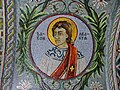 Avakum the DeaconNew Martyr · Deacon of Moštanica MonasteryDec 17
- Sergius FlorinskyHieromartyr · Archpriest at RakvereDec 17
- Hadji-Georgis the AthoniteVenerable · Monk from CappadociaDec 17
- Michael the SynkellosVenerable · Confessor of ConstantinopleDec 17
- Abramius of EleutheropolisMartyrDec 17
- Alexander SavelovHieromartyrDec 17
- AnaniasMartyr · Youth of BabylonDec 17
- AnthonyHoly VenerablesDec 17
- BriarchVenerableDec 17