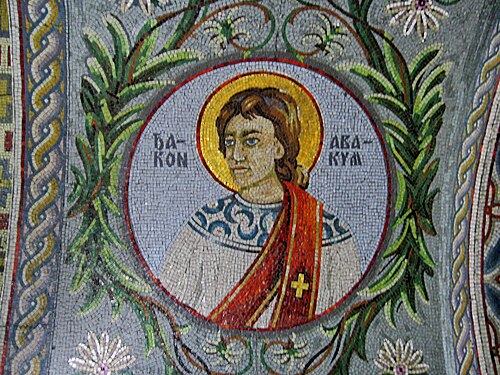
New Martyr
Avakum the Deacon
Deacon of Moštanica Monastery
Monk-deacon of Moštanica who joined Hadži-Prodan's rebellion, and died a martyr in 1814 for refusing to renounce his faith.
- Feast
- December 17old style December 30
- Reposed
- 181419th century
- Place
- Belgrade
- Order
- Martyrs
Life
Saint Avakum the Deacon (baptismal name Lepoje Prodanović, 1794 - 30 December 1814) was a Serbian monk and deacon of the Moštanica monastery, who joined the rebellion of Hadži-Prodan and was put to death as a new martyr at Belgrade for not renouncing the Christian faith. The Serbian Orthodox Church placed him among the saints and commemorates him on 17 December by the old calendar (30 December by the new), with special veneration in the village of Trnava. The sources speak also of a companion in martyrdom, Abbot Pajsije.
Beginnings
The name Avakum is the Serbian form of the Greek name Avvakoum, that is, Habakkuk. He was born in 1794 in Knešpolje, below Kozara (near the Moštanica monastery, in the Bosnia eyalet), of father Gavrilo and mother Božana. When he was young he lost his father, and his mother took him to the Moštanica monastery. There, with the confessor Đenadije (or Genadije) Šuvak, he learned to read and prepared for monastic life, then was tonsured, and became a deacon. After the Turks put down in blood, in 1809, the rising in the region, and after Ottoman pressure to pay fines, the Serbian population began to move: Abbot Genadije, with his son Stojan, Deacon Avakum and his mother left Moštanica, which was to be destroyed, and walked across Bosnia to the Trnava monastery near Čačak, to Abbot Pajsije Ristović, who had lived there alone until then. They helped Pajsije with the work. Avakum is described as young and beautiful.
The rebellion and martyrdom
After the failure of the First Serbian Uprising in 1813, the Ottomans began a reign of terror over the Serbs. The people decided to try another revolt, this time under Hadži-Prodan Gligorijević. Among the organizers were the clergy of Trnava: Abbot Pajsije, Hieromonk Genadije, Deacon Avakum and Priest Radovan Vujović. The rebellion was quickly put down, with the help of the former rebel leader Miloš Obrenović, who rightly thought that the time for a revolt had not come. In the suppression, the Turks seized some three hundred prominent Serbs and killed them, by beheading or impalement. Among those seized were Abbot Pajsije, Abbot Genadije, his son Stojan and Deacon Avakum, who were taken to Belgrade and chained in the Nebojša tower beneath Kalemegdan. Abbot Pajsije was impaled at once, with many others, as an example to the rest of the disobedient population of the Belgrade pashalik. Then came the turn of Abbot Genadije and his son Stojan and of Deacon Avakum.
Before they were led out of the dungeon, the Turks offered the captive Serbs to convert to Islam and so save their heads. In fear for his own life and his son's, Abbot Genadije accepted, taking the name Mula Salija, and his son Stojan Redžep. Avakum refused. According to the popular tradition, preserved in epic songs, the saint answered that no faith is better than the Christian, that the Serb is Christ's and rejoices in death, that the terrible judgment awaits the Turks too, and that they should do as they pleased, for God is witness, and His justice.
It is said that Avakum sang these words aloud even as the Turks led him to the Stambol gate (today the area around the National Theatre in Belgrade), where executions were carried out in those days. When, carrying on his shoulder the stake on which he was to be impaled, he came to the plateau in front of the entrance to the Belgrade fortress, his poor mother came to meet him, wishing to save her son from torment. Instructed by the Turkish commanders that Avakum would be spared if he went over to Islam, she fell on her knees before him and, weeping, begged him, in the name of the milk with which she had nursed him, to accept Islam and save his young life, for God would forgive him, since he would have done it from great necessity. The son answered her, in the folk song, that he thanked her for the milk, but not for such teaching, that she would soon rejoice in her son when they stood before the face of God, and that death delivers from all troubles, like the spring flower that comes after winter.
According to the people's testimony, seeing that neither his mother's words nor her curses helped, the Turks came to Avakum themselves and, readying the stake, offered him again to turn Turk. Tradition says that Avakum asked them whether Turks ever die, and when they answered yes, he added that blessed is he who dies sooner, for he has less torment and sin. Hearing this, the commander of Belgrade and of the whole pashalik, Suleiman Pasha Skopljak, according to tradition ordered the executioner to kill Avakum quickly, that he might not suffer long on the stake. The English source says that, seeing his fearlessness and faith, the Turks decided to pierce his heart with a knife and not to impale him alive, but dead. He died on 30 December 1814, on the ground between the Warriors' House (Ratnički dom) and the National Theatre, where the Turks carried out executions.
Veneration
The Serbian Orthodox Church proclaimed him a saint and commemorates the day of his death and of his presentation before the Lord on 17 December by the old calendar. The school at Trnava bears the name "Holy Deacon Avakum".
Commemorated the same day December 17
 DanielProphet · The ProphetDec 17
 Ananias, Azarias and MisaelHoly The Righteous · The Three Holy YouthsDec 17
 BeggaVenerable · Founder of Andenne AbbeyDec 17
 AzariahProphet · Old Testament prophetDec 17
- Sergius FlorinskyHieromartyr · Archpriest at RakvereDec 17
- Hadji-Georgis the AthoniteVenerable · Monk from CappadociaDec 17
- Michael the SynkellosVenerable · Confessor of ConstantinopleDec 17
- Abramius of EleutheropolisMartyrDec 17
- Alexander SavelovHieromartyrDec 17
- AnaniasMartyr · Youth of BabylonDec 17
- AnthonyHoly VenerablesDec 17
- BriarchVenerableDec 17