Hieromartyr
Ananias of Lakedaimonia
Metropolitan of Lacedaemonia
Metropolitan of Lacedaemonia, born at Dimitsana, who was martyred in April 1764 before the Orlov revolt.
Life
Saint Ananias the hieromartyr, in the world Anastasios Theofilis-Lambardis, was metropolitan of Lacedaemonia, born at Dimitsana in the Peloponnese at the beginning of the eighteenth century, and martyred at Mystras in April 1764, shortly before the Russian-backed revolt in the Morea. He is regarded as a martyr of the Greek nation. The Orthodox Church commemorates him on 15 April.
Youth and ministry
He was born at Dimitsana in Arcadia, with the name Anastasios. His great-grandfather was the noble Stasinos of Akova, descended from the Palaiologoi, who married Kanella Lambardopoulou of the powerful Lambardis family of Dimitsana. His parents were a granddaughter of the noble Stasinos and Theofilis of Stemnitsa. He was educated at the Philosophou monastery and before 1741 was made bishop of Karyoupolis in Mani. In 1747 he took the see of archbishop of Dimitsana, which was then an independent archdiocese. When in 1750 the metropolitan of Lacedaemonia, Parthenios Kalimeris, died, Ananias received that diocese as well. It is said that he had a country house near the springs of the river Loussios, where he is thought to have gone to meet his associates. In 1754 he rebuilt the metropolis at Mystras, putting up at his own expense a new metropolitan building, as an inscription with an epigram and the date 1754 shows.
Preparing the movement for liberation
Through the powerful families from which he came, he also distinguished himself in political life and rose to the office of morayannis (the ayan of the Morea), one of the leaders of local self-government, elected from the families of notables. From this position and thanks to his prestige he worked at preparing a liberation movement. Under the pretext of household crafts he founded at Dimitsana the first gunpowder mills, which supplied the later uprisings. He built there, at his own expense, an aqueduct, to which the place name "the Despot's Fountain" at the entrance to the town is due. In some districts of the Peloponnese he created a network of priests initiated into the uprising, among them Bishop Anthimos Karakallos, Neophytos Deligiannis of Langadia, bishop of Zarnata and Akova, Parthenios of Old Patras, Makarios of Corinth and others. For the same purpose he worked with notables such as P. Benakis, Androutsos Zaimis, Londos, Polos and Sisinis, and he came to understandings with the klephts. In 1754 he helped found the bishopric of Zarnata and Akova, with Neophytos Deligiannis as metropolitan, a man of his full trust.
The martyrdom
At that time the vizier of the Peloponnese was the mild Topal Osman Pasha, against whom other Turkish officials reacted, going to Constantinople and demanding his transfer. The Greek notables took the vizier's side, and five of them, headed by Ananias, also went to Constantinople in 1762: Petros Deligiannis, an uncle of Asimakis Zaimis, Krevvatas (grandfather of Panagiotis Krevvatas) and an uncle of Panoutsos Notaras. They succeeded in keeping Topal Osman Pasha in his post and in obtaining the death sentence of the aghas who had moved against him, which raised the morale of the enslaved.
But after two years the cruel Hamza Pasha of Karystos was installed in his place as vizier of the Peloponnese, and the fanatical Turks found an opportunity to incriminate Ananias and the other four envoys and to bring about the issue of a secret firman condemning them to death. In 1764 Deligiannis, Zaimis, Krevvatas and Notaras, found at the vizier's seat at Tripolitsa, were hanged, while Ananias was at Mystras. A body of 150 horsemen was sent against him, but Ananias was secretly warned by a special messenger. In the metropolis at Mystras twenty Maniots and ten men of Dimitsana defended him for nine days, until their supplies were exhausted. So after twelve were killed, the rest managed to escape while Ananias remained to suffer death. He prayed and received communion of the Immaculate Mysteries and then was beheaded, in the church or in his room. The Turks brought his head to the vizier, and his body was buried at Mystras. With Ananias his dragoman was also executed, as morayannis. These things happened in April 1764.
After the execution of Ananias, the Turks turned against his relatives and other Christians to suppress the movement at its birth. Through the patriarchate they deposed Neophytos Deligiannis, bishop of Zarnata, whose father, Petros Deligiannis, had been hanged earlier. The murder of Ananias and the lament of his sister Eugeniki, wife of Georgakis Philosophopoulos, is recalled in a folk song preserved by T. Kandiloros: a fair-haired, dark-eyed girl sitting outside the town takes out her florins and pearls and asks why they cut down Lord Ananias and the metropolitan.
Commemorated the same day April 15
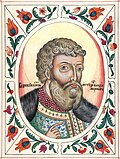 Mstislav the GreatRight-Believing · Grand Prince of KyivApr 15
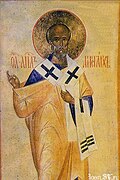 AristarchusApostle · Apostle of the SeventyApr 15
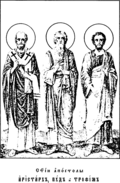 Trophimus the EphesianApostle · Apostle of the SeventyApr 15
 PudensApostleApr 15
- Felix of ByzantiumSaint · Bishop of ByzantiumApr 15
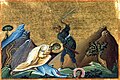 Basilissa and AnastasiaMartyr · Martyrs of RomeApr 15
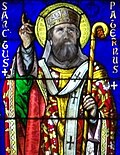 Padarn of WalesSaint · British abbot-bishopApr 15
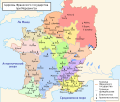 Abbo II of MetzSaint · Bishop of MetzApr 15
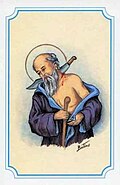 Maro of PicenumHieromartyr · Martyr of PicenumApr 15
 Daniel of AchinskRighteousApr 15
 Sukias the AlanVenerable MartyrApr 15
 Leonidas of AthensHieromartyr · Bishop of AthensApr 15