Saint
Anatolius of Laodicea
Bishop of Laodicea
Syro-Egyptian mathematician and bishop of Laodicea on the Syrian coast from 268, who died in 283.
Life
Saint Anatolius was bishop of Laodicea, on the Syrian coast, from 268, a scholar of Alexandria, mathematician and a noted computer of Easter. He fell asleep on 3 July 283. His feast is on 3 July.
He was born and raised at Alexandria, in Egypt, in the early third century. Before becoming one of the great lights of the Church he enjoyed great prestige at Alexandria, where, it is said, he was also a senator. According to Eusebius of Caesarea, he had rich knowledge of arithmetic, geometry, physics, rhetoric, dialectic and astronomy and was thought worthy to maintain the Aristotelian school at Alexandria; the pagan philosopher Iamblichus was among his disciples. Fragments survive of ten books on arithmetic written by him, a nearly complete work known as the Introduction to Arithmetic. He also wrote a work on the time of the celebration of Easter, in which he set a nineteen-year paschal cycle, preserved in seven medieval manuscripts of the Latin text De ratione paschali; he is regarded as the beginner of the Alexandrian paschal computation, which lasted over a thousand years, until the calendar reform of 1582. For reckoning the date of Easter he relied on the Book of Enoch.
Eusebius tells how Anatolius put an end to a revolt in the Bruchion, a quarter of Alexandria, held by the forces of Zenobia and besieged by the Romans, whose inhabitants were dying of hunger. Anatolius, who lived there, agreed with the besiegers to receive all the women, children and old people, while letting those who wished leave; this broke the defence, and the rebels surrendered. Later he went to Palestine, where the aged Theotecnus of Caesarea ordained him assistant bishop, with a view to his succeeding him. On his way to Antioch, to the council that was to judge the teaching of Paul of Samosata, he passed through Laodicea, left without a bishop after the death of Eusebius, and the people made him bishop. It is not known for certain whether his friend Eusebius had died or whether they shepherded together. His time of flourishing is placed between 250 and 275.
Commemorated the same day July 3
 Leo II of RomeSaint · Bishop of RomeJul 3
 Anatolius of ConstantinopleSaint · Patriarch of ConstantinopleJul 3
 Hyacinth of CaesareaMartyr · Martyr of CaesareaJul 3
 Heliodorus of AltinoSaint · First bishop of AltinumJul 3
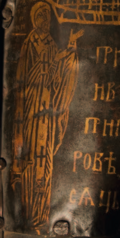 Basil KalikaSaint · Archbishop of NovgorodJul 3
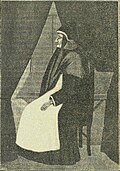 Euphrosyne of KolyupanovoFool-for-Christ · Fool for Christ and hermitJul 3
 Germanus of ManSaint · First bishop of the Isle of ManJul 3
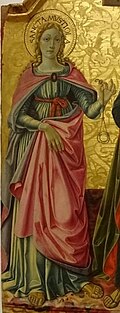 MustiolaMartyr · Martyr of ChiusiJul 3
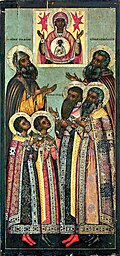 Basil Vsevolodovich of YaroslavlRight-Believing · Prince of YaroslavlJul 3
 Anatolius the RecluseVenerable · Recluse of the Kiev CavesJul 3
 John of YarenskVenerableJul 3
 Longinus of YarenskVenerableJul 3