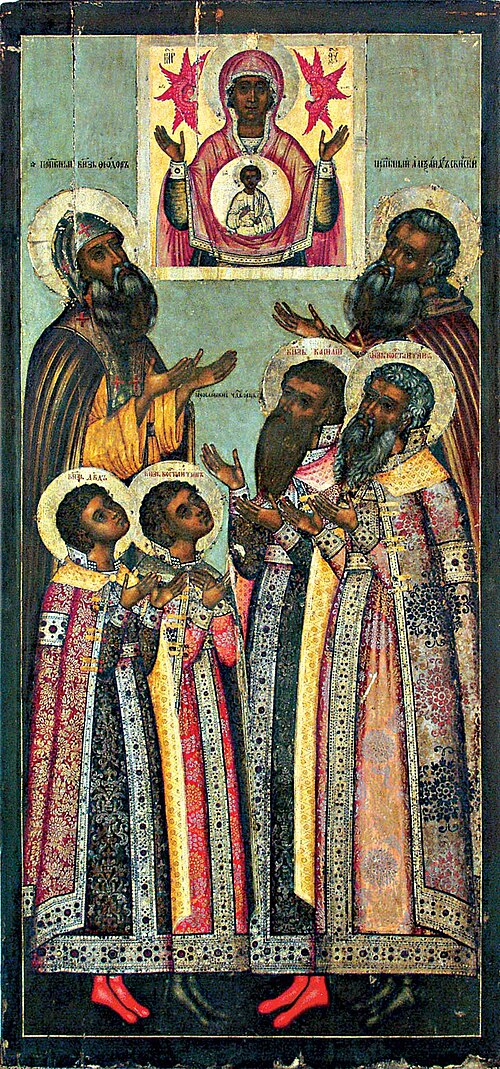
Right-Believing
Basil Vsevolodovich of Yaroslavl
Prince of Yaroslavl
Second prince of Yaroslavl, elder son of Vsevolod Konstantinovich, named in chronicles from 1238; died in 1249.
- Feast
- July 3old style July 16
- Reposed
- 124913th century
- Place
- Vladimir
Life
The holy right-believing Prince Vasily Vsevolodovich was the second prince of Yaroslavl, the elder son of Vsevolod Konstantinovich, and died in 1249, at Vladimir, on a visit to the grand prince. He is honoured together with his brother, Constantine, in the Russian Church. Our calendar gives four days: 23 May, 8 June, 3 July and 15 July.
The prince
He was born in 1229 at the latest. He is first mentioned in the chronicles in the year 1238, as one of the princes "saved from Batu's sword". Having become ruler after his father's death in the battle with the Mongol-Tatars on the river Sit, in 1238, he went with the other princes to the Horde "for his patrimony", that is, to be confirmed in the principality of Yaroslavl by the khan's will, and Batu let him go with honour. After that he went twice more to the Horde: in 1244, with his uncle, Vladimir Konstantinovich of Uglich, again "for the patrimony", as in 1239, and in 1245, with the grand prince Yaroslav Vsevolodovich, on an occasion not known.
From his marriage to Xenia, of unknown origin, he had a son, Vasily, mentioned in the year of his father's death and of whom nothing more is known, and a daughter, Anastasia, by whose hand the throne of Yaroslavl passed to the prince of Smolensk and Mozhaisk, Fyodor Rostislavich. He died in 1249, at Vladimir, on a visit to the grand prince. At the funeral of their kinsman were Alexander Nevsky, the princes of Rostov and Beloozero, Boris and Gleb Vasilkovich, with their mother. He was buried by Bishop Cyril of Rostov at Yaroslavl, in the Dormition cathedral. His daughter Anastasia was married to the prince of Smolensk, Fyodor Rostislavich, who became prince of Yaroslavl on the extinction of the male line of the local dynasty.
Veneration
He was canonized, like his brother Constantine, after the finding of their relics in 1501, following a fire at the Dormition cathedral in Yaroslavl, where they had been buried. The relics became the chief holy treasure of the cathedral, together with the Yaroslavl icon of the Mother of God, brought to the city, by tradition, by the two brothers. In 1744, through the carelessness of those who put out candles, which were laid in a box near the tomb with the relics, the relics burned with the shrine and the wooden canopy. The surviving relics were gathered and kept in a new silver shrine, on the same spot.
The Russian Church honours them as holy right-believing princes, their commemoration being kept on 3 (16) July, the day of Constantine's death, and on 23 May (5 June), together with the synaxis of the saints of Rostov and Yaroslavl.
Commemorated the same day July 3
 Leo II of RomeSaint · Bishop of RomeJul 3
 Anatolius of ConstantinopleSaint · Patriarch of ConstantinopleJul 3
- Anatolius of LaodiceaSaint · Bishop of LaodiceaJul 3
 Hyacinth of CaesareaMartyr · Martyr of CaesareaJul 3
 Heliodorus of AltinoSaint · First bishop of AltinumJul 3
 Basil KalikaSaint · Archbishop of NovgorodJul 3
 Euphrosyne of KolyupanovoFool-for-Christ · Fool for Christ and hermitJul 3
 Germanus of ManSaint · First bishop of the Isle of ManJul 3
 MustiolaMartyr · Martyr of ChiusiJul 3
 Anatolius the RecluseVenerable · Recluse of the Kiev CavesJul 3
 John of YarenskVenerableJul 3
 Longinus of YarenskVenerableJul 3