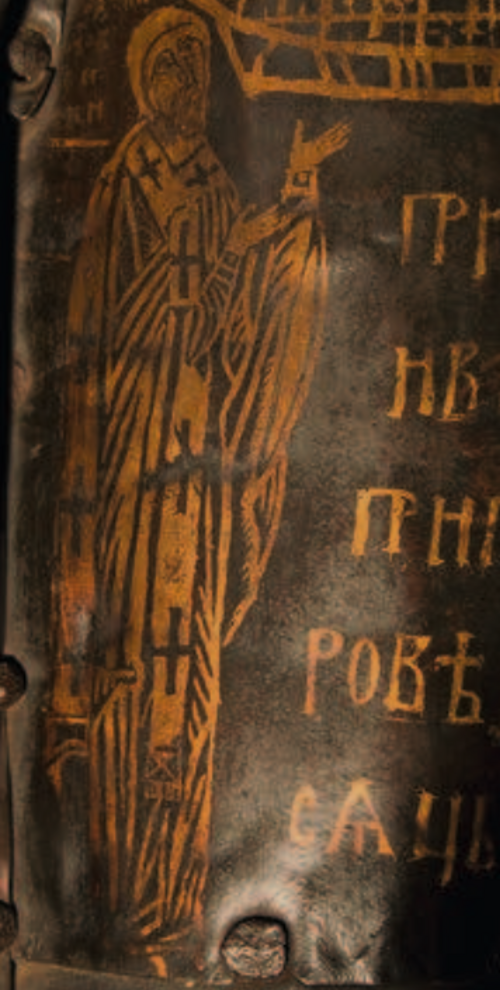
Saint
Basil Kalika
Archbishop of Novgorod
Archbishop of Novgorod and Pskov from 1330 to 1352, who strengthened the office after the Mongol invasion.
Life
Saint Basil Kalika was Archbishop of Novgorod and Pskov from 1330 to 1352. A former parish priest and pilgrim to the Holy Land, he shepherded Novgorod through hard times as the city's advocate before the grand princes of Moscow, a peacemaker in its quarrels, and a builder of walls, bridges and churches. He died in 1352 after going to pray for plague-stricken Pskov, and his relics rest in the Cathedral of Holy Wisdom in Novgorod.
Origins and pilgrimage
His baptismal name was Gregory, and before his archiepiscopate he was a priest of the Church of Saints Cosmas and Damian on Slavna Street, north of the Novgorod citadel. The name Kalika means "pilgrim" in Old Russian and shows that he made a pilgrimage to the holy places of the East.
He mentions this journey himself in his famous "Epistle on Paradise", written in 1347 to Bishop Theodore of Tver and preserved in two Russian chronicles. In one redaction of the Novgorod First Chronicle his name appears as Kaleka, meaning "lame", and so he is sometimes called Basil the Lame, but most scholars regard Kalika as the correct form.
Election and consecration
Basil was elected by the Novgorod veche after the retirement of Archbishop Moses. At the time of his election he was a monk of the Holy Angels Monastery in Novgorod. The following year he was sent to Vladimir-in-Volhynia, where Metropolitan Theognostus was then residing, to be consecrated.
At that time the people of Pskov wished to separate from Novgorod and have a bishop of their own. They chose a certain Arseny and sent him to the metropolitan for confirmation, and Grand Duke Gediminas of Lithuania and Prince Alexander Mikhailovich of Pskov urged Theognostus to accept him. The metropolitan did not divide the diocese and consecrated Basil, Novgorod's choice, as Archbishop of Novgorod and Pskov. According to a Greek register, Basil was canonically chosen from among three candidates by a council of bishops in Volhynia.
The journey home
In 1331, on his way back from Vladimir-in-Volhynia, Basil escaped a pursuit organized by Gediminas thanks to a warning from Theognostus. Near Chernigov, however, Prince Fyodor of Kiev, with Tatar baskaks and a band of fifty men, attacked the party, took a ransom and carried off the metropolitan's protodeacon Ratislav as a captive.
At the same time Basil made an agreement with Fyodor that his nephew Gleb (Narimantas), son of Gediminas, would be received into Novgorod's service, the first prince from outside the house of Rurik to be accepted there. The historian Karamzin doubted that a promise made under threat would have been kept and regarded the invitation of Narimantas as the free decision of the Novgorodians.
Defender of Novgorod before Moscow
His episcopate fell in difficult years. Novgorod, which had only just defended itself against the princes of Tver with Moscow's help, now began to suffer from Moscow itself. Grand Prince Ivan Kalita demanded the silver the Novgorodians had brought back from their trade beyond the Kama, and when they refused, in 1333 he seized Bezhetsk and Torzhok with other princes and began to ravage the country.
Archbishop Basil went to him at Pereslavl to seek peace but could not appease him, and the grand prince left in anger for the Horde. Facing this danger, the Novgorodians made peace with the prince of Pskov. Basil went to Pskov with his clergy, blessed the people, baptized the prince's son and remained his teacher; it was the first visit of a Novgorod archbishop to Pskov in seven years.
Only in 1334, through the mediation of Metropolitan Theognostus, whom he visited in Vladimir, did Basil succeed in reconciling Ivan Kalita with Novgorod. The grand prince came to Novgorod and, pleased with his reception, invited the archbishop and the city's leading men to Moscow to return their hospitality.
In 1337 the quarrels with Moscow began again. Basil went once more to Pskov for support, but this time he was received very coldly; the people of Pskov refused him even the customary court dues, and he left, pronouncing a curse on the city, as Metropolitan Theognostus had done before him.
Walls, bridges and churches
Soon after his consecration, between 1331 and 1333, Basil built a stone wall along the north-eastern side of the Novgorod citadel, beside the river. He renovated the Cathedral of Holy Wisdom, renewing its roof and surrounding it with an iron fence, commissioned icons for it, and in 1335 installed the so-called Vasilyevsky Gates of gilded copper.
By his order the rich treasury of Holy Wisdom gave generously for charity and for the adornment of the city. When in 1337 the floodwaters of the Volkhov destroyed the "Great Bridge" between the two sides of Novgorod, and the dispute between them over a new bridge threatened bloodshed, Basil built the bridge at the expense of the archbishopric. With his own hands he laid the foundation of a new city wall on the other bank of the Volkhov.
A great fire once ravaged both sides of the city, burning houses and shops, forty-eight wooden and three stone churches, the citadel, the archbishop's palace and the Cathedral of Holy Wisdom. Fearing more fires, people fled their homes and lived in the fields or even in boats on the water, and the archbishop could barely calm them with processions and services of prayer. He restored the cathedral walls, roofed it with lead, set up a new iconostasis, helped from his own treasury to restore the burned churches, and rebuilt the "Great Bridge".
Basil was himself an icon painter and adorned the churches with the work of his hands; an icon of Saints Boris and Gleb that he painted for their church is known. He also decorated the Cathedral of Holy Wisdom with Greek-style painting.
Peacemaker of the city
Novgorod was troubled by much unrest and feuding between factions, and the archbishop acted as peacemaker. In 1342, when Ontsifor Lukinich stirred up a riot in the city, Basil and his vicar Boris brought peace between the warring sides. He did the same in 1344, at the election of a new posadnik.
In 1340 he again mediated for peace when Novgorod clashed with Grand Prince Simeon the Proud over the town of Torzhok. Fearing the grand prince's army, the Novgorodians sent Basil with the boyars to ask for peace, which was made at the cost of heavy tribute. Simeon long held a grudge against the Novgorodians; only in 1347, at the invitation of Basil, who had gone to Moscow, did he come to Novgorod and stay there three weeks.
Care for the faith
In 1339 Basil sent his nephew with a Novgorod embassy that made peace with Sweden, seeking to protect the Orthodox Karelians from being killed if they crossed into Novgorod's lands. In 1348 King Magnus Eriksson of Sweden demanded that the Novgorodians debate the true faith with his theologians. The archbishop, in consultation with the posadnik, answered that if the Swedes wished to know which faith was better, they should send to the patriarch in Constantinople, from whom the Russians had received their faith.
Basil was an active pastor rather than a learned theologian. In his "Epistle on Paradise" he sought to show Bishop Theodore that the paradise in which the first people lived still exists somewhere in the East, and he cited testimonies about the place of torment in the West. Some modern scholars have faulted him for not doing enough against the Strigolniki heresy then spreading in Novgorod and Pskov, although his use of church wealth and property ran entirely counter to their teaching.
Honoured by Constantinople
His love for the city and his works of charity earned him the deep respect and affection of the Novgorodians. He was honoured in Constantinople as well: unlike other Russian bishops, he received from the patriarch vestments adorned with crosses and a white klobuk. A whole tale was later written about this white klobuk, meant to exalt Novgorod above Moscow. According to tradition, the white klobuk, of silk adorned with pearls and precious stones, long remained the distinction of the archbishops of Novgorod alone and was later adopted by the metropolitans and patriarchs of Russia.
The final sacrifice
In 1352 the Novgorod government sent him to rebuild the fortress of Orekhov, destroyed in fighting with Sweden; the remains of the stone wall he built there were excavated in 1969 and can still be seen. That same year the Black Death broke out in Pskov and quickly devastated the city.
The people of Pskov, overwhelmed by grief and fear, begged the archbishop, whom they had earlier vexed by their disobedience, to come and pray for them and with them. Basil came at once, served in three churches, led a procession around the city and comforted its people.
There he himself fell ill. He reposed on the way back to Novgorod, on 3 July 1352, at the Monastery of the Archangel Michael at the mouth of the Uza, where it flows into the Shelon. His body was brought to Novgorod and buried in the Martyrius Porch of the Cathedral of Holy Wisdom, where many of his predecessors and successors rest. He was succeeded once more by Archbishop Moses.
Veneration
By the middle of the fifteenth century Basil was already venerated as a local saint, and in 1981 his veneration throughout the Russian Church was confirmed by his inclusion in the Synaxis of the Saints of Novgorod. His relics rest in the Cathedral of Holy Wisdom in Novgorod. He is commemorated on 3 July, the day of his repose, on 10 February and 4 October with the Synaxis of the Hierarchs of Novgorod, and on the third Sunday after Pentecost with the Synaxis of the Saints of Novgorod.
Commemorated the same day July 3
 Leo II of RomeSaint · Bishop of RomeJul 3
 Anatolius of ConstantinopleSaint · Patriarch of ConstantinopleJul 3
- Anatolius of LaodiceaSaint · Bishop of LaodiceaJul 3
 Hyacinth of CaesareaMartyr · Martyr of CaesareaJul 3
 Heliodorus of AltinoSaint · First bishop of AltinumJul 3
 Euphrosyne of KolyupanovoFool-for-Christ · Fool for Christ and hermitJul 3
 Germanus of ManSaint · First bishop of the Isle of ManJul 3
 MustiolaMartyr · Martyr of ChiusiJul 3
 Basil Vsevolodovich of YaroslavlRight-Believing · Prince of YaroslavlJul 3
 Anatolius the RecluseVenerable · Recluse of the Kiev CavesJul 3
 John of YarenskVenerableJul 3
 Longinus of YarenskVenerableJul 3