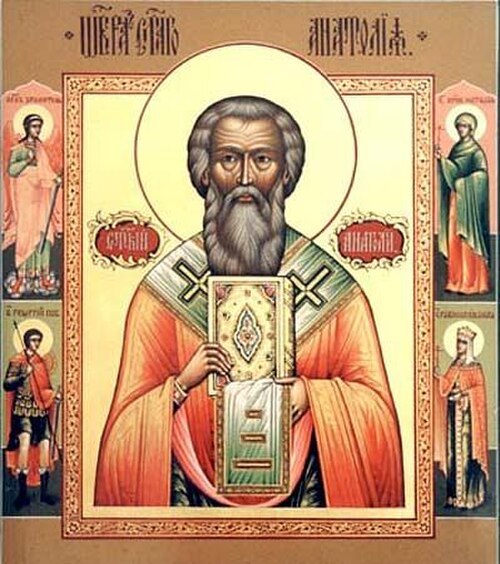
Saint
Anatolius of Constantinople
Patriarch of Constantinople
Patriarch of Constantinople from 449 to 458, in whose time the Council of Chalcedon was held.
Life
Saint Anatolius, hierarch, was archbishop and then patriarch of Constantinople between 449 and 458, in whose time the Fourth Ecumenical Council was held at Chalcedon. He is honoured by the Orthodox and Catholic Churches and commemorated on 3 July.
Life
He was born at Alexandria. He was ordained deacon by Saint Cyril of Alexandria and took part in the Third Ecumenical Council at Ephesus, in 431. Cyril sent him to Constantinople as representative (apocrisiarius) of Alexandria at the court, for his learning. After the Second Council of Ephesus (449, called the “Robber Council”) deposed Flavian, he became archbishop of Constantinople, through the influence of Dioscorus of Alexandria and the emperor Theodosius II. Suspected of Eutychianism, Anatolius publicly condemned the teachings of Eutyches and Nestorius and subscribed to the letters of Cyril against Nestorius and of Pope Leo I against Eutyches. He drew away from Dioscorus’ influence.
After Theodosius’ death, in 450, the new policy of Marcian and Pulcheria supported revising the decisions of 449 and understanding with Pope Leo. Anatolius accepted the “Tome to Flavian” and supported preparation of a new council. He took part in the Council of Chalcedon, in October-November 451, presided with the pope’s legates and supported the definition of one Christ in two natures. The council deposed Dioscorus, restored Flavian to the diptychs among the saints and rejected the decisions of 449. By the famous canon 28, passed at the close of the council, Constantinople was granted rank equal to Rome, “second in honour and power to the bishop of Rome”, and the right to ordain the metropolitans of Pontus, Asia and Thrace. This caused a controversy with Pope Leo, who accepted the definition of faith but not canon 28, complaining to the emperor, to Pulcheria and to Anatolius. The third canon of the council of 381 had already said that the bishop of Constantinople has the prerogative of honour after the bishop of Rome, because it is New Rome.
Anatolius helped build new churches and bring to Constantinople the relics of martyrs. On 7 February 457 he crowned the emperor Leo I, the first coronation of a Byzantine emperor by the patriarch. In 458 he convened a local council at Constantinople, which renewed the decisions of Chalcedon and annulled the election of the Monophysite Timothy the Cat as bishop of Alexandria. When near death he was healed by Saint Daniel the Stylite, who came to see him. It is also said that Dioscorus’ followers were responsible for his death, on 3 July 458. Some hymns are attributed to him, and the introduction of hymn-singing into the Liturgy.
Commemorated the same day July 3
 Leo II of RomeSaint · Bishop of RomeJul 3
- Anatolius of LaodiceaSaint · Bishop of LaodiceaJul 3
 Hyacinth of CaesareaMartyr · Martyr of CaesareaJul 3
 Heliodorus of AltinoSaint · First bishop of AltinumJul 3
 Basil KalikaSaint · Archbishop of NovgorodJul 3
 Euphrosyne of KolyupanovoFool-for-Christ · Fool for Christ and hermitJul 3
 Germanus of ManSaint · First bishop of the Isle of ManJul 3
 MustiolaMartyr · Martyr of ChiusiJul 3
 Basil Vsevolodovich of YaroslavlRight-Believing · Prince of YaroslavlJul 3
 Anatolius the RecluseVenerable · Recluse of the Kiev CavesJul 3
 John of YarenskVenerableJul 3
 Longinus of YarenskVenerableJul 3