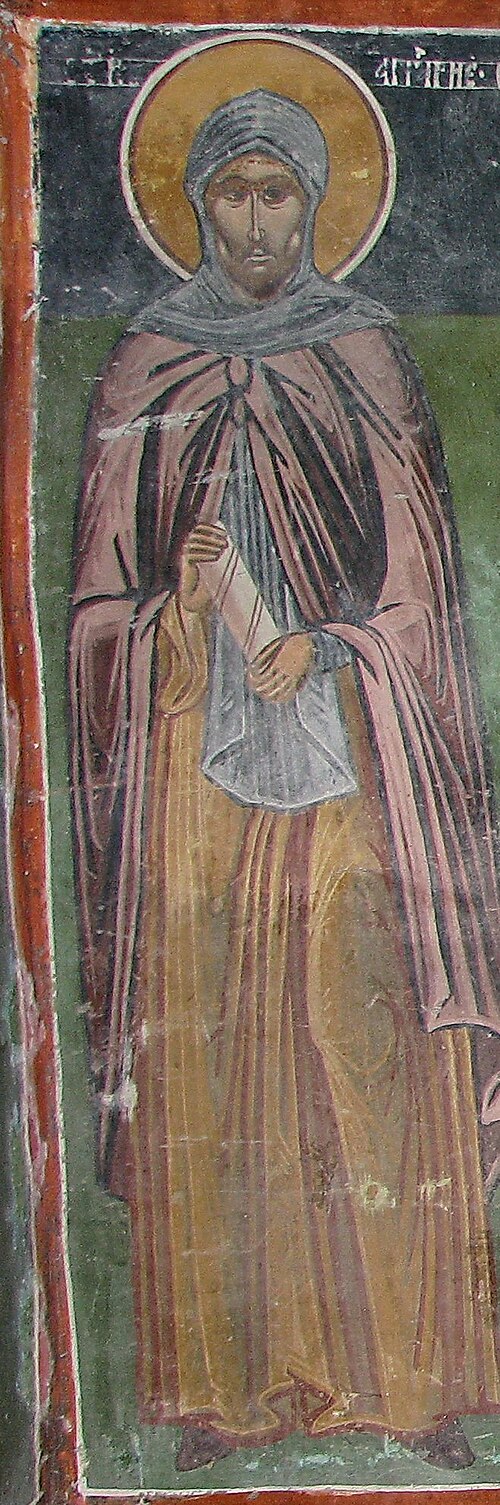
Venerable
Angelar
Disciple of Saints Cyril and Methodius
Bulgarian scholar, disciple of Saints Cyril and Methodius and Slavic enlightener, who died in 886.
- Feast
- July 27old style August 9
- Reposed
- 8869th century
- Place
- Pliska
- Order
- Venerables
Life
Saint Angelar, the Venerable (in Slavonic Angelarii, in Bulgarian Angelari, died about 886), was a disciple and fellow worker of Saints Cyril and Methodius in Great Moravia and Pannonia and afterwards a scholar in Bulgaria. He is counted one of the Seven Saints (the Sedmochislenitsi), the group of close disciples of the two brothers from Thessalonica, commemorated on 27 July. Very little is known of his life, and the sources show more a name than a biography.
Disciple of the holy brothers
The name Angelar, more common in the Western Christian world, shows that he was probably a native of Great Moravia or Pannonia. The fact that the Life of Saint Clement names him among the distinguished disciples of Cyril and Methodius shows he took an active part in the work of writing and translating of the Moravian mission, at least in the time of Methodius's archbishopric, though his works are not known. The text says nothing of his church rank. According to the Bulgarian sources, in 868 at Rome he and Sava were ordained deacons by Bishops Formosus and Gauderic, while Gorazd, Clement and Naum were ordained priests by the same bishops.
After Methodius's death, in 885, Pope Stephen V forbade the use of the Slavic liturgy, and the Frankish bishop Wiching, Methodius's successor, drove the disciples of the two brothers out of Great Moravia. Angelar entered, with Gorazd, Clement and Naum, the group of Slavic clergy who, by order of Wiching and Prince Svatopluk I, were thrown into prison. There the prisoners' chains broke three times, miraculously. Taken out of the prison, except Gorazd, they were cruelly beaten, stripped and, under guard of German soldiers who constantly threatened them with death, driven out of the capital of Great Moravia, Velehrad.
In Bulgaria
With great hardship and want they reached Sirmium (today Sremska Mitrovica) and crossed the Danube at Belgrade, then a Bulgarian frontier fortress. The governor of the city, the boritarkan, who knew of the wish of Prince Boris of Bulgaria, equal to the apostles, to have Slavic priests in Bulgaria, received them warmly and soon sent them on to the capital of the Bulgarian state, Pliska, where the exiles found shelter in distinguished houses. Angelar lived in the house of the boyar Chesslav, but because of the sufferings and want he had endured he soon fell asleep. The place of his burial is not known.
Theophylact of Ohrid, in the Long Life of Saint Clement, written in the second half of the eleventh century, is the first medieval author to mention him. He writes that the two brothers found the Slavic alphabet, translated the Scriptures from Greek into Bulgarian and strove to give divine knowledge to their more capable disciples. Among these chosen ones and "leaders of the choir" were Gorazd, Clement, Naum, Angelar and Sava. After the expulsion from Great Moravia, Clement, with Naum and Angelar, reached Belgrade. There they appeared before the boritarkan and told him all about themselves. He, understanding that they were great men and close to God, sent them to the ruler of Bulgaria, Boris. Boris received them with honour, thanked God for having sent benefactors to Bulgaria, clothed them in vestments suitable for priests and ordered that they be given dwellings set apart for his first friends. Chesslav's house was sanctified by Angelar's stay, but Chesslav could not enjoy his presence among the living for long, for Angelar lived with him a time and fell asleep, not without joy, in the arms of the holy angels.
His veneration
There the account of Angelar ends, and Theophylact omits even his burial. The account lacks the enthusiasm and praises usual in a saint's life. Angelar has no life of his own, service, day of commemoration in the calendars, veneration or iconography separate from those of the Seven Saints, nor any medieval word of praise. His name is not found in any Old Bulgarian writing of the ninth and tenth centuries, and the date of his death does not enter the Bulgarian church calendar. Some authors doubt that Angelar existed at all. The veneration of the Seven Saints is believed to have been established in the first half of the thirteenth century by Archbishop Demetrios Chomatianos of Ohrid. Angelar's veneration at Ohrid rests on his mention in the Life of Saint Clement of Ohrid.
According to Bulgarian tradition, the relics of Angelar and Gorazd are kept at Belgrade, that is, today's Berat, in the old region of Kutmichevitsa. The Bulgarian Orthodox Church, like the Catholic Church, has set 27 July as the day of the Dormition of Saint Clement of Ohrid and of the Seven Saints. A peak in Antarctica bears the name Angelariy Peak, after the Bulgarian scholar Angelariy, disciple of Saints Cyril and Methodius.
Commemorated the same day July 27
 SethRighteous · The ForefatherJul 27
- Aurelius and NataliaHoly MartyrsJul 27
 Clement of OhridEqual-to-the-Apostles · Bishop of OhridJul 27
 PanteleimonGreat Martyr · The HealerJul 27
 Herman of AlaskaVenerable · Missionary to AlaskaJul 27
 Gorazd of MoraviaSaint · Disciple of St. MethodiusJul 27
 Ambrose of SarapulHieromartyr · Bishop of Sarapul and YelabugaJul 27
 Maurus, Pantalemon and SergiusHoly Martyrs · Martyrs of BisceglieJul 27
- Anthusa of MantineaVenerable · Abbess in ConstantinopleJul 27
 Platon GornykhHieromartyr · PriestJul 27
- John SolovyovHieromartyr · PriestJul 27
- 153 Martyrs of ThraceHoly MartyrsJul 27