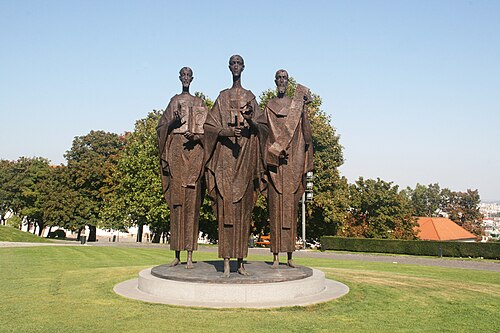
Saint
Gorazd of Moravia
Disciple of St. Methodius
Cleric of Great Moravia, disciple of Sts. Cyril and Methodius, named by Methodius as his successor.
Life
Saint Gorazd was a cleric of Great Moravia in the ninth century, one of the most prominent disciples of Saints Cyril and Methodius, the Apostles of the Slavs. He was named by Methodius as his successor, but could not take over the leadership of the Church of Moravia. With Clement of Ohrid, Naum, Angelarius and Sava, he belongs to the group of the Seven Apostles, commemorated in the Eastern Church on 27 July.
According to a testimony attributed to Methodius, Gorazd came from a noble family. Scholars hold that he was born in Moravia, in the land of present-day Slovakia near Nitra, and credit him with a good knowledge of the local Slavic tongue, Latin and Greek. He was among the disciples of Cyril and Methodius, who were sent from Byzantium at the invitation of Duke Rastislav. The earliest mention of him is in the Long Life of Saint Clement of Ohrid, written by Archbishop Theophylact of Ohrid on the basis of older Slavic writings. According to it, he went to Rome in 867 with Cyril and Methodius and was ordained priest the following year by Bishops Gauderic and Formosus (later pope), together with Clement and Naum.
On his deathbed, in 885, Methodius named him, as the best of his two hundred disciples, his successor and archbishop. It is not known whether Gorazd was ever consecrated bishop; the historian Dvornik thinks it unlikely, given the opposition of Western prelates to Methodius. In 885-886, under the influence of Wiching, bishop of Nitra, the new pope Stephen V issued the bull Quia te zelo fidei, which forbade the Slavic language in the liturgy and sacraments, allowing it only in sermons. Wiching took over the Church of Moravia, with the blessing of the pope and the new ruler Svatopluk I, accused the Byzantine missionaries and their disciples of heresy, because of the Filioque and the order of feasts, and expelled them. Some of them, Clement, Naum and Angelarius, fled to Belgrade and found shelter in the Bulgarian Empire, where they founded the schools of Pliska, Ohrid and Preslav, from which their writings spread also to Rus. Other sources say that those who did not submit were sold into slavery to Jewish merchants and ransomed at Venice by envoys of the emperor Basil I.
Gorazd's fate is unknown. Some traditions, among them the Prologue of Ohrid, count him among those who fled to Bulgaria, but the Long Life of Clement does not mention him. Some think he was imprisoned for a time, then freed by his relatives or banished; others believe he died in prison. It has been guessed that he took refuge in Bohemia or Poland (by one opinion he was the first bishop of Kraków), but the sources do not confirm this. Some Bulgarian scholars suppose he wrote the Life of Methodius, the so-called Pannonian Legend. According to one tradition, his relics and those of Angelarius are kept at Berat, in Albania. His memory is kept on 27 July.
Commemorated the same day July 27
 SethRighteous · The ForefatherJul 27
- Aurelius and NataliaHoly MartyrsJul 27
 Clement of OhridEqual-to-the-Apostles · Bishop of OhridJul 27
 PanteleimonGreat Martyr · The HealerJul 27
 Herman of AlaskaVenerable · Missionary to AlaskaJul 27
 Ambrose of SarapulHieromartyr · Bishop of Sarapul and YelabugaJul 27
 AngelarVenerable · Disciple of Saints Cyril and MethodiusJul 27
 Maurus, Pantalemon and SergiusHoly Martyrs · Martyrs of BisceglieJul 27
- Anthusa of MantineaVenerable · Abbess in ConstantinopleJul 27
 Platon GornykhHieromartyr · PriestJul 27
- John SolovyovHieromartyr · PriestJul 27
- 153 Martyrs of ThraceHoly MartyrsJul 27