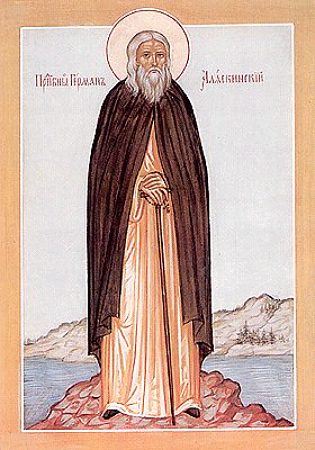
Venerable
Herman of Alaska
Missionary to Alaska
Russian monk and missionary to Alaska, the first canonized saint of North America, who died in 1837.
- Feast
- July 27old style August 9
- Reposed
- 183719th century
- Place
- Spruce Island
- Order
- Venerables
Life
Saint Herman of Alaska was a Russian monk of Valaam and a missionary among the Aleuts of Alaska, then part of Russian America. He died in 1837 on Spruce Island, and the Church honours him as the first saint of North America canonized by the Orthodox Church and as protector of the Orthodox there.
Beginnings
Biographers disagree about his early life. The official Life, printed at Valaam in 1867, made him the son of a merchant family of Serpukhov and a novice at the Trinity-Saint Sergius Hermitage near Saint Petersburg. The scholar Sergei Korsun has shown that this rests on mistaken information, mixed up with the life of another monk. Other testimony, including a letter of the saint himself, shows him born between 1751 and 1757 into a prosperous peasant family of the Voronezh region, with the lay name Egor Ivanovich Popov, and entering Sarov as a novice. According to some sources he had earlier served in a military office.
According to some accounts he moved in 1777 to the hermitage near Saint Petersburg, and in 1782 he came to Valaam Monastery, where he was tonsured a monk on 1 November 1782 with the name Herman. The abbot Nazarius took him under his care as a father would a son. Herman asked to live in a hermitage two kilometres from the monastery and twice refused ordination to the priesthood, remaining a simple monk to the end.
The Alaskan mission
In 1793, at the request of Shelikhov's trading company, Empress Catherine decided to send not a single priest but a whole mission to America. Metropolitan Gabriel of Saint Petersburg chose monks from Valaam, Herman among them. The missionaries reached Kodiak Island on 24 September 1794. The reality was not what Shelikhov had painted. The natives were harshly treated by the men of the company, led by Alexander Baranov, and hunters were forced out after sea otter even in foul weather, while women and children were abused. The monks were shocked at the drunkenness and at the way many settlers lived with native women, and the supplies promised to them never came, so that they tilled the ground with wooden tools.
Even so, the monks baptized more than seven thousand of the natives and built a church and a monastery. Herman worked in the bakery and served as steward of the mission. The missionaries became the defenders of the Kodiak people, and Herman was especially noted for his zeal in shielding them from the company's excessive demands. After Bishop Joasaph drowned in a shipwreck in 1799, only four missionaries were left on the island, and from 1807, when the hieromonk Gideon departed, Herman led the mission. He took charge of the school where twenty boys learned reading, writing, the faith, sacred history, church singing and farming.
New Valaam
Between 1811 and 1817, seeking quiet, Herman moved to Spruce Island, close to Kodiak, which he named New Valaam. He dug a dugout in the ground and lived there in fasting and prayer to the end. He raised orphans, kept the monastic rule of fasting, prayer and silence, and wore the same clothing summer and winter, with a deerskin over it that he is said not to have taken off for years. In a letter to Abbot Nazarius he wrote that in his mind he saw his beloved Valaam across the great ocean. The Aleuts called him Apa, meaning father.
According to tradition his prayer was powerful: once it stopped a flood, another time a fire. He pleaded for the guilty, helped the needy and cared for the sick. A community of women gathered around him, led by the Aleut Sophia Vlasova. Semyon Yanovsky, a former head of the company, was brought by him from deism to Orthodoxy. He is said to have foretold that America would have its own bishop, and in 1840 a diocese was founded on the North American continent. In old age he went blind and lived withdrawn in his cell, telling the faithful the hour of his death and the place of his burial. He fell asleep in the Lord on 13 December 1837 and was buried on Spruce Island.
Veneration
His veneration was known in Russia already in the 1860s, and healings through his prayers were recorded until 1970. His Life was printed at Valaam in 1868. In 1936 Archimandrite Gerasim opened the grave and placed the relics in a small chapel, and in 1967 a monastery of Saint Herman of Alaska was founded at Platina in California. On 9 August 1970 Metropolitan Ireney glorified Herman in the Resurrection Cathedral at Kodiak, and on the same day the Russian Orthodox Church Outside of Russia glorified him in the cathedral at San Francisco. On 12 November 1970 the Holy Synod of the Russian Orthodox Church entered his name in the calendar.
Saint Herman is commemorated on 27 July, which is 9 August on the new calendar, and the Church also remembers him on 13 December, the day of his repose. Saint Herman Orthodox Theological Seminary in Kodiak bears his name, and part of his relics rests in the chapel of Saint Ignatius of Antioch in the United States.
Commemorated the same day July 27
 SethRighteous · The ForefatherJul 27
- Aurelius and NataliaHoly MartyrsJul 27
 Clement of OhridEqual-to-the-Apostles · Bishop of OhridJul 27
 PanteleimonGreat Martyr · The HealerJul 27
 Gorazd of MoraviaSaint · Disciple of St. MethodiusJul 27
 Ambrose of SarapulHieromartyr · Bishop of Sarapul and YelabugaJul 27
 AngelarVenerable · Disciple of Saints Cyril and MethodiusJul 27
 Maurus, Pantalemon and SergiusHoly Martyrs · Martyrs of BisceglieJul 27
- Anthusa of MantineaVenerable · Abbess in ConstantinopleJul 27
 Platon GornykhHieromartyr · PriestJul 27
- John SolovyovHieromartyr · PriestJul 27
- 153 Martyrs of ThraceHoly MartyrsJul 27