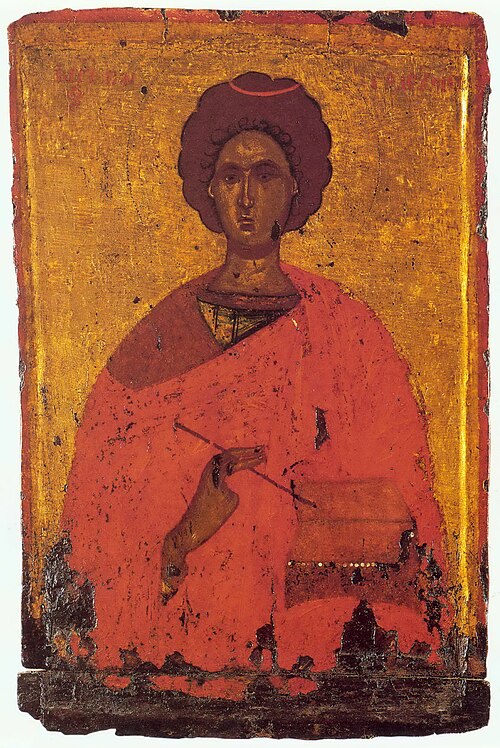
Great Martyr
Panteleimon
The Healer
Physician of Nicomedia who healed the sick without payment, killed in the persecution of Diocletian.
- Feast
- July 27old style August 9
- Reposed
- 3054th century
- Place
- Nicomedia
- Order
- Great Martyrs
Life
Saint Panteleimon, the Great Martyr and Healer, called Pantoleon at birth, was a physician in Nicomedia who healed the sick without payment, in the name of Christ. He received the crown of martyrdom in the persecution of Diocletian, around 305. In the East he is one of the unmercenary physicians, and in the West one of the Fourteen Holy Helpers. The Church commemorates him on 27 July.
Youth and calling
He was born at Nicomedia in Bithynia around 275, into the family of the wealthy pagan Eustorgius. His mother, Eubula, was a Christian and wished to raise him in the faith, but she died when he was a child. His father sent him to a pagan school, and then the young man studied medicine under the renowned physician Euphrosynus. The name Pantoleon means "lion in all things." The emperor Maximian heard of him and wished to make him physician to the court.
At that time the priests Hermolaus, Hermippus and Hermocrates, survivors of the killing of twenty thousand Christians in 303, were living in hiding in Nicomedia. Pantoleon began to visit Hermolaus, who spoke to him of the Christian faith. One day he found a dead child in the street, bitten by a great snake. Pantoleon prayed to Jesus Christ to raise the child and destroy the snake, and resolved that if his prayer were granted he would receive baptism. The child rose up, and the snake died.
Then Pantoleon was baptized by Hermolaus and received the name Panteleimon, "all-merciful." He prepared his father for the faith, and Eustorgius, seeing his son heal a blind man by invoking the name of Jesus, believed and was baptized together with the man who received his sight.
The unmercenary physician
After his father's death, Panteleimon gave his life to the suffering. He healed all who came to him without payment, in the name of Jesus Christ, and visited those in prison, mostly Christians, healing their wounds. In a short time the townspeople left the other physicians and came only to him. The envious physicians denounced him to the emperor.
Martyrdom
Maximian asked him to prove he was no Christian by sacrificing to the idols. Panteleimon confessed his faith and proposed that a sick man with no hope of cure be brought: let the physicians call on their gods, and he would pray to his God. A man paralysed for many years was brought, and the pagan priests, skilled in medicine, called on their gods without success. Then, before the emperor's eyes, the saint healed him by calling on the name of Jesus Christ. Maximian put the healed man to death and gave Panteleimon over to harsh tortures.
The Lord appeared to him and strengthened him. He was hung from a tree and torn with iron hooks, burned with fire, stretched on the wheel, thrown into a cauldron of boiling tar and cast into the sea with a stone round his neck, but he remained unharmed. The priests Hermolaus, Hermippus and Hermocrates were also brought to trial, confessed the Saviour and were beheaded. Panteleimon was taken to the circus to be devoured by wild beasts, but the animals licked his feet, and the crowd cried out that great is the God of the Christians.
At the place of execution he was tied to an olive tree. As he prayed, the soldier's sword grew soft like wax and did not wound him, and a voice from heaven called him by name to the Kingdom of heaven. The soldiers fell to their knees, but the saint told them to carry out the emperor's command, that they might have a share with him in the life to come. When his head was cut off, the olive tree became covered with fruit. According to tradition, milk flowed from the wound instead of blood. His body, thrown into the fire, remained unharmed and was buried by Christians. His servants Laurence, Bassus and Probus witnessed the martyrdom and wrote it down.
Veneration
His lives are late and partly legendary, but the martyrdom itself is supported by an old veneration: Theodoret mentions him in a sermon on the martyrs in the fifth century, and the emperor Justinian rebuilt his shrine at Nicomedia. His relics, venerated at Nicomedia, were brought to Constantinople, and portions were distributed throughout the Christian world. According to Orthodox sources his head is at the Russian monastery of Saint Panteleimon on Mount Athos; in the West a head is venerated at Lyon. Many churches and monasteries are dedicated to him, among them the twelfth-century church at Nerezi in North Macedonia. He is the protector of physicians and of soldiers, and the sick call on him in prayer. The Church commemorates him on 27 July.
Commemorated the same day July 27
 SethRighteous · The ForefatherJul 27
- Aurelius and NataliaHoly MartyrsJul 27
 Clement of OhridEqual-to-the-Apostles · Bishop of OhridJul 27
 Herman of AlaskaVenerable · Missionary to AlaskaJul 27
 Gorazd of MoraviaSaint · Disciple of St. MethodiusJul 27
 Ambrose of SarapulHieromartyr · Bishop of Sarapul and YelabugaJul 27
 AngelarVenerable · Disciple of Saints Cyril and MethodiusJul 27
 Maurus, Pantalemon and SergiusHoly Martyrs · Martyrs of BisceglieJul 27
- Anthusa of MantineaVenerable · Abbess in ConstantinopleJul 27
 Platon GornykhHieromartyr · PriestJul 27
- John SolovyovHieromartyr · PriestJul 27
- 153 Martyrs of ThraceHoly MartyrsJul 27