Saint
Ansfried of Utrecht
Bishop of Utrecht
Bishop of Utrecht, reposed in 1010.
Life
Saint Ansfried of Utrecht, also called the Younger, was count of Huy, sword-bearer to the emperor Otto I, and from 995 bishop of Utrecht. He reposed on 3 May 1010 near Leusden. He is commemorated on 3 May (the date was later moved to 11 May) and is patron of Amersfoort.
He came of a noble family of the Maasgau, where he later founded the abbey of Thorn. He studied secular and ecclesiastical subjects under his uncle Robert, archbishop of Trier, and then at the cathedral school of Cologne. In 961 Otto I took him into his service and made him sword-bearer; when Otto was crowned emperor at Rome the next year, he told Ansfried to keep close at hand with the sword. As a noble he was respected for his Christian commitment and held rich possessions along the Meuse, in Brabant and in Gelderland. He succeeded in suppressing piracy and robbery. In 985 Otto III granted him the right to mint coins at Medemblik. He married Heresuint, or Hilsondis, and had a daughter, Benedicta. Around 992 he built the convent of Thorn for his wife and daughter.
After his wife's death he wished to become a monk, but in 995 the emperor Otto III and Bishop Notker of Liège persuaded him to take the vacant see of Utrecht. He thought himself unworthy, having borne arms, but the emperor insisted. The elderly count laid down his sword on the altar of Saint Mary in Aachen and in the same ceremony was ordained priest and consecrated bishop, the eighteenth of Utrecht. In 1006 he founded the abbey of Heiligenberg, dedicated to Saint Michael. Toward the end of his life, weakened by fasting and almost blind, he retired there as a monk and cared for the sick.
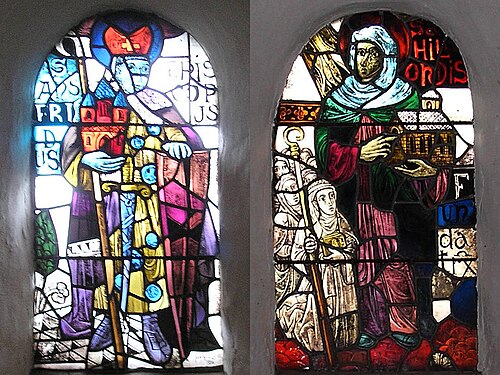
At his death the townsfolk of Heiligenberg took possession of his body while the people of Utrecht were putting out a fire; the abbess of Thorn mediated, and Ansfried was buried in the cathedral of Saint Martin in Utrecht. He is shown holding a small church, as a founder, or as a knight with weapons at his feet, as one who renounced knighthood, or with mitre and staff, or as a Benedictine monk.
Commemorated the same day May 3
 James the LessApostle · The ApostleMay 3
 Theodosius of the CavesVenerable · Abbot of the Kiev Caves LavraMay 3
 Juvenal of NarniHieromartyr · First Bishop of NarniMay 3
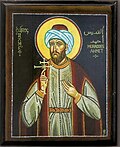 Ahmed the CalligrapherNew Martyr · Ottoman official of ConstantinopleMay 3
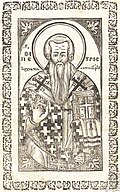 Peter of ArgosSaint · Bishop of ArgosMay 3
- Oecumenius of TriccaSaint · Bishop of TriccaMay 3
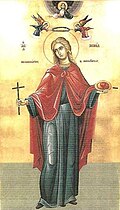 Xenia of KalamataGreat MartyrMay 3
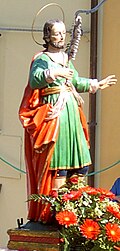 Primianus of LarinoMartyrMay 3
- Gabriel the New MartyrNew MartyrMay 3
- 27 MartyrsHoly MartyrsMay 3
- AdalsindisVenerableMay 3
- Aethelwine of LindseySaint · Bishop of LindseyMay 3