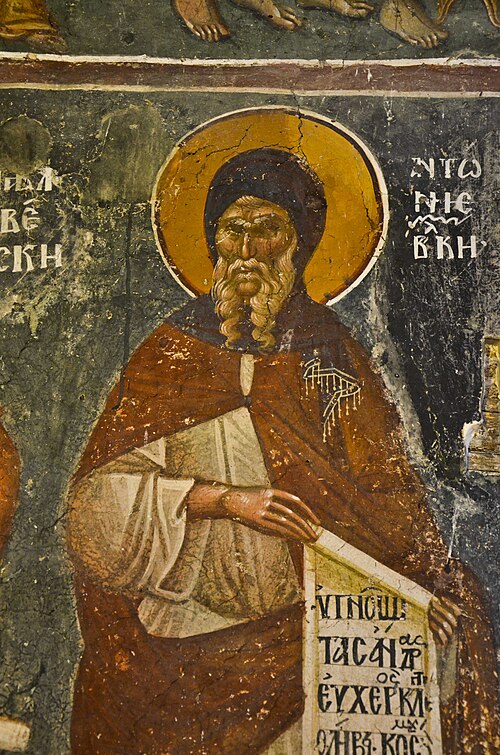
Venerable
Anthony of the Caves
Founder of the Kiev Caves Lavra
Monk, founder of monastic life in Kievan Rus and, with Theodosius, of the Kiev Caves Lavra; died in 1073.
- Feast
- July 10old style July 23
- Reposed
- 107311th century
- Place
- Kyiv
- Order
- Venerables
Life
Saint Anthony of the Caves was a monk and the founder of monastic life in Kievan Rus', born around 983 at Liubech and dead in 1073, at nearly ninety. Together with Saint Theodosius, his disciple, he laid the foundations of the Kiev Caves Lavra. The Church remembers him as the father of all Russian monks, on 10 July.
Youth and Mount Athos
He was born at Liubech, near Chernigov, and received the name Antipas at baptism. From his youth he was drawn to the spiritual life and left for Mount Athos, where he took the name Anthony, in honour of Saint Anthony the Great. The tradition kept in the Paterikon says that the Mother of God appeared in a dream to his abbot and told him that the Russian monk must return home to increase monastic life and the word of God. According to some versions of his life he lived in a solitary cave overlooking the sea, at the monastery of Esphigmenou.
Return to Kiev
The sources do not agree on the dates. According to the most widespread tradition, Anthony returned to Kiev and, not finding in the monasteries there the strictness of Athos, settled in a small cave dug by the priest Hilarion, who would become the first native metropolitan of Kiev. According to some versions, in 1015, after the death of Prince Vladimir the Great and the war between his sons, he went again to Athos, from which his abbot sent him back, foretelling that many monks would join him. Other versions regard this second journey as an editor's attempt to reconcile contradictory sources.
He ate rye bread every other day and drank little water. His fame spread far beyond Kiev. The priest Nikon came to him first, then Theodosius, and later Barlaam and Ephraim, the future metropolitan of Pereyaslav.
The Lavra
When the brothers numbered twelve, they dug a larger cave with a church and cells. Anthony appointed Barlaam abbot and himself withdrew to a neighbouring cave, which came to be called the Near Caves or Caves of Anthony. There he lived as a recluse, but remained the guide of the brotherhood. When Barlaam was called to head a new monastery set up by Prince Iziaslav, the brothers asked Anthony to name a successor, and he chose Theodosius, around 1062.
As the brothers multiplied, Anthony asked the grand prince Iziaslav to give the monks the hill above the caves. On it a wooden church of the Dormition of the Mother of God was raised, then cells and a precinct with a fence. Theodosius ordered the community by the rule of the Stoudios, and Anthony remained his counsellor.
Trials and repose
The sources say that Grand Prince Iziaslav became angry with Anthony. The cause is not clear; some sources speak of Anthony's prophecy of the prince's defeat against the Cumans, others of the suspicion that Anthony took the side of Vseslav. Anthony was taken in secret to Chernigov, to Prince Sviatoslav, where he dug a cave. The Boldin monastery, according to the Russian sources, or the Eletsky monastery, according to others, is said to stand on the site of his cave. After Sviatoslav took the throne of Kiev in 1073, he returned to Kiev and, according to the account, took part in laying the foundation of the stone church of the Dormition, the site of which had been marvellously shown through his prayers.
He fell asleep in 1073 and was buried in his cave, as he had ordered. Before his death he consoled the brothers and asked them to hide his relics forever. To this day his relics have not been found, but many come to his cave to pray and testify to healings there. He is honoured in the Russian and Ukrainian Churches as the father of Russian monks, and the caves of the Kiev Lavra bear his name.
Commemorated the same day July 10
 Anthony of TobolskSaint · Metropolitan of Tobolsk and SiberiaJul 10
- ApolloniusMartyrJul 10
 George of ThessalonikiSaintJul 10
- Joseph of DamascusHieromartyr · Priest and educatorJul 10
- Martyrs of Nitria and ScetisHoly MartyrsJul 10
 The 45 Martyrs of Nicopolis in ArmeniaHoly MartyrsJul 10
 Alexander the SoldierMartyrJul 10
- Alexander of NicopolisMartyrJul 10
- Alexander PopovHieromartyrJul 10
 Amalberga of MaubeugeVenerableJul 10
 Amalberga of TemseVenerableJul 10
- AmaliaSaintJul 10