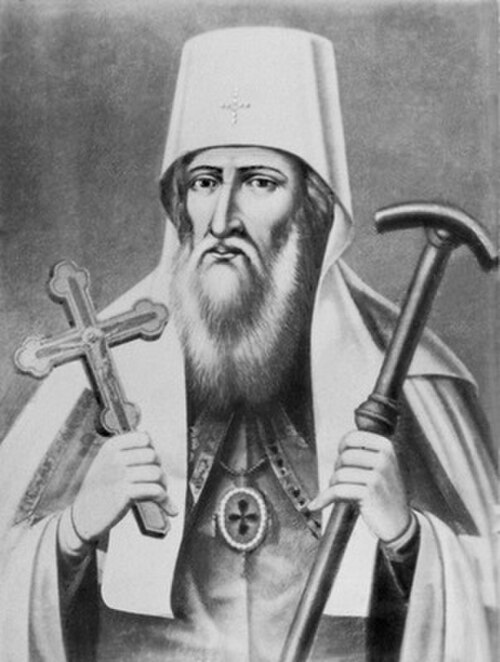
Saint
Anthony of Tobolsk
Metropolitan of Tobolsk and Siberia
Archbishop of Chernigov, then Metropolitan of Tobolsk, born in 1672 and died in 1740; canonized in 1984.
Life
Saint Anthony, hierarch (born Andrei Georgievich Stakhovsky, 1671 or 1672 to 27 March 1740), was archbishop of Chernihiv, rector of the college of Chernihiv and, from 1721, metropolitan of Tobolsk and of all Siberia. He was numbered among the saints in 1984 in the Synaxis of the Saints of Siberia, so, according to our sources, as a saint venerated locally in the region. He is commemorated (Old Style) on 10 July.
Life
He was born in the village of Repki in the Chernihiv district, in the family of a priest of Polish noble stock. In 1693 to 1695 he studied at the Theological Academy at Kyiv and during his studies received tonsure with the name Anthony. In 1699 he was appointed treasurer of the diocese of Chernihiv, in 1700 abbot of the Boris and Gleb monastery of Chernihiv, and from 1701 preacher of the diocese. In 1709 he was raised to archimandrite and appointed abbot of the Transfiguration monastery at Novgorod-Siversky. On 20 September 1713 he was consecrated at the Kremlin bishop of Chernihiv, with the rank of archbishop. In August 1720 he was summoned to the capital in the matter of the vision of the hieromonk Porphyry, whom Anthony refused to defrock, though Prince Menshikov demanded it. On 5 March 1721, by a decree of Peter I, he was moved to the see of Tobolsk, with the rank of metropolitan of Siberia and Tobolsk, and arrived there on 7 December 1721.
In the twenty years he spent in Siberia he busied himself much with enlightenment and mission. He sent missionaries to Kamchatka and to China, and in 1725 opened, at the Ascension monastery in Irkutsk, a Russian-Mongolian school for the preaching of Christianity in China. He enlarged the Slavic-Russian school at Tobolsk, introduced Latin and raised the general level of teaching, lengthening it to six years, so that the number of pupils grew quickly. In his time new churches and monasteries were built, and at the end of his shepherding the diocese had two hundred and sixty-five churches, fourteen men's monasteries and six women's. In the same time there was cast, for the first time in Siberia, at the Tagil works, a great bell of 1,011 poods for the cathedral of Saint Sophia. He died on 27 March 1740, at about seventy, and was buried in the cathedral of Saint Sophia at Tobolsk. He left a great library, bought later for the seminary at Tobolsk. He wrote in syllabic verse "The Mirror from Divine Scripture" (1705), which includes a poem for the hetman Mazepa, and "A Tale on Holy Scripture" (1705), and under his guidance the "History" of Titus Livy was translated from Latin in 1716.
Commemorated the same day July 10
 Anthony of the CavesVenerable · Founder of the Kiev Caves LavraJul 10
- ApolloniusMartyrJul 10
 George of ThessalonikiSaintJul 10
- Joseph of DamascusHieromartyr · Priest and educatorJul 10
- Martyrs of Nitria and ScetisHoly MartyrsJul 10
 The 45 Martyrs of Nicopolis in ArmeniaHoly MartyrsJul 10
 Alexander the SoldierMartyrJul 10
- Alexander of NicopolisMartyrJul 10
- Alexander PopovHieromartyrJul 10
 Amalberga of MaubeugeVenerableJul 10
 Amalberga of TemseVenerableJul 10
- AmaliaSaintJul 10