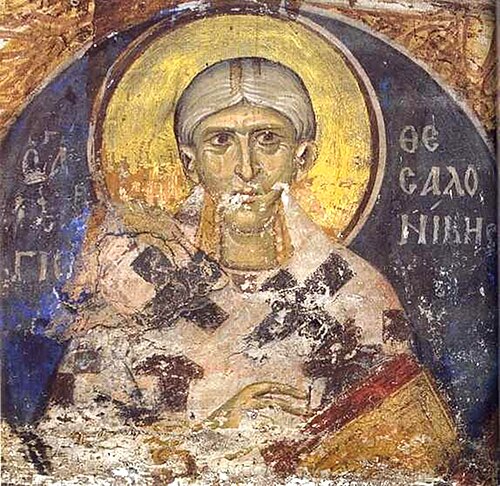
Saint
George of Thessaloniki
Orthodox bishop associated with Thessaloniki, in the 11th century.
Life
Saint George was metropolitan and archbishop of Thessaloniki in the third decade of the eleventh century, in the Byzantine Empire. He is commemorated on 10 July, and tradition calls him "the Sweet". Little is known about him, and the information rests on two written witnesses and an oral tradition.
The first witness is the Synodikon of Thessaloniki, an important source for the history of the Church in that city. His name stands twenty-ninth, after Nicetas I, who was active around 1020, and before Theophanes I, who is known to have governed the diocese between 1031 and 1038. From this his episcopate is placed in the third decade of the eleventh century. His inclusion in such a synodikon shows that George held a significant place, for he defended the Orthodox faith at a time of dogmatic disputes.
The second witness is an inscription in the prothesis of the katholikon of Vatopedi Monastery on Mount Athos. On the north wall a beardless bishop is painted, labelled "Saint George of Thessaloniki". With his right hand he blesses, and in his left he holds a closed Gospel book. He wears a polystavrion phelonion in bright colours and an omophorion. Hieromonk Justin of Simonopetra, who published the image, notes that his appearance resembles that of eunuchs. The painting belongs to the first phase of decoration of the katholikon, in 1312, and is well preserved.
A tradition of Vatopedi holds that Archbishop George came from this monastery, and that for this reason he was painted there.
The sources given mention no act of canonization and no written life. His veneration appears only in this Vatopedi image, in the monastery's tradition and in the commemoration of 10 July.
Commemorated the same day July 10
 Anthony of the CavesVenerable · Founder of the Kiev Caves LavraJul 10
 Anthony of TobolskSaint · Metropolitan of Tobolsk and SiberiaJul 10
- ApolloniusMartyrJul 10
- Joseph of DamascusHieromartyr · Priest and educatorJul 10
- Martyrs of Nitria and ScetisHoly MartyrsJul 10
 The 45 Martyrs of Nicopolis in ArmeniaHoly MartyrsJul 10
 Alexander the SoldierMartyrJul 10
- Alexander of NicopolisMartyrJul 10
- Alexander PopovHieromartyrJul 10
 Amalberga of MaubeugeVenerableJul 10
 Amalberga of TemseVenerableJul 10
- AmaliaSaintJul 10