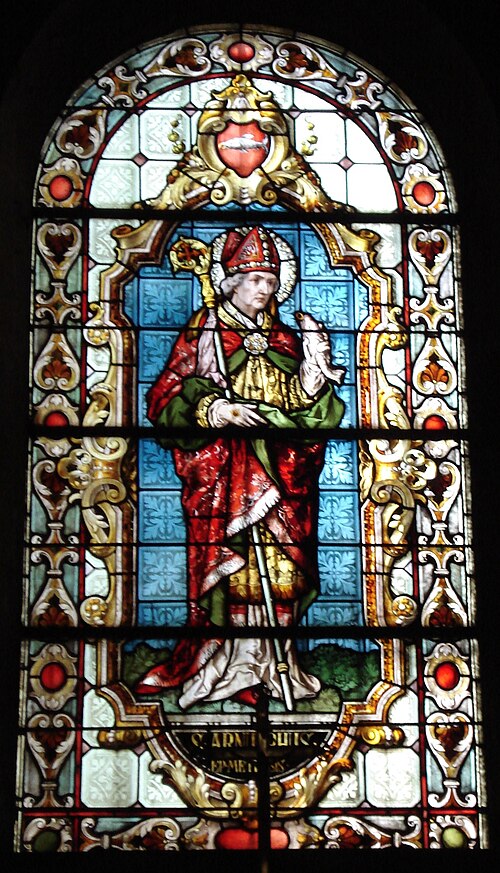
Saint
Arnulf of Metz
Bishop of Metz
Bishop of Metz and adviser at the Merovingian court of Austrasia, who retired to a monastery at the end.
Life
Saint Arnulf, bishop of Metz, was an adviser at the Merovingian court of Austrasia and, near the end of his life, a hermit in the region of Remiremont. The Catholic Church commemorates him on 18 July. Tradition regards him as the earliest known ancestor of Charlemagne and of the Carolingian dynasty.
Family and service at court
He was born around 582, near Nancy in Lorraine, into a distinguished Frankish family with great estates between the Moselle and Meuse rivers. The Life written shortly after his death says that he was of noble and very rich parents. Later texts give him various fathers, but these are considered fabrications; his ancestry cannot be traced. As an adolescent he was called to the court of King Theudebert II of Austrasia, where he was educated by Gondulf of Provence, and then sent to serve as duke on the Scheldt. He distinguished himself as a soldier and in administration, at one time having six provinces in his care. In 596 he married Dode; their sons included Chlodulf, later bishop of Metz; Ansegisel, their son according to the Carolingian tradition, married Begga, daughter of Pepin of Landen, and from this line came Pepin of Herstal, Charles Martel and, some generations later, Charlemagne.
Bishop
Around 611 Arnulf and his friend Romaricus, also an officer of the court, planned a pilgrimage to the abbey of Lérins. King Chlothachar, who valued his skill, offered him the vacant see of Metz, capital of Austrasia. His wife took the veil at Trier, and Arnulf saw this as a sign from God, became a priest and then a bishop. He nevertheless remained in the king’s service, as steward and courtier.
In 613 Arnulf allied himself with Pepin of Landen and led the opposition of the Frankish nobles to Queen Brunhilda, who ruled Austrasia and Burgundy in the name of her great-grandchildren. The revolt led to the queen’s fall, torture and death, and to the reunion of the Frankish lands under Chlothachar II. Chlothachar then made his son Dagobert I king of Austrasia, and Arnulf was his adviser; in 625 he took part in the council of Frankish bishops at Reims.
The hermit
Drawn to the spiritual life, around 628-629 he retired as a monk to a hermitage in the Vosges, on his own estates. His friend Romaricus, whose parents had been killed by Brunhilda, had withdrawn there around 613 and founded, with Amatus, the abbey of Remiremont. After Chlothachar’s death in 629 Arnulf settled nearby and died between 640 and 647. He was buried at Remiremont, and later his relics were moved to the abbey that bears his name at Metz. In icons he is shown with a pastoral staff or a rake.
A legend says that Arnulf, tormented by the violence around him and by the thought that he had shared in the wars and murders of the ruling families, one day threw his bishop’s ring from a bridge into the Moselle, praying God to give him a sign of forgiveness by returning the ring. After many years of penance, a fisherman brought to the bishop’s kitchen a fish in which the ring was found. Arnulf accepted the sign and at once resigned his see, living as a hermit to the end.
Commemorated the same day July 18
 Stephen II of ConstantinopleSaint · Patriarch of ConstantinopleJul 18
 Philastrius of BresciaSaint · Bishop of BresciaJul 18
 Pambo of NitriaVenerable · Desert FatherJul 18
 Symphorosa of TivoliMartyr · Martyr of TivoliJul 18
 Aemilianus of DurostorumMartyr · Soldier of DurostorumJul 18
 Rufillus of ForlimpopoliSaint · First bishop of ForlimpopoliJul 18
 John the Much-SufferingVenerable · Monk of the Kiev CavesJul 18
- Hyacinthus of AmastrisMartyrJul 18
 Pamva the RecluseVenerable · Recluse of the Caves LavraJul 18
 Arnold of ArnoldsweilerRight-BelievingJul 18
- Arnulf of YvelinesSaintJul 18
- AthanasiusSaintJul 18