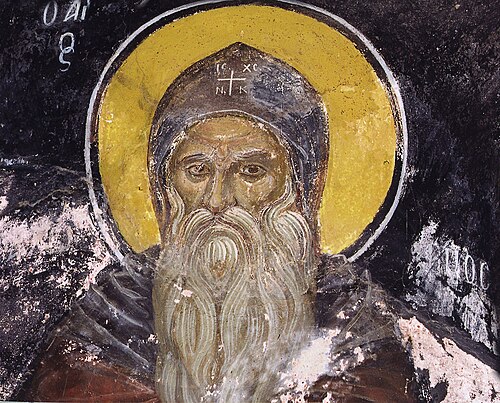
Venerable
Pambo of Nitria
Desert Father
Desert father of the fourth century, a disciple of Anthony the Great, who died around 390.
- Feast
- July 18old style July 31
- Reposed
- 3754th century
- Place
- Nitria
- Order
- Venerables
Life
Saint Pambo of Nitria, a venerable father, was a desert father of fourth-century Egypt, a Copt, disciple of Saint Anthony the Great. He lived in the Nitrian desert, where he founded several monasteries, and fell asleep around 390. His feast is on 18 July.
Sources and his silence
Much of what is known of him comes from the Lausiac History of Palladius and brief mentions by Jerome and Rufinus. Little is known of his life before becoming a monk. His most striking penance was silence. It began early, when from his spiritual father he received the opening of Psalm 38: "I said, I will take heed to my ways, that I sin not with my tongue." For six months he did not say a word to his father, but laboured to take these words into himself, and he humbly told other monks that he had scarcely learned them even eighteen years later. To any question he answered only after much thought and prayer, fearing to say something he would later repent of. Saint Anthony said of him that the Holy Spirit had filled him with the fear of God. And Saint Poemen the Great said: "We saw three things in Abba Pambo: hunger every day, silence and sewing." Saint Theodore the Studite called him "lofty in deed and word."
Father and abbot
He is known as founder of monasteries in the Nitrian desert. He had a close relationship with Melania the Elder, who made many gifts to him and his monastery. One account says she brought him several hundred pounds of silver, and he, without leaving his work and without looking at the money, distributed it to poor monasteries, without thanking her; only after her entreaties did he allow her to give the alms to a brother to distribute. It is said that thus he overturned her "haughty attitude about money." Pambo was either banished or simply went on pilgrimage to Palestine with Isidore, Pisimius, Adelphius, Paphnutius and a dozen other clergy, and Melania went with them.
During the early debates over Arianism, Saint Athanasius brought him from Nitria to support him in the Alexandrian courts. Later he wrote of him as "well pleasing to God." It is told that his face "shone like lightning," a mark of his high holiness. Two brothers received a large inheritance from their father; one gave it all away, while the other built a monastery and cared for those in need. Asked which was holier, Pambo said they were equal, and is said to have had a vision of the two brothers standing before God. He personally knew Bessarion, Isaiah, Paesios, Arsisius and Serapion the Great, fellow monks of the Egyptian deserts, and is quoted speaking with several of them in the collections of sayings. The historian and theologian Rufinus visited him in 374. His disciples were great ascetics, among them Dioscorus (later bishop of Hermopolis), Ammonius, Eusebius and Euthymius, mentioned in the life of Saint John Chrysostom; he is also counted spiritual father of other saints, among them Pishoy and John the Dwarf. He was held in great esteem and consulted by many, among them Athanasius, Melania the Elder and Ammonas of Egypt. At the same time he prized the monastic calling highly and taught laypeople to honour monasticism.
His repose
He was weaving a basket when he fell asleep, and this was the first of his relics; Melania the Elder, who collected relics of many holy men, was at Nitria and received the very basket. Speaking to the brethren gathered at his bedside of the virtues he had pursued in life, he said: "From the time that I came into this place of solitude and built my cell and dwelt in it, I do not call to mind that I have eaten save what my hands have toiled for, nor repented of any word that I spoke... And so I go to the Lord as one that has not yet made a beginning of serving God." He is said to have died in the seventieth year of his life.
The year of his death is uncertain: some hold that the "historical Pambo" died between 373 and 374; the Lausiac History says only that he died before Palladius entered the desert, that is, before 385; a Catholic martyrology says "about 390," and others 393. Scholars such as Graham Gould hold there is little historical ground for believing that he was a highly educated man or tied to Origenism; the charge arose from controversy around some of his pupils and fellow monks, the Tall Brothers of Kellia. The story that he opposed women's participation in liturgical singing does not appear, according to more recent research, to predate the sixth century, so it cannot be taken as his sure opinion.
Commemorated the same day July 18
 Arnulf of MetzSaint · Bishop of MetzJul 18
 Stephen II of ConstantinopleSaint · Patriarch of ConstantinopleJul 18
 Philastrius of BresciaSaint · Bishop of BresciaJul 18
 Symphorosa of TivoliMartyr · Martyr of TivoliJul 18
 Aemilianus of DurostorumMartyr · Soldier of DurostorumJul 18
 Rufillus of ForlimpopoliSaint · First bishop of ForlimpopoliJul 18
 John the Much-SufferingVenerable · Monk of the Kiev CavesJul 18
- Hyacinthus of AmastrisMartyrJul 18
 Pamva the RecluseVenerable · Recluse of the Caves LavraJul 18
 Arnold of ArnoldsweilerRight-BelievingJul 18
- Arnulf of YvelinesSaintJul 18
- AthanasiusSaintJul 18