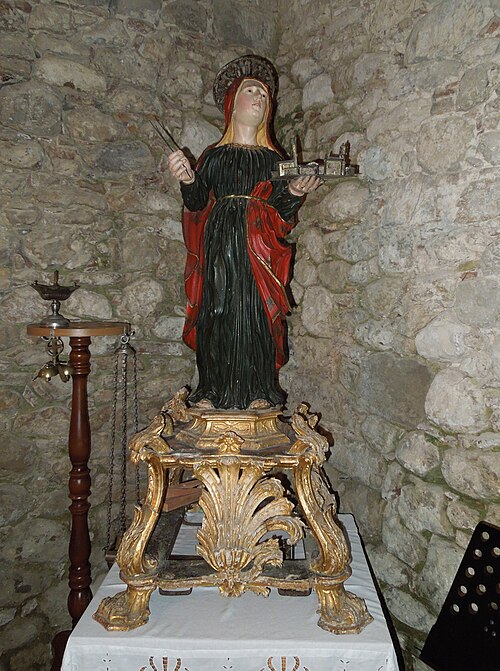
Martyr
Symphorosa of Tivoli
Martyr of Tivoli
Woman of Tibur (modern Tivoli) put to death with her seven sons under Hadrian or Trajan.
Life
Saint Symphorosa, martyr, was a woman of Tibur (today Tivoli in Lazio), put to death with her seven sons, according to tradition toward the end of the reign of Hadrian (117 to 138) or in the time of Trajan, around 138. She is commemorated on 18 July. The diocese of Tivoli honours her as a patron, and the Roman Martyrology has her on 18 July.
The story of their martyrdom is told in an ancient Passio, the credibility of which is seriously questioned by many modern hagiologists. According to it, Symphorosa was a Tiburtine matron, the widow of Getulius, a native of Gabii in Sabina. He had been a tribune in the Roman army, but left it when he was baptized a Christian and retired to his estate near Tivoli, where his brother Amantius joined him. Getulius and Amantius were then beheaded under Hadrian, and Symphorosa buried their remains on the estate. Not long after, Symphorosa and her children were arrested. The Russian tradition tells that when Hadrian completed his costly palace at Tivoli and offered pagan sacrifice, he received the answer: "The widow Symphorosa and her sons torment us daily, praying to their God. If she and her sons sacrifice to us, we promise to give you all you ask." When all the emperor's attempts to induce Symphorosa and her sons to sacrifice to the Roman gods failed, he ordered her taken to the Temple of Hercules, where, after various tortures, she was thrown into the river Anio with a heavy rock fastened to her neck. Her brother Eugenius, a member of the council of Tibur, buried her with her husband.
The next day the emperor summoned the seven sons of Symphorosa and, equally unsuccessful with them, ordered them tied to seven stakes erected around the Temple of Hercules. Each had his own martyrdom, according to the Russian source: Crescens was pierced in the throat, Julian in the chest, Nemesius in the heart, Primitivus in the navel, Justin in the back, Stracteus (also called Stacteus) in the side, and Eugenius was split in two from top to bottom; their limbs were torn out. Their bodies were thrown into a deep ditch, afterwards called by the pagan priests "At the seven self-murderers" (Ad septem Biothanatos), a Greek word used for those who died by their own hand and applied by pagans to Christians killed as martyrs. Then the persecution ceased for one year and six months, and in this time the Christian community found the martyrs' bodies and buried them on the Via Tiburtina, eight or nine miles from Rome.
Scholars cannot say how reliable these Acts are. The opinion that they were written by Julius Africanus (third century) has been rejected almost universally. The Hieronymian Martyrology, compiled by an unknown author in the second half of the fifth century, commemorates Symphorosa and her sons on 18 July, but the names of the sons are entirely different from those in the Acts, which shows it draws on another source; in the same martyrology, on 27 June, seven brother-martyrs are commemorated whose names are those given elsewhere for the sons of Symphorosa, so it is thought these were later appropriated. Some hagiologists regard the seven sons of Symphorosa, like those of Felicitas of Rome, as a mere adaptation of the seven sons of the Maccabean mother. In the seventeenth century, Bosio discovered the ruins of a basilica at the place popularly called "le sette fratte" (taken to be a corruption of words meaning "the seven brothers"), on the Via Tiburtina. The Acts and the Hieronymian Martyrology agree in designating this spot as the tomb of Symphorosa and her sons, and further discoveries, by Stevenson, leave no room for doubt that the basilica was built over their tomb. The remains were moved to the church of Sant'Angelo in Pescheria in Rome by Pope Stephen II in 752. There a sarcophagus was found in 1610 with the inscription: "Here rest the bodies of the holy martyrs Symphorosa, her husband Zoticus (Getulius) and her sons, transferred by Pope Stephen." The relics of Symphorosa and Getulius lie there still at Sant'Angelo in Pescheria.
In the Middle Ages Settecamini was called the "Field of Seven Brothers", in memory of the seven sons. Symphorosa is venerated as a patron of Tivoli (along with other saints) and of the places Roccadaspide and Tossicia and as protector of San Chirico Raparo. She is no longer in the General Roman Calendar, because the information in the Acts, thought to be an imitation of the Passion of Felicitas of Rome, is untrustworthy.
Commemorated the same day July 18
 Arnulf of MetzSaint · Bishop of MetzJul 18
 Stephen II of ConstantinopleSaint · Patriarch of ConstantinopleJul 18
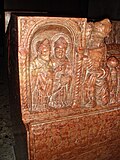 Philastrius of BresciaSaint · Bishop of BresciaJul 18
 Pambo of NitriaVenerable · Desert FatherJul 18
 Aemilianus of DurostorumMartyr · Soldier of DurostorumJul 18
 Rufillus of ForlimpopoliSaint · First bishop of ForlimpopoliJul 18
 John the Much-SufferingVenerable · Monk of the Kiev CavesJul 18
- Hyacinthus of AmastrisMartyrJul 18
 Pamva the RecluseVenerable · Recluse of the Caves LavraJul 18
 Arnold of ArnoldsweilerRight-BelievingJul 18
- Arnulf of YvelinesSaintJul 18
- AthanasiusSaintJul 18