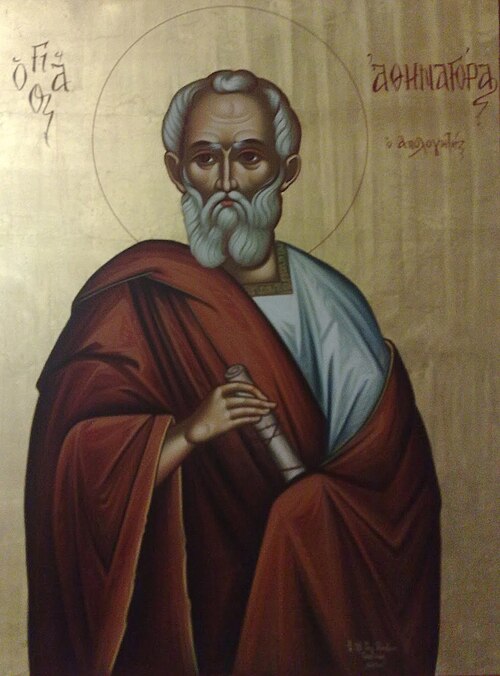
Saint
Athenagoras of Athens
Christian apologist
Athenian philosopher turned Christian, an apologist of the second half of the second century.
- Feast
- July 24old style August 6
- Era
- unknown
- Place
- Athens
Life
Saint Athenagoras of Athens was an Athenian philosopher who became a Christian and one of the notable apologists of the second half of the second century. His work A Plea for the Christians is a defence of the faith addressed to the Roman emperors. Very few certain things are known about his life. The Orthodox Church commemorates him on 24 July.
Who he was
In the title of his work, Athenagoras calls himself "the Athenian, a philosopher and Christian." He was trained in Platonic and Stoic philosophy and, according to a later source, Philip of Side, he turned to Christ by reading the Scriptures he meant to refute. The same source says he headed the catechetical school of Alexandria, but this is not proven and is probably wrong. Eusebius of Caesarea does not mention him, and early writers recall him little: Saint Methodius of Olympus quotes a passage from him. Scholars place him in the time of the emperors Marcus Aurelius and Commodus, around 177. The place and year of his death are not known, and nothing is known of a martyrdom. His two works survive in a manuscript of the year 914.
A Plea for the Christians
The work, called in Latin Legatio pro Christianis, is addressed to the emperors Marcus Aurelius and Commodus, whom he calls conquerors and, above all, philosophers. Athenagoras asks that Christians be judged for their deeds, not for their name, as any other citizen is judged. He answers the three charges brought against Christians: atheism (because they do not worship the gods of the city), feasts of murdered children, and incestuous unions. He shows that Christians are not atheists, since they worship one God, Creator of the world, unbegotten and imperishable, a thing the poets and philosophers have also said. He then confesses the Father, the Son, His Word, and the Holy Spirit, united in power and distinct in order. Of the life of Christians he says that they cannot bear even to watch a man put to death and do not attend gladiatorial fights, and that those who love their enemies cannot be murderers. He counts procured abortion as killing too.
On the Resurrection of the Dead
The second surviving work, On the Resurrection of the Dead, is a philosophical defence of the resurrection of bodies, against those who held it impossible. Athenagoras shows that God, who made man out of nothing, can raise him, that man is made of soul and body and that both are called to judgment and eternal life. He argues from reason, from justice and from the purpose of man.
Veneration
Athenagoras is regarded as one of the clearest apologists of the second century, and his writings are valued for the way they speak of the Trinity and the resurrection of the body. The Orthodox Church commemorates him on 24 July.
Commemorated the same day July 24
 The MagiSaints · Wise Men from the EastJul 24
 ChristinaGreat Martyr · of TyreJul 24
 George KonisskySaint · Archbishop of MogilevJul 24
 Segolena of AlbiVenerable · Deaconess of AlbiJul 24
 Bogolep of Chorny YarVenerable · Child schemamonkJul 24
 Polycarp of the Kiev CavesVenerable · Archimandrite of the Kiev CavesJul 24
 Martyrs of PrebilovciHoly New MartyrsJul 24
- Athanasius of KiosNew MartyrJul 24
 New Martyrs of MgarVenerable MartyrJul 24
- George the HungarianMartyrJul 24
- AliprandusVenerableJul 24
- Alphaeus KorbanskyHieromartyrJul 24