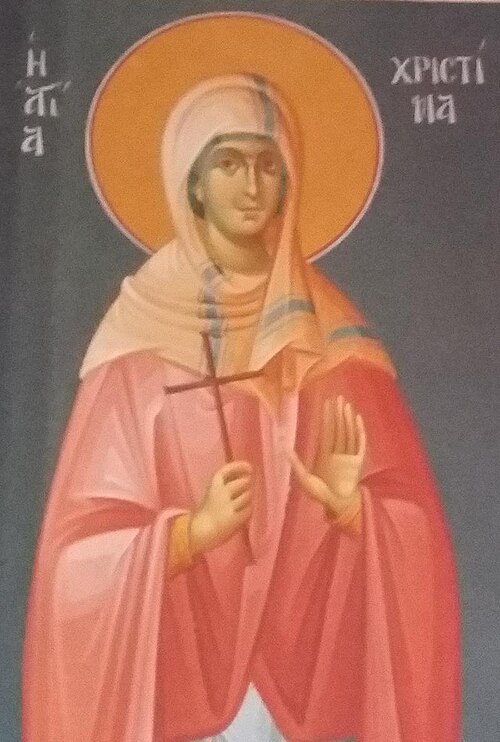
Great Martyr
Christina
of Tyre
Virgin great martyr of the third century, honored in both East and West.
- Feast
- July 24old style August 6
- Born
- 3003rd century
- Place
- Bolsena
- Order
- Great Martyrs
Life
Saint Christina of Tyre, great martyr, also called Christina of Bolsena, is honoured as a virgin martyr of the third century, in both East and West. She is commemorated on 24 July. Her existence is poorly attested, and her life, written in the ninth century, has many variants and the character of a legend.
The sources
Some variants place her at Tyre, in Phoenicia, others at Bolsena, in central Italy, where catacombs were found with an old church and the tomb of a female martyr named Christina. Inscriptions there show that the community honoured her as a saint from the fourth century, and at Tyre archaeological excavations have shown she was honoured by the fourth century. A sixth-century mosaic in the basilica of Sant’Apollinare Nuovo at Ravenna shows a procession of virgins, among them a Saint Christina with the martyr’s crown. The Roman calendar of 1969 removed her, “because nothing is known of this virgin and martyr apart from her name and her burial at Bolsena”, but she remained in the Martyrology.
Life according to tradition
According to the story, Christina was born into a rich family, daughter of Urbanus, governor of Tyre (according to Western tradition, of a Roman family). At eleven she was exceptionally beautiful, and many sought her in marriage. Her father, wishing to make her a priestess of the idols, put her in a dwelling with many gold and silver idols and commanded her to burn incense before them, with two servants. It is said that an angel appeared to her and taught her the Christian faith, calling her a bride of Christ and foretelling her sufferings. Then Christina smashed the idols and threw them out of the window, according to some she sold the pieces and gave the money to the poor. Her father, asking what had become of the idols, learned the truth from the servants. Her mother begged her to behave humanly, but Christina said that from now on she was only “a child of God”.
Urbanus had her tortured, but God thwarted his effort. The torments differ by source: iron hooks, fire, furnace, wheel, snakes, arrows, being thrown into the sea or a lake, a millstone; she survived them all. Her father died on the night he meant to kill her, and his successors, Dion and then Julian, continued the torments; Dion died suddenly before the crowd. According to the synaxarion, three thousand people at Tyre believed on seeing the miracles. Julian had her breasts and tongue cut off; the martyr took her tongue in her hand and threw it in his eyes, after which he went blind. In the end she was beheaded (according to other variants, shot with arrows or drowned in Lake Bolsena).
Relics and veneration
Her relics are kept, according to some sources, at Toffia, near Rieti, at Santa Cristina Gela, near Palermo, of which she is a patron, and at the church of San Francesco della Vigna in Venice, which claims to have her incorrupt body. The miracle of Bolsena, in 1263, when a priest from Prague, Peter, who doubted the Real Presence, saw the Precious Blood drip from the Host during Mass in the basilica of Santa Cristina, was an impetus for the feast of Corpus Christi. Her prayer: “Your lamb, Jesus, Christina, cries with a strong voice: You, my Bridegroom, I love, and seeking You I suffer.”
Commemorated the same day July 24
 The MagiSaints · Wise Men from the EastJul 24
 Athenagoras of AthensSaint · Christian apologistJul 24
 George KonisskySaint · Archbishop of MogilevJul 24
 Segolena of AlbiVenerable · Deaconess of AlbiJul 24
 Bogolep of Chorny YarVenerable · Child schemamonkJul 24
 Polycarp of the Kiev CavesVenerable · Archimandrite of the Kiev CavesJul 24
 Martyrs of PrebilovciHoly New MartyrsJul 24
- Athanasius of KiosNew MartyrJul 24
 New Martyrs of MgarVenerable MartyrJul 24
- George the HungarianMartyrJul 24
- AliprandusVenerableJul 24
- Alphaeus KorbanskyHieromartyrJul 24