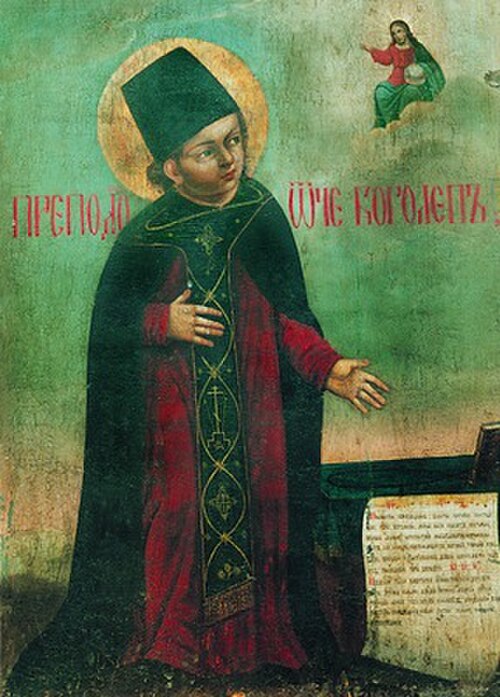
Venerable
Bogolep of Chorny Yar
Child schemamonk
Russian child schemamonk, born Boris Ushakov in 1647, who died at seven in 1654; venerated locally.
- Feast
- July 24old style August 6
- Reposed
- 165417th century
- Place
- Chorny Yar
- Order
- Venerables
Life
Saint Bogolep of Chorny Yar (in the world Boris Yakovlevich Ushakov, 2 May 1647 - 1 August 1654) the venerable was a child schema-monk, venerated as a locally venerated saint of the Russian Church, with the title of venerable. He is commemorated on 24 July (old style) and on the second Sunday after Pentecost, in the synaxis of all the saints of the Russian land. The year of death is given in some versions of the Life as 1654 or 1659; the first date is considered more fitting for the hagiographic story.
His life
He was born in Moscow into the old and influential house of the Ushakovs (being thus a distant relative of two later saints, the hieromonk Theodore and the admiral Fyodor Ushakov), to the boyar Yakov Lukich Ushakov and Yekaterina Vasilieva Ushakova. At baptism he was named Boris, in honour of Prince Boris Vladimirovich. In 1651 his father was appointed voivode at Chorny Yar (now in Astrakhan Oblast). The Life tells that from early on the child was very pious: as a baby he kept the fasts of Wednesday and Friday and cried at the sound of the bell, showing that he should be carried to church.
Boris was very sickly: at seven an ulcer appeared on his leg, which soon passed, but a new illness began, called "chechuy" (sores on the face). One day he saw a wandering monk and was amazed at his vestments. Boris asked his parents to tonsure him into the schema, saying that after that he would recover. The parents agreed, and Boris was tonsured into the schema with the name Bogolep (the Russian translation of the Greek name Theoprepios). According to the Life, the next day after the tonsure he recovered, and a day after that he fell ill with "ognevitsa" (fever) and died. He was buried beside the church of the Resurrection of the Lord, and later a chapel was built over his grave.
Veneration
His veneration arose soon after his death. The day of his commemoration is entered in the Kaidalov calendar (end of the seventeenth century) and in the "Description of the Russian Saints" (known from copies of the seventeenth and eighteenth centuries). He was credited with saving Chorny Yar from the troops of Stenka Razin, from the Kuban Tatars (1689, 1711) and from the plague of 1717. The first icon of the holy child was painted in 1695 by the icon painter John, priest of the church of the Nativity of the Mother of God at Astrakhan, who, by tradition, was afterwards healed of an eye disease.
In 1722 Peter the Great visited Chorny Yar, inspected the child's grave, forbade memorial services at it and ordered the chapel to be destroyed. The icon of Bogolep painted by John was destroyed at that time too. In 1723 Bishop Joachim (Vladimirov) of Astrakhan was removed from his see by imperial decree, with the order to send him "to a suitable diocese as vicar"; this is linked with the Astrakhan uprising of 1705-1706, when, as the tsar's troops approached Chorny Yar, the rebel Old Believers spread the rumour that the child Bogolep would save them from the tsar-antichrist. Nonetheless Joachim kept up the veneration of the venerable Bogolep in his diocese. Local tradition, on the contrary, says that the tsar took an interest in the child's story and allowed memorial services at his grave.
In 1731-1732 Savva Tatarinov, fulfilling a vow made after his release from Kalmyk captivity, wrote the Life of the venerable Bogolep. In 1736, in place of the wooden church of the Resurrection, at the expense of the Moscow merchant I. P. Krasnoselov, the building of a stone church at Chorny Yar began. During the building, in 1741, Bogolep's grave was included in a side chapel dedicated to Saint John the Warrior. His local canonization took place in the second half of the eighteenth century. By the middle of the nineteenth century the bank of the Volga on which the church of the Resurrection stood had been badly undermined; all the holy things were taken out of the church, and in 1848, by order of Archbishop Eugene (Bazhanov), an attempt was made to find the relics of the venerable Bogolep, but they were not found. In spring 1849 the part of the church under which his grave lay collapsed into the Volga. The Local Council of 1917-1918 confirmed the existing local canonization, entering his name in the synaxis of all the saints who shone in the Russian land.
Commemorated the same day July 24
 The MagiSaints · Wise Men from the EastJul 24
 Athenagoras of AthensSaint · Christian apologistJul 24
 ChristinaGreat Martyr · of TyreJul 24
 George KonisskySaint · Archbishop of MogilevJul 24
 Segolena of AlbiVenerable · Deaconess of AlbiJul 24
 Polycarp of the Kiev CavesVenerable · Archimandrite of the Kiev CavesJul 24
 Martyrs of PrebilovciHoly New MartyrsJul 24
- Athanasius of KiosNew MartyrJul 24
 New Martyrs of MgarVenerable MartyrJul 24
- George the HungarianMartyrJul 24
- AliprandusVenerableJul 24
- Alphaeus KorbanskyHieromartyrJul 24