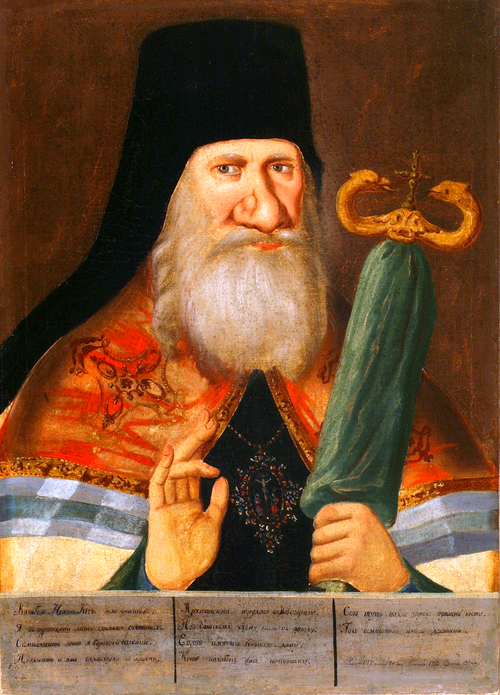
Saint
George Konissky
Archbishop of Mogilev
Archbishop of Mogilev, preacher, philosopher and theologian, born in Nezhin in 1717, died in 1795.
Life
Saint George Konissky, Archbishop of Mogilev, Mstislavl and Orsha, was one of the most learned hierarchs of the eighteenth century: professor and rector of the Kyiv Academy, philosopher, theologian, preacher and writer. For nearly two decades he was the only Orthodox bishop in the Polish-Lithuanian Commonwealth, and he defended with all his strength the faith of the Orthodox of Belarus, who were then in great distress. The Church honours him as a confessing pastor and a teacher of the faith.
Family and schooling
He was born on 20 November 1717 at Nizhyn in the Chernihiv Cossack regiment, and was baptised Gregory. He came from the Konissky family of Cossack officers. His father, Joseph, had been a non-commissioned officer of a Zaporozhian company and from 1727 was mayor of Nizhyn.
In 1728 he entered the Kyiv Theological Academy, completing it in 1743 "with special praise". There he learned Latin, Polish, Greek, Hebrew and German and began writing verse.
Monk and professor in Kyiv
On 11 August 1744 he was tonsured a monk in the Kyiv Caves Lavra, taking the name George. From 1744 to 1746 he was preacher of the Lavra, and from 1745 he taught poetics at the Academy. From 1747 he was professor of philosophy and theology and prefect of the Academy, and was ordained hieromonk. On 1 August 1751 he became archimandrite of the Brotherhood Monastery in Kyiv, and in 1751-1752 rector of the Academy.
In 1746 he wrote the drama "The Resurrection of the Dead", staged at the Academy in 1747. Drawing on the Gospel parable of the heartless rich man and the patient poor man, who after death go one to hell and the other to paradise, the play carried a social critique that was keenly felt at a time when Cossack officers were seizing the lands of poorer Cossacks. Five interludes in the living speech of the people, full of Ukrainian humour, were added to it. His verse is in the Baroque style, while in his sermons he preferred a simpler, classical manner.
Philosopher and theologian
In his Latin lectures on philosophy of 1749-1751 George Konissky showed acquaintance with thinkers of many schools and ages. He taught that nature, created by God, is the inner principle of the motion and rest of things, and that matter, once created at the beginning of the world, neither comes into being nor perishes but remains as it was made. He told his students of the astronomical discoveries of his day and explained many natural phenomena by their natural causes. He trusted in the power of human reason while recognising its limits.
As professor of theology he was the first scholar of the Kyiv Academy to set out theology in systematic order. Metropolitan Macarius (Bulgakov), the historian of the Russian Church, wrote that he unquestionably surpassed all his predecessors and successors.
Bishop in the Commonwealth
On 14 October 1754 the Orthodox bishop of Belarus, the last Orthodox hierarch in the Polish-Lithuanian Commonwealth, died suddenly. The Uniate Metropolitan Florian Hrebnicki then tried to abolish the diocese and annex it to the Uniate see of Polotsk, relying on a forged privilege attributed to King Sigismund III. Empress Elizabeth of Russia opposed this, and King Augustus III confirmed the rights of the Orthodox to the diocese of Mstislavl, Mogilev and Orsha. George Konissky was chosen as the new bishop.
On 20 August 1755 he was consecrated Bishop of Mogilev in the Cathedral of Saint Sophia in Kyiv by Metropolitan Timothy (Shcherbatsky) of Kyiv, Bishop Heraclius (Komarovsky) of Chernihiv and Bishop John (Kozlovich) of Pereyaslav. On 26 October he entered Mogilev.
The Orthodox in the Commonwealth were then almost outside the law. The new bishop worked for equal rights for believers of every confession and took care to educate his clergy so that they in turn could teach their flocks. He asked the Holy Synod of Russia for help in restoring the Transfiguration Cathedral in Mogilev, which was in a wretched state, and received 10,000 roubles for it. In 1762 he consecrated the renovated cathedral. He built and renewed churches, put up a consistory building and a bishop's residence, put the diocesan records in order and founded its first archive.
He refused to ordain the unlettered. In 1757 he sent the whole clergy a pastoral letter accompanied by a primer and a catechism. That same year he founded the seminary in Mogilev, which began work once the Synod approved it, and opened a printing press at the bishop's residence, where he printed the catechism of Archbishop Theophan of Novgorod. He set up parish schools at Bykhov, Gomel, Mstislavl, Orsha, Rogachev and elsewhere. He preached constantly, answering the Jesuit and Dominican preachers, and his contemporaries thought him an outstanding preacher.
Persecution and danger
His work aroused the hostility of part of the Catholic nobility and clergy. In the summer of 1759 at Orsha he was driven out of church during the service and had to hide in a monastery, which a crowd then besieged intending to kill him. He escaped secretly, hidden in a peasant cart covered with manure. In 1760, at the instigation of a Catholic parish priest and the local Jesuits, the bishop's residence and the seminary were attacked, several seminarians were wounded, and the bishop took refuge in a cellar. In 1759 and 1760 there were also attempts on his life.
Discouraged by these struggles, in 1762 he asked the Synod to transfer him to another diocese, and the Synod offered him the see of Pskov. The new empress, Catherine II, however, did not allow the move.
Defender of the Orthodox
In 1762 he was in Moscow for the coronation of Catherine II, and on 10 October he addressed her, asking her to defend the Orthodox in Poland. He then stayed in Saint Petersburg until 1765. In 1765 he delivered a stirring speech in defence of the Orthodox before the new king, Stanisław August Poniatowski, and sent the Polish government a memorandum on the state of the Orthodox in all the western dioceses. He relied on many historical documents and legal acts guaranteeing their rights.
Though not the formal leader of the Confederation of Słuck, he was one of its real leaders. With Russian support and in alliance with the Protestants, he secured at the Diet of 1767-1768 equality in many rights for Roman Catholics, Uniates, Orthodox and Protestants. In 1767 he published in Warsaw a work on the rights and liberties of the believers of the Greek Eastern rite in Poland and Lithuania. Polish historiography regards him as an instrument of Catherine II's policy and even accuses him of encouraging the peasant rising of 1768. The Bar Confederation refused to recognise the Diet's decisions, and in the civil war that followed the bishop had to withdraw to Smolensk, returning to Mogilev only after the first partition of Poland in 1772.
Archbishop in the Russian Empire
After 1772 eastern Belarus passed to Russia, and from then on George was styled Bishop of Mogilev, Mstislavl and Orsha. In 1780 he laid the foundation of the Church of the Righteous Joseph in Mogilev in the presence of Empress Catherine II and Emperor Joseph II of Austria. He obtained a decree allowing Uniate parishes left without a priest to return to Orthodoxy. In the following three years 112,578 Uniates returned to Orthodoxy.
On 22 September 1783 he was raised to the rank of archbishop and made a member of the Holy Synod. In 1784 he proposed the creation of an Orthodox diocese in Poland with its seat at Słuck and recommended as its bishop his longtime collaborator Hegumen Victor (Sadkovsky), who had long directed the Mogilev seminary. The proposal was accepted in 1785 and greatly strengthened the position of the Orthodox in Poland. In 1780 he reorganised the seminary, opening classes in theology and philosophy, and in 1785 built it a new two-storey building.
Writer and preacher
He wrote several books, of which the best known was the handbook for clergy "On the Duties of Parish Presbyters", printed four times during his life. He also wrote a history of the diocese of Mogilev, a work showing that until the end of the sixteenth century there had been no union with the Church of Rome in Russia, treatises on dogmatic and moral theology, textbooks on poetics and philosophy, and polemical writings. He wrote in Latin, Russian and Polish. He lovingly collected old writings: his library held 1,269 books and 241 manuscripts and documents. For a long time the "History of the Rus" was attributed to him, but modern scholarship has rejected his authorship.
His sermons sternly rebuked human sins and touched the social wounds of his time: unjust courts, twisted laws, the indifference of the powerful. He did not spare the clergy either, rebuking lazy priests who did not teach their people and hypocritical monks who vowed fasting and lived in plenty. The poet Pushkin counted him among the most memorable men of the eighteenth century, saying that his sermons were simple, even rough, like the teachings of the ancient fathers, but that their sincerity was captivating.
Repose
He reposed in the Lord at Mogilev on 13 February 1795 (2 February Old Style). He was buried in the Church of the Saviour in Mogilev, which he himself had completed and consecrated. A copper plate on his tomb bore a verse epitaph he wrote himself, summing up his life: born at Nizhyn, taught in Kyiv, made a bishop at thirty-eight, he fought the wolves for seventeen years and for twenty-two shepherded the sheep in peace, becoming for his labours archbishop and member of the Synod. He likened himself to a post horse that had run without rest.
Veneration
Archbishop George is depicted among the great figures of Russian history on the Millennium of Russia monument raised at Novgorod in 1862. A street in Mogilev bears his name, and in 2021 the foundation of a monument to him was laid there.
His cause was examined by the synodal commission in Moscow in 1992 and 1993, which asked for further material. In 1993 the Synod of the Belarusian Exarchate numbered him among the locally venerated saints, and a service and akathist were composed for him. His veneration also spread to Ukraine, especially to the diocese of Chernihiv, where he was born. On 30 November 2017 the Council of Bishops of the Russian Orthodox Church decided on his veneration throughout the Church, with his feast on 24 July, that is 6 August in the civil calendar.
Commemorated the same day July 24
 The MagiSaints · Wise Men from the EastJul 24
 Athenagoras of AthensSaint · Christian apologistJul 24
 ChristinaGreat Martyr · of TyreJul 24
 Segolena of AlbiVenerable · Deaconess of AlbiJul 24
 Bogolep of Chorny YarVenerable · Child schemamonkJul 24
 Polycarp of the Kiev CavesVenerable · Archimandrite of the Kiev CavesJul 24
 Martyrs of PrebilovciHoly New MartyrsJul 24
- Athanasius of KiosNew MartyrJul 24
 New Martyrs of MgarVenerable MartyrJul 24
- George the HungarianMartyrJul 24
- AliprandusVenerableJul 24
- Alphaeus KorbanskyHieromartyrJul 24