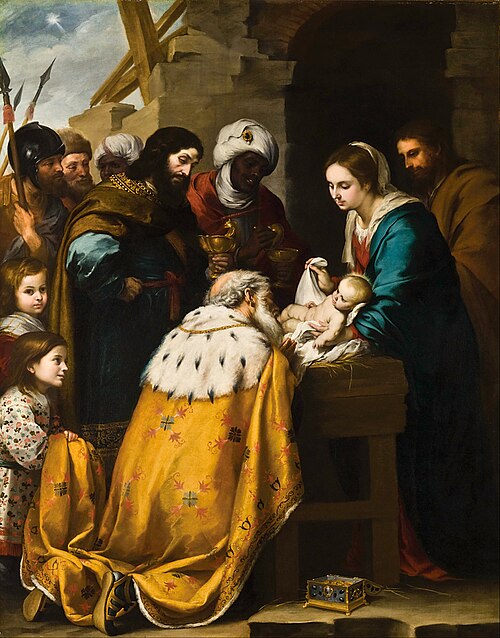
Saints
The Magi
Wise Men from the East
The wise men who came from the East to worship the infant Jesus, bringing gifts of gold, frankincense, and myrrh.
- Feast
- July 24old style August 6
- Era
- unknown
Life
The Magi are the wise men who, according to the Gospel of Matthew, came from the East to worship the Child Jesus after His birth in Bethlehem. The Church honours them as the first of the Gentiles to know Christ and worship Him. Among the people they are also known as the "three kings of the East". Few facts about them are given, and much of what is said comes from tradition.
In the Gospel
The Gospel says they saw His star in the East and came to Jerusalem, asking where the King of the Jews was born. King Herod was troubled and learned from the scribes that, according to the prophet Micah, Christ was to be born in Bethlehem. Herod called the Magi in secret and asked them to tell him when they found the Child, intending to kill Him. The star went before the Magi until it stopped over the place where the Child was.
Entering the house, they saw the Child with Mary His mother, worshipped Him, and offered Him gifts: gold, frankincense and myrrh. Warned in a dream not to return to Herod, they went back to their country by another way. Saint John Chrysostom explained the gifts as fit not for a king alone but for God. The later interpretation, common in the Church, sees in the gold homage to the King, in the frankincense homage to God, and in the myrrh a sign of the death of the One who would die for men.
Who they were
The Gospel does not say how many they were, what they were called or where they came from; it says only "from the East". The Greek word magoi comes from Old Persian and named the priestly caste of the Zoroastrians, known as watchers of the stars. Some Fathers thought them Babylonian, others Persian, others Arabian. Tradition counted them three, from the three gifts, although Syriac Christianity often speaks of twelve.
In the West they received the names Melchior, Caspar and Balthasar. In the Armenian tradition they are Melkon, king of Persia, Gaspar, king of India, and Balthasar, king of Arabia. Among Syrian Christians they are Larvandad, Gushnasaph and Hormisdas, and among the Ethiopians Hor, Karsudan and Basanater. None of these names is found in Scripture. In Byzantine icons of the Nativity they are painted as Persians, in trousers and Phrygian caps.
Veneration
The Orthodox Church commemorates them on the feast of the Nativity of the Lord, 25 December, whether kept on the new or the old calendar. In the West their day is 6 January, the Western Epiphany, where they are also called saints.
According to tradition, their relics were found by Saint Helena, brought to Constantinople, to Hagia Sophia, and then taken to Milan. From there, after Emperor Frederick I conquered the city, Archbishop Rainald von Dassel moved them to Cologne, where the cathedral still keeps them in a great shrine. At the Monastery of Saint Paul on Mount Athos a fifteenth-century case is kept in which the gifts of the Magi are believed to lie. It was donated to the monastery by Mara Branković, daughter of Despot Đurađ Branković of Serbia. It was brought temporarily to Athens after the earthquake of 1999, and at Christmas 2014 it was shown in Ukraine and Belarus.
Commemorated the same day July 24
 Athenagoras of AthensSaint · Christian apologistJul 24
 ChristinaGreat Martyr · of TyreJul 24
 George KonisskySaint · Archbishop of MogilevJul 24
 Segolena of AlbiVenerable · Deaconess of AlbiJul 24
 Bogolep of Chorny YarVenerable · Child schemamonkJul 24
 Polycarp of the Kiev CavesVenerable · Archimandrite of the Kiev CavesJul 24
 Martyrs of PrebilovciHoly New MartyrsJul 24
- Athanasius of KiosNew MartyrJul 24
 New Martyrs of MgarVenerable MartyrJul 24
- George the HungarianMartyrJul 24
- AliprandusVenerableJul 24
- Alphaeus KorbanskyHieromartyrJul 24