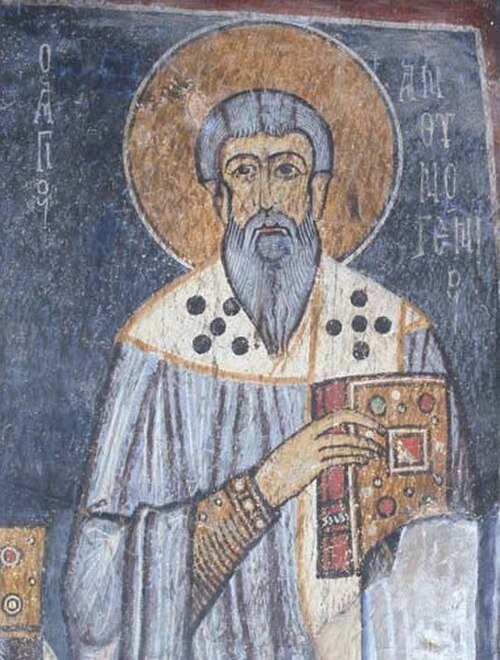
Hieromartyr
Athenogenes of Pedachtoë
Chorepiscopus of Pedachtoë
Priest and chorepiscopus, leader of the Christian community of Pedachtoë, martyred around 303.
Life
Holy Hieromartyr Athenogenes, priest and chorepiscopus at Pedachtoë, died a martyr in the time of the Diocletianic persecution, about the year 303. He is commemorated on 16 July, Old Style (29 July New Style). The sources do not agree in everything: the Serbian source makes him bishop at Sebaste in Armenia and says he suffered in 311, together with ten disciples, all killed by the sword; the English source, based on the old texts, shows him as chorepiscopus, dead by fire, most probably in 303 (some think 304).
Life
According to what is said of him, he was born into a Christian family in the Black Sea region of present-day Turkey, in an obscure village called Epiklesoi, near Sebastopolis (today Sulusaray) or Sebaste (today Sivas). He was married and had a son, Patrophilos. His early Lives show him as a holy man, a wonderworker. His cult formed fairly early, since writers only a few decades after his death, such as Basil the Great, mention him.
Martyrdom
The martyrdom story took shape between the fourth and sixth centuries, and takes place in the first or second year of Diocletian's persecution. The earliest account says that two Christians, Ariston (a reader) and Severianos (a psalmist), from a small village near Pedachtoë, were arrested at Sebaste by Agricolaus, governor of the province of Roman Armenia (apparently the same as the prosecutor in the story of the Forty Martyrs of Sebaste), for arson and for circulating Christian writings against the tetrarchy. Ariston refused to cooperate and was condemned to be burned. Severianos said under torture that Athenogenes was the author of the book circulated and the instigator of their deeds. Then Athenogenes was arrested and brought to Sebaste, where he and Severianos were questioned and in the end condemned to death by fire. Later versions change some details, for example leaving out Severianos; according to some traditions, ten of Athenogenes's disciples were killed with him. Scholars put the start of the trial on 12 July 303, with some confidence, and the death on 17 July, but others think the events took place in 304.
The written Life and the relics
The stories of his miracles recall those of Gregory the Wonderworker from the neighbouring city of Neocaesarea: he had power over animals, real and imaginary (among them a dragon), and over waters. Scholars think, as with many other Lives, that the author wove into them details from older stories of martyrs. The oldest surviving Life is a work of Anysius, "The Passion of Athenogenes of Pedachthoe", kept in a tenth-century manuscript, Codex Sabaiticus 242, today in the Patriarchal Library at Jerusalem; scholars judge it was written about the sixth century. It is said to be unusual among Lives, since it gives a fairly realistic account of the trial of Ariston, Severianos and Athenogenes, probably put together from an old preserved record of proceedings, not merely a literary invention. Some later writers attributed to him the evening hymn "Phos Hilaron", which he is said to have sung on the way to death, but scholars today judge that this is not true, and even in antiquity Basil the Great denied that he wrote it.
At the time the old Life was written there was a church on the place where he was killed, and at Pedachtoë a shrine, built above an octagonal underground crypt which he had made to shelter the remains of some martyrs and where, it seems, his own had been brought from Sebaste. In the fourth century Gregory the Illuminator, leader of the Armenian Christians, brought a relic of him from Pedachtoë to Vagharshapat, where it was placed in the cathedral of Etchmiadzin.
Commemorated the same day July 16
 Julia of CorsicaMartyrJul 16
 Fulrad of Saint-DenisVenerable · Abbot of Saint-DenisJul 16
 Vitalianus of CapuaSaint · Bishop of CapuaJul 16
 TenenanSaint · Breton saint of ArmoricaJul 16
 Matrona of AnemnyasevoFool-for-Christ · Fool for ChristJul 16
 Jacob MaskaevHieromartyr · Archbishop of BarnaulJul 16
- Vitalian of OsimoSaint · Bishop of OsimoJul 16
- Antiochus of SebasteMartyr · Physician of SebasteJul 16
- AnastasiusSaint · Bishop of ThessalonicaJul 16
- Ardalion PonomarevVenerable MartyrJul 16
- Brecan of Cluain CathaSaintJul 16
 Brissos of ÉvoraHieromartyrJul 16