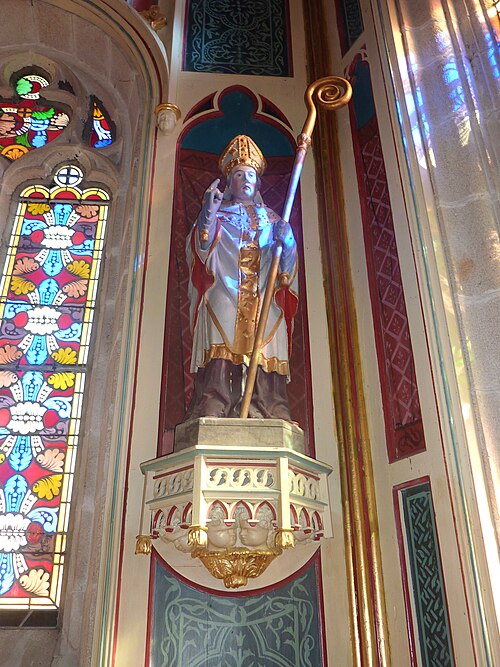
Saint
Tenenan
Breton saint of Armorica
Legendary Breton saint of Armorica, also known as Tudogilus, father of Saints Gouesnou and Majan.
- Feast
- July 16old style July 29
- Reposed
- 6357th century
- Place
- Saint-Pol-de-Léon
Life
Saint Tenenan (Ténénan or Thénénan in Breton and French) is one of the Breton saints of Armorica, who came from the British Isles. Very little is known of his life, and it is wrapped in legend. According to tradition he was bishop of Léon in the first half of the seventh century. Several traditions also identify him with Tudon, father of Saints Gouesnou and Majan. He is honoured in north-west Brittany, above all at Plabennec, La Forest-Landerneau and Guerlesquin, and his commemoration is on 16 July.
Who he was
So little is known of Tenenan that Albert Le Grand, the seventeenth-century Breton scholar, wrote that at least three saints may be confused under his name: one of Irish origin in the fifth century, a contemporary of Saint Patrick, another called Tenenan-Tinidor, and a third from the time of the Norman invasions. Some call him Tudogilus, Tudon or Thudon and make him father of Saint Gouesnou, Saint Majan and a girl called Tudona. The records suggest that Tenenan and Tudon came to Brittany at the same time and frequented the same places, so they may be one and the same person. He is sometimes confused with Saint Arnoc, and some historians regard them as the same saint.
Youth and healing
According to Albert Le Grand, Tenenan or Tinidor was born in the British Isles, in Wales, son of Tinidor, whose name was wrongly attributed to him, and nephew of Saint Jaoua. He was at first a brilliant young man who frequented noble courts. As a teenager he was so handsome that the daughter of the Countess of Arundel wanted him alone for her husband. Wishing to flee the world and resolved to keep his virginity, he prayed to be made so ugly and deformed that no one would want him, promising perpetual chastity in return. The prayer was granted and in a moment his whole body was covered with leprosy, so that he horrified all who looked upon him.
He then entered the monastery directed by Saint Carantec, in Hibernia (present-day Ireland). Carantec cured him of the leprosy by plunging him in a bath, and his skin became clear and white like a child's. Then he sent him to preach in Armorica. An angel appeared to him and told him to set out over the sea to Brittany, to shepherd the flock that Saint Paul Aurelian had shepherded.
Arrival in Léon
His ship passed through the Goulet strait and went up the river Élorn. Landing at Joyeuse-Garde, he made his hermitage in the forest at Lan-Tinidor, not far from Landerneau, in an uninhabited place ringed by a thick wall of trees. Later he went deeper into the forest and settled near Gallo-Roman ruins at Plabennec.
Tradition says that not long before, the Danes, "wild men and idolaters", had landed on the coast of Léon and were plundering. The peasants had fled into a great forest near Landerneau with their flocks and best goods and kept watch in a castle. When the guards saw Tenenan's ship they cried that a servant of God was coming who would defend them from the barbarians. The castellan and the garrison rushed to the battlements and filled the air with shouts of joy. For that reason, tradition says, the castle was called the Castle of the Joyful Guard (Joyeuse-Garde).
Seeing, says the story, neglect of the rules of the faith, Tenenan built two churches. One at the lower end of the forest, near the castle, which today bears his name, at La Forest-Landerneau. The other at the other end of the same forest, called Plou-bennec (Plabennec), dedicated to Christ the Saviour and the holy Apostle Peter. With his priests and clerics he settled at Les-Quélen, where he made a hermitage of branches and straw. Gradually a village arose, protected from wanderers and wolves by a palisade. He advised the people of Plabennec to build a small round tower beside the church, to hide their silver and treasures from barbarians. Indeed the Danes came to plunder Plabennec, seized the church and besieged the tower, trying to burn it, as well as the fort of Les-Quélen, but the saint's prayers were heard and the Danes withdrew. It is also said that he built a church at Carantec in honour of his master.
Bishop and repose
In 615, after the death of Saint Goulven, bishop of Léon, Tenenan was elected in his place. Envoys went to Plabennec to bring him the news. He answered that he felt his shoulders too weak to bear so heavy a burden, but at last, at their entreaties, he accepted. He was consecrated bishop in the cathedral of Dol by Saint Guennou. After some years as bishop of Léon he fell asleep, according to tradition, on 16 July 635 (other sources say around 650), in the episcopal residence at Léon, and was buried in the cathedral there. Dom Lobineau says instead that he was buried at Plabennec, where his relics were kept for a time. In time of wars they were hidden in the pond of Melouet. According to Dom Lobineau, at the start of the eighteenth century only one part of his relics remained, in the church of Trégarantec, under the name of Saint Ternoc.
Veneration in Brittany
A single village bears his name in the old form, Saint-Thonan, but the church there is today dedicated to Saint Nicholas. In the diocese of Léon, Tenenan, unless it is a matter of Saint Arnoc, was the first patron of Landerneau, but was later replaced, at an unknown date, by Saint Houardon. He is patron of Guerlesquin, La Forest-Landerneau and Plabennec, where his relics once lay. At Plabennec there was a kind of processional walk, a tromenie, that began at the chapel of Saint-Ténan at Lez-Kélen, until its ruin. He is also honoured at Lannilis, at Plourin, where a statue of him stands in the calvary of the church, beside statues of Paul Aurelian and Saint Corentin, and at Trégarantec. At Roscoff he is patron of the chapel of Saint-Strignon, earlier called Saint-Ninian.
In the diocese of Cornouaille, a chapel of Saint-Théran or Saint-Ténan at Plougernével has disappeared, and at Languidic a megalith bears the name of Saint Éléran. In the diocese of Tréguier, the church of Saint-Ténénan at Guerlesquin, in Finistère, bears his name. Statues of the saint are seen at Plabennec and La Forest-Landerneau.
Commemorated the same day July 16
 Julia of CorsicaMartyrJul 16
 Fulrad of Saint-DenisVenerable · Abbot of Saint-DenisJul 16
 Vitalianus of CapuaSaint · Bishop of CapuaJul 16
 Athenogenes of PedachtoëHieromartyr · Chorepiscopus of PedachtoëJul 16
 Matrona of AnemnyasevoFool-for-Christ · Fool for ChristJul 16
 Jacob MaskaevHieromartyr · Archbishop of BarnaulJul 16
- Vitalian of OsimoSaint · Bishop of OsimoJul 16
- Antiochus of SebasteMartyr · Physician of SebasteJul 16
- AnastasiusSaint · Bishop of ThessalonicaJul 16
- Ardalion PonomarevVenerable MartyrJul 16
- Brecan of Cluain CathaSaintJul 16
 Brissos of ÉvoraHieromartyrJul 16