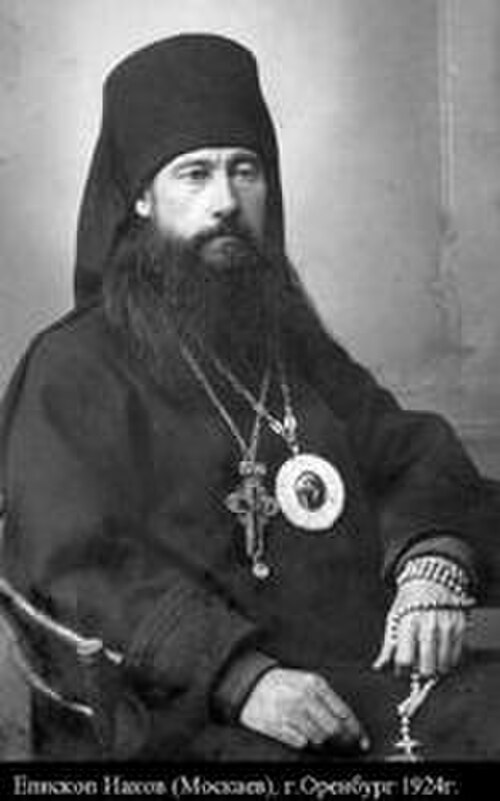
Hieromartyr
Jacob Maskaev
Archbishop of Barnaul
Archbishop of Barnaul, born in Uralsk, who died a martyr in 1937; canonized in 2000.
Life
Saint Jacob Maskaev, Hieromartyr, was Archbishop of Barnaul, a village priest for twenty-two years, then a bishop in the years of persecution, who passed through prisons and exile and received the crown of martyrdom in 1937 at Barnaul. The Russian Church numbered him among the New Martyrs and Confessors in the year 2000.
Family and youth
Born Yakov Ivanovich Maskaev at Uralsk, today in Kazakhstan, into a family of simple people: his father, Ivan Silantyevich, a peasant from the Simbirsk region, was a painter, among other things of churches, and his mother, Kaleria Grigoryevna, was a townswoman of Uralsk. The family had a small guest house, with rooms to let and a laundry, from which the children could be educated. Yakov, the firstborn, was named in memory of the apostle James the son of Alphaeus; after him were born Pavel (1884), Evdokia (1888) and Agrippina (1894). In August 1891 he entered the ecclesiastical school at Uralsk, which he finished with distinction in 1895, then attended the Orenburg seminary, finishing in 1901.
In his last year at the seminary he married Valentina Petrovna Nikolskaya, a priest's daughter, left at eleven without a mother and a year later without a father, raised in the house of her uncle, Fr Alexei Nikolsky, who introduced her to Yakov. In 1902 their son Boris was born. The child fell gravely ill, and young Fr Yakov prayed fervently to all the saints, especially to Saint Seraphim of Sarov, and vowed that if the infant recovered he would go on pilgrimage to the relics of Saint Seraphim, just glorified. The child recovered and he fulfilled his vow. They had nine children, four of whom died young; the others were Boris, Alexandra, Nina, Konstantin (missing at the front in 1942) and Zoya. His wife died in 1918, shortly after the birth of the last child, who died too.
The priest of Zobovo
He was ordained deacon and then priest by Bishop Vladimir (Sokolovsky-Avtonomov) at the Kazan church of the Mother of God in the village of Zobovo, in the Orenburg diocese, where he served twenty-two years. He was a tireless worker in the Lord's vineyard, preached much, and through his labour in 1902 to 1906 a new stone church was built in the village, a hundred and seventy versts from the provincial capital, in place of the old wooden one. Though he had a large family and little means, he was one of the most generous donors of the diocese, a benefactor of the society helping poor seminary students, and he collected money for the needs of the army and fleet during the Russo-Japanese War. In 1909 he built a parish school in the village of Voronino. For his zeal he received the belt, then the kamilavka and the rank of archpriest in 1915 and sat on the Orenburg diocesan administration. In the civil war years he saved the people of Zobovo several times from being shot by White Guards. Between 1920 and 1922 he was elected to the diocesan administration, close to Bishop Aristarkh (Nikolaevsky). He was so respected that, when the vicariate of Orsk was founded, in January 1923 the assembly of clergy and laity elected him candidate for bishop of Orsk.
Bishop and the Renovationist trial
After the Renovationist schism broke out in 1922, Bishop Aristarkh declared full submission to Patriarch Tikhon and, before leaving for Moscow, convened a diocesan congress that elected Yakov Maskaev as his vicar, sent to Moscow for consecration. In Moscow, on 19 March 1923, after tonsure as a monk with the name Jacob, after the apostle James the Lord's brother, he received episcopal consecration, performed by the Renovationist bishop Antonin Granovsky together with the retired Archbishop Vladimir Sokolovsky. According to the historian Damascene, Vladimir told him that he was under the obedience of Patriarch Tikhon and had never broken communion with him. Back at Orenburg, as Bishop of Orsk, vicar of the diocese, he was allowed by Aristarkh to exercise his duties temporarily, but without the right to ordain. On 10 May 1923, leaving for Moscow, Aristarkh gave him the governing of the diocese. In July 1923 the priests of Orsk asked him to go to Moscow for correction of his episcopal rank and a blessing. On 16 September he wrote to Patriarch Tikhon a petition in which he said: "I humbly ask not to be counted a careerist... if I did anything through inexperience, without ill will, I beg you to forgive me, I confess fidelity 'unto death' to the One Holy, Catholic and Apostolic Church... I sympathize with no Renovationist group and will never introduce reforms. I set out to Your Holiness, but was arrested in the carriage at Orenburg; ... I laid upon myself, as a cross, a prohibition from serving."
Orthodox bishop
On 22 September 1923, after the assembly of bishops examined the case, Patriarch Tikhon told him that he received him into prayerful communion, asking for a written declaration that he had nothing in common with the Renovationists, and on 28 September he signed a certificate receiving him into canonical communion and naming him temporary administrator of the Orthodox parishes of the Orenburg diocese. At that time he was often summoned to the secret police, threatened with arrest, offered cooperation and not allowed to leave the town. He had to pretend to be less firm toward the Renovationists. On 13 August 1924 Patriarch Tikhon named him Bishop of Orenburg and Turgai, where he continued to oppose the schism. The secret police noted in 1924 that "among the people the popularity of the pillars of the Tikhonite church predominates", and he categorically refused secret cooperation and passing into schism.
On 19 March 1925 he was arrested at Orenburg and released on his own recognizance on 22 August; his release was received with joy by the faithful, and a hostile witness said that the "fanatical" clergy presented him to the crowd as a martyr. On 13 November 1925 he was sentenced to two years' exile from the Orenburg governorate for "anti-Soviet activity", served at Samara until 1927. On 2 January 1928 he was named Bishop of Kurgan, then of Ostashkov, vicar of Tver, and from 6 February 1929 Bishop of Balashov, vicar of Saratov; the secret police noted that he "is stubborn, insistent and categorically refused to carry out our tasks". On 12 February 1930 he was arrested at Balashov with fourteen clergy, nuns and laymen in the case of a "counter-revolutionary church organization", accused of anti-Soviet activity, and did not admit guilt. A witness said that the bishop said in a sermon that a hard time had come for the faithful, that the authorities pressed on them everywhere, and that by closing churches they left them without a piece of bread.
Martyrdom
After further arrests and exiles, in which he remained faithful to the Church, he became Archbishop of Barnaul and received the crown of martyrdom in 1937 at Barnaul. He was numbered among the New Martyrs and Confessors of Russia at the Council of Bishops in 2000.
Commemorated the same day July 16
 Julia of CorsicaMartyrJul 16
 Fulrad of Saint-DenisVenerable · Abbot of Saint-DenisJul 16
 Vitalianus of CapuaSaint · Bishop of CapuaJul 16
 TenenanSaint · Breton saint of ArmoricaJul 16
 Athenogenes of PedachtoëHieromartyr · Chorepiscopus of PedachtoëJul 16
 Matrona of AnemnyasevoFool-for-Christ · Fool for ChristJul 16
- Vitalian of OsimoSaint · Bishop of OsimoJul 16
- Antiochus of SebasteMartyr · Physician of SebasteJul 16
- AnastasiusSaint · Bishop of ThessalonicaJul 16
- Ardalion PonomarevVenerable MartyrJul 16
- Brecan of Cluain CathaSaintJul 16
 Brissos of ÉvoraHieromartyrJul 16