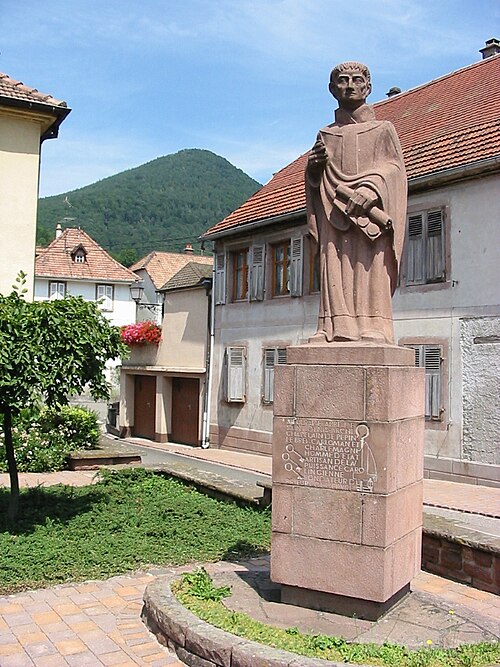
Venerable
Fulrad of Saint-Denis
Abbot of Saint-Denis
Abbot of Saint-Denis and counselor of Pepin the Short and Charlemagne; died in 784.
- Feast
- July 16old style July 29
- Reposed
- 7848th century
- Place
- Royal abbey of Saint-Denis
- Order
- Venerables
Life
Saint Fulrad was abbot of the monastery of Saint-Denis and counsellor of Pepin the Short and Charlemagne. He was born around 710 in Alsace and fell asleep on 16 July 784. Historians regard him as important for his role in the rise of the Frankish kingdom and for the picture he gives of early Carolingian society. He is commemorated on 16 July.
The abbot
He was born in Frankish Alsace, entered the abbey of Saint-Denis and in 750 was elected abbot. With his parents' inheritance he enlarged the abbey, and he won back lands taken by Charles Martel. He founded new monasteries, in Alsace-Lorraine and Alemannia, which at first he ran himself. Each had relics, which made them places of pilgrimage. As he could no longer provide the pastoral care there himself, he asked Pope Stephen II for a "cloister" bishop. His main care remained Saint-Denis. He advised the Frankish bishops and had the role of a "quasi-bishop". He never became bishop, but rose in the ecclesiastical hierarchy, being "capellanus", first of Pepin III, then of Charlemagne, "arch-chaplain" and counsellor.
Counsellor of kings
He was close to the royal family, through service under Pepin and then Charlemagne. He stood on Charlemagne's side especially in the Saxon attacks on Francia. He had a role in shaping the history of Western Europe: he urged the Franks to side with the papacy rather than the Byzantines, a diplomatic decision that would end with Charlemagne's coronation as emperor in 800, eleven years after Fulrad's death. In 750 he was sent by Pepin to Pope Zachary to obtain approval for making Pepin king in place of Childeric. By the decision that followed, he prepared a bond between the Franks and the pontiff. In 756 he obtained the handing over of the exarchate of Ravenna to the pope.
The testament
Fulrad's Testament gives a picture of early Carolingian society: it makes a survey of places, with their religious, political and economic differences. The places he put under the royal abbey served as a defence against the eastern nobles, the eastern lands being valuable economically. The testament also shows the lives of Carolingian persons, for it identifies whose descendants they are, a part regarded as so important that Alain Stoclet devoted a whole chapter to it in Autour de Fulrad de Saint-Denis.
Commemorated the same day July 16
 Julia of CorsicaMartyrJul 16
 Vitalianus of CapuaSaint · Bishop of CapuaJul 16
 TenenanSaint · Breton saint of ArmoricaJul 16
 Athenogenes of PedachtoëHieromartyr · Chorepiscopus of PedachtoëJul 16
 Matrona of AnemnyasevoFool-for-Christ · Fool for ChristJul 16
 Jacob MaskaevHieromartyr · Archbishop of BarnaulJul 16
- Vitalian of OsimoSaint · Bishop of OsimoJul 16
- Antiochus of SebasteMartyr · Physician of SebasteJul 16
- AnastasiusSaint · Bishop of ThessalonicaJul 16
- Ardalion PonomarevVenerable MartyrJul 16
- Brecan of Cluain CathaSaintJul 16
 Brissos of ÉvoraHieromartyrJul 16