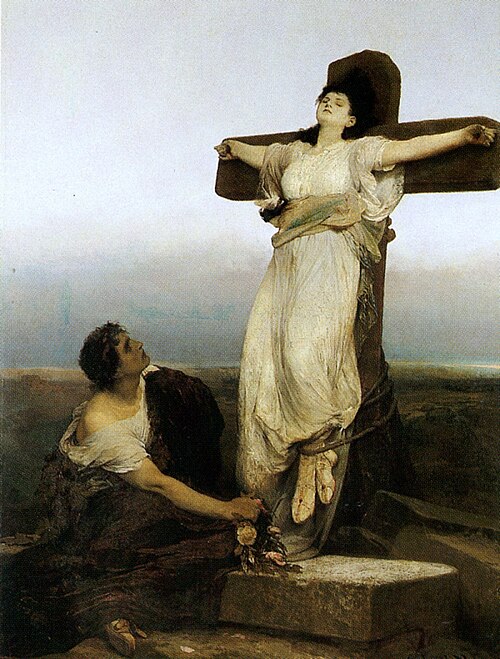
Martyr
Julia of Corsica
Virgin martyr of Carthaginian origin, put to death in Corsica, most probably in 439.
Life
Saint Julia of Corsica, martyr, was a virgin of Carthaginian origin, put to death in Corsica for her faith, most probably in the year 439 or a little after. She is venerated chiefly in the West and is a patroness of Corsica, together with Saint Devota. The Orthodox Church commemorates her on 16 July, and the West on 22 May.
The sources
The oldest testimony about her comes from Victor of Vita, bishop of Africa, who wrote the history of the persecution of the Vandals in the time of the kings Geiseric and Huneric. In 429 Geiseric crossed from Spain to Africa, and in 439 he took Carthage by surprise and tried to draw Christians to Arianism, committing acts that the bishops could neither forget nor forgive. The story of Julia survives only in the edition of the learned Benedictine Thierry Ruinart. Victor says he investigated the matter by asking elders who had heard of her from their parents, so the martyr was already known as such among the people.
The story
Julia was a girl of Carthage, taken captive when the city was seized and brought into the service of a man named Eusebius, probably sold as a slave after the Vandal conquest. She served a master after the flesh, but she followed Christ. Eusebius was a pagan, yet he admired so great a virtue. When her tasks were done she spent her free time reading or insisting on prayer. She had grown pale and thin from fasting, despite her master's threats and blandishments, and her mind, fixed on heaven, fed daily on the words of God.
Eusebius, a Syrian merchant from Palestine, was travelling to Gaul with a precious cargo. He anchored overnight at Cap Corse, where the pagans were preparing a sacrifice: that day they were slaying a bull to their gods. Eusebius went to take part in the feast, but Julia would not worship idols and stayed on the ship. When Felix, the governor of the place, learned of it, he made Eusebius drunk, since he would not bring the girl, and when he fell asleep Felix ordered Julia brought and asked her to sacrifice to the gods.
Because she refused, and above all for her bold answer, the virgin was condemned to death. They struck her on the face until it bled, dragged her by the hair, beat her, and then she was crucified. According to tradition a dove came out of her mouth, a sign of purity and holiness. Monks from the island of Gorgona came for her body and buried it in their monastery. Later her relics were taken to Brescia in northern Italy, where veneration of the saint spread.
The Corsican tradition
According to local tradition, Julia was from Nonza and lived in the time of Diocletian, together with Saint Devota. Because she refused to sacrifice to the gods she was tortured; the executioners cut off her breasts and threw them on the rocks below the village, and there two springs gushed out. Enraged at the miracle, they tied her to a fig tree and left her to die of pain, and a dove came out of her mouth. This version is sometimes regarded as less likely than the first. Iconography shows her crucified, sometimes with her breasts cut off, as in a sixteenth century painting in the church at Nonza.
Veneration
Veneration of the saint at Nonza began soon after her death. A sanctuary was built below the village, destroyed in 734, and to the springs that never run dry, called the Fountain of the Breasts, pilgrims come from all over Corsica, many barefoot; its waters are held to heal and to help mothers who lack milk. Saint Julia was declared patroness of Corsica on 5 August 1809, and her feast is kept each year throughout the island. Her relics, a few bone fragments, are at Brescia, in the former church of Santa Giulia, now part of the city museum.
Commemorated the same day July 16
 Fulrad of Saint-DenisVenerable · Abbot of Saint-DenisJul 16
 Vitalianus of CapuaSaint · Bishop of CapuaJul 16
 TenenanSaint · Breton saint of ArmoricaJul 16
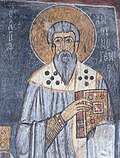 Athenogenes of PedachtoëHieromartyr · Chorepiscopus of PedachtoëJul 16
 Matrona of AnemnyasevoFool-for-Christ · Fool for ChristJul 16
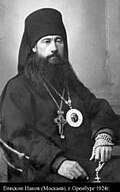 Jacob MaskaevHieromartyr · Archbishop of BarnaulJul 16
- Vitalian of OsimoSaint · Bishop of OsimoJul 16
- Antiochus of SebasteMartyr · Physician of SebasteJul 16
- AnastasiusSaint · Bishop of ThessalonicaJul 16
- Ardalion PonomarevVenerable MartyrJul 16
- Brecan of Cluain CathaSaintJul 16
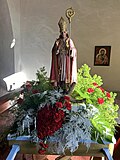 Brissos of ÉvoraHieromartyrJul 16