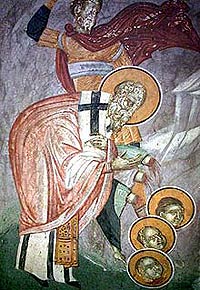
Hieromartyr
Babylas of Antioch
Patriarch of Antioch
Patriarch of Antioch from 237 to 253, who died in prison during the Decian persecution.
- Feast
- September 4old style September 17
- Reposed
- 2513rd century
- Place
- Antioch
- Order
- Martyrs
Life
Saint Babylas of Antioch, hieromartyr, was bishop of Syrian Antioch from 237 to 253 and died for Christ in the persecution raised by the emperor Decius. The Orthodox Church keeps his feast on 4 September, and the West on 24 January. He is also the first saint whose relics are known to have been solemnly translated, a practice that became very common in later centuries.
Ministry
Babylas succeeded Zebinus in the see of Antioch and was the twelfth bishop of the city, in the days of the emperor Gordian III. Saint John Chrysostom tells, and the Acts of the Martyrs repeat, that Babylas once refused a pagan emperor who had come to the city entry into the church on account of his sinful life, and ordered him to take his place among the penitents. John does not name the emperor, while the Acts call him Numerian. Scholars think it more likely to have been Philip the Arab, of whom Eusebius writes that a bishop would not let him enter the Easter vigil. A later legend adds that Babylas demanded penance for the murder of the young Gordian III.
Martyrdom
In the persecution of Decius, in the year 250, Babylas confessed the faith unshaken and was thrown into prison. Eusebius of Caesarea says that he died in prison after his confession, and that Fabian succeeded him. The account in his Life, drawn from another source, says that he was arrested, openly confessed himself a Christian, was put in chains, led through the city and pressed to worship idols and renounce Christ.
With him were three disciples, brothers, Urban, Prilidian and Epolonius, aged twelve, nine and seven. They too were forced to sacrifice to the idols, and when they refused they were wounded, one wound for each year of their age. Then they were hung with the bishop on a tree and tortured with fire. Seeing their steadfastness, the emperor ordered them beheaded. Babylas had asked that the chains he had worn for love of Christ be buried with him, and so he was laid in the tomb together with his disciples.
His relics
In 351 the Caesar Constantius Gallus built a church in the saint's honour at Daphne, near Antioch, and moved his relics there. His aim was to weaken the pagan influence of the temple of Apollo in that place or, as John Chrysostom puts it, to bring a physician to the sick. It is the first recorded translation of a saint's relics.
According to John Chrysostom and the historian Socrates, when the emperor Julian the Apostate consulted the oracle of Apollo at Daphne in 362, he received no answer and was told that the cause was the nearness of the martyr Babylas. Julian ordered the relics taken out and carried back. On 22 October a fire broke out that consumed the roof of the temple and the statue of the god. Chrysostom says the temple was struck by lightning, while the pagan historian Ammianus Marcellinus reports a rumour about candles lit by a worshipper. The relics were placed in a church dedicated to the saint on the far side of the river Orontes, to whose building Bishop Meletius contributed with his own hands. The columns and walls of the ruined temple were still pointed out twenty years later. In the Middle Ages the relics were said to have been taken to Cremona.
Some Byzantine calendars identify Babylas of Antioch with Babylas of Nicomedia, commemorated on the same day, but there are not sufficient grounds for this identification.
Commemorated the same day September 4
 MosesProphet · The LawgiverSep 4
 Joseph the All-ComelyRighteous · Son of JacobSep 4
 Boniface I of RomeSaint · Bishop of RomeSep 4
 Hermione of EphesusMartyr · Martyr of EphesusSep 4
 Candida the ElderMartyr · Patron of NaplesSep 4
 Peter ZimonjićHieromartyr · Metropolitan of Dabar and BosniaSep 4
 Theodore, Mian, Julian and KionHoly Martyrs · Martyrs of NicomediaSep 4
- Ultan of ArdbraccanSaint · Abbot-bishop of ArdbraccanSep 4
- Babylas of NicomediaMartyrSep 4
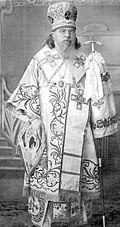 Sergius DruzhininHieromartyr · Bishop of NarvaSep 4
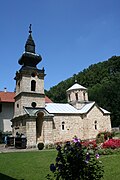 Stephen of TronošaVenerable · ArchimandriteSep 4
- TheodoreMartyrSep 4