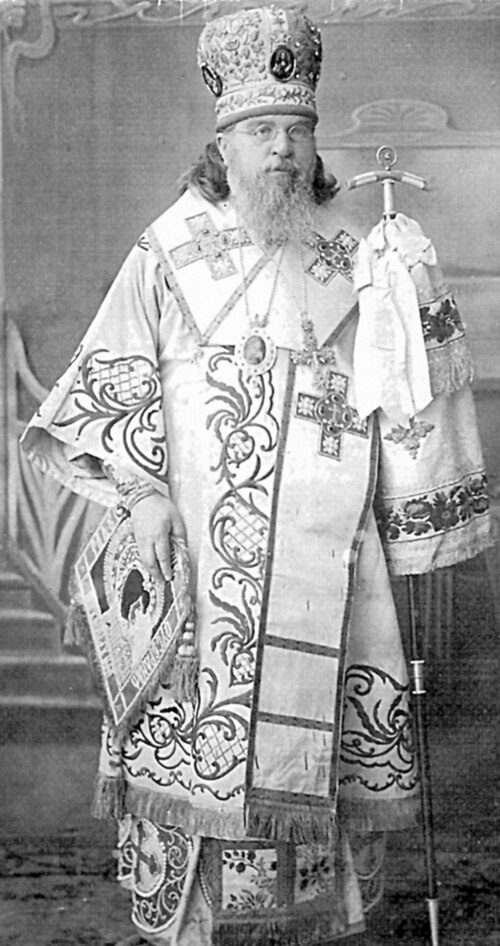
Hieromartyr
Sergius Druzhinin
Bishop of Narva
Bishop of Narva, vicar of the Leningrad diocese and leader of the Josephite movement, canonized in 2020 and died in 1937.
- Feast
- September 4old style September 17
- Reposed
- 193720th century
- Place
- Yoshkar-Ola
- Order
- Martyrs
Life
Saint Sergius (in the world Ivan Prokhorovich Druzhinin, 1863-1937), hieromartyr, was Bishop of Narva, vicar of the Leningrad diocese, and one of the leaders of the Josephite movement, which separated from Metropolitan Sergius after the declaration of 1927. He was arrested, then exiled to Yoshkar-Ola and shot there on 17 September 1937. The Russian Orthodox Church canonized him on 11 March 2020. He is commemorated on 4 (17) September.
Youth and monastic life
He was born on 20 June 1863 in the village of Novoe Selo, in the Bezhetsk district of Tver province, into a well-off peasant family. He was educated at home and loved the church services. From the age of twelve he visited the men's monasteries where relatives of his mother lived. In 1881, aged eighteen, on the advice of his cousins, nuns of Novodevichy, he entered Valaam as a novice, where he stayed some years. He later said that the obediences there were heavy and that his weak health could not bear them. On the abbot's advice he moved to Saint Sergius Hermitage near Strelna.
He was received on 9 September 1887 and, according to the rule, lived two years as a layman. On 24 September 1893 he was tonsured a monk with the name Sergius, in honour of Saint Sergius of Radonezh, in 1894 he was ordained hierodeacon, in 1898 hieromonk, and from 1902 he was sacristan of the hermitage. From 1900 he was the confessor of Grand Dukes Konstantin Konstantinovich and Dmitry Konstantinovich and of the children of the former. He was a convinced monarchist. In 1904-1905 he was a military priest in Manchuria. From 1915 he was abbot of Saint Sergius Hermitage, with the rank of archimandrite. The revolution of 1917, as he said later, he considered the heaviest calamity for the country. At the beginning of 1919 he was driven out of the monastery by some of the monks, who disliked his strictness, and moved to the Alexander Nevsky Lavra. From 1920 he was rector of the nearby church of Saint Andrew of Crete, beloved of parishioners. In 1924 thousands of signatures were gathered for his consecration as bishop, though the diocesan council of bishops opposed it, probably for his lack of theological education.
Bishop and the Josephite movement
On 23 November 1924 he was consecrated Bishop of Narva, vicar of the Leningrad diocese, by Patriarch Tikhon himself. He served in his church, in the Resurrection Cathedral and in other churches. He was a supporter of Metropolitan Joseph (Petrovykh). He opposed the declaration of Metropolitan Sergius (Stragorodsky), and on 26 December 1927 he signed with Bishop Demetrius (Lyubimov) the act of separation from him. On 30 December Metropolitan Sergius suspended him from service. For a short time he gave up his opposition, but in January 1928 he returned to his earlier position. He became one of the leaders of the Josephite movement and on 12 October 1928 secretly consecrated, with Bishop Demetrius, Bishop Maxim (Zhizhilenko). After Demetrius's arrest in November 1929 he led the Josephite Leningrad diocese.
Arrest, exile and martyrdom
He was arrested on 7 December 1930 and sentenced to five years' imprisonment. He did not hide his monarchist convictions and behaved courageously at the investigation, saying that the Bolsheviks would answer for the shooting of clergy, for the destruction of churches and for the thousands of sons of the fatherland lost. He served his term in Yaroslavl prison, and on 7 October 1935 was sentenced to three years of exile in the Mari autonomous region, at Yoshkar-Ola. He served in secret, and the local people honoured him as a holy elder. In a letter of 1936 he said that a poor nun had given him a corner and was caring for him, since he could do nothing himself, and that on the road he had been robbed and nearly frozen.
On 7 September 1937 he was arrested, accused of uniting under his leadership all the counter-revolutionary groups of the True Orthodox Church in the region. He admitted no guilt and named no one. On 11 September an NKVD troika sentenced him to death, and on 17 September 1937 he was shot in the cellar of the Yoshkar-Ola prison.
Canonization
In the preparation of the canonization of the New Martyrs made by the Russian Orthodox Church Outside Russia in 1981, his name was entered in a provisional list of names, published only in the late 1990s. On 11 March 2020 the Holy Synod of the Russian Orthodox Church included him in the Synaxis of the New Martyrs and Confessors, together with Bishop Maxim (Zhizhilenko) and other ascetics venerated in the Church Abroad, setting his commemoration on 4 (17) September.
Commemorated the same day September 4
 MosesProphet · The LawgiverSep 4
 Joseph the All-ComelyRighteous · Son of JacobSep 4
 Boniface I of RomeSaint · Bishop of RomeSep 4
 Babylas of AntiochHieromartyr · Patriarch of AntiochSep 4
 Hermione of EphesusMartyr · Martyr of EphesusSep 4
 Candida the ElderMartyr · Patron of NaplesSep 4
 Peter ZimonjićHieromartyr · Metropolitan of Dabar and BosniaSep 4
 Theodore, Mian, Julian and KionHoly Martyrs · Martyrs of NicomediaSep 4
- Ultan of ArdbraccanSaint · Abbot-bishop of ArdbraccanSep 4
- Babylas of NicomediaMartyrSep 4
 Stephen of TronošaVenerable · ArchimandriteSep 4
- TheodoreMartyrSep 4